November 5, 2026

Capitalizations Index – B ∞/21M

Bitcoin Bull Trap? Not So, Says Lesser-Known Price Indicator

Bitcoin bull trap? Not so, says lesser-known price indicator

Bitcoin Bull Trap? Not So, Says Lesser-Known Price Indicator

Is the reversal of a lesser-known bitcoin price indicator signaling a bull trap?

That’s the question being asked by Twitter’s more expert crypto analysts after bitcoin’s rise to $8,500 this week, a figure that’s up more than 25 percent since its early April lows. As such, many investors and traders are wondering if the market’s rally, propelled largely by a single day of strong gains, is over (if only for now).

Stepping back, the indicator in question, ETH/BTC, which tracks the value of ether against bitcoin, has been behaving oddly of late. In the past, ether’s rise against bitcoin has been greeted as a negative sign for bitcoin, one that signals more traders are willing to exchange bitcoin for ether, the world’s second-largest cryptocurrency.

Still, this time bitcoin is leading the way.

After bottoming out around $6,400 on April 1, the subsequent recovery seems to have helped oversold ether regain poise (ETH fell 53.8 percent in March, while BTC dropped 32 percent). So, the argument that bitcoin’s rally could be a bull trap does not hold ground this time.

As per the historical data, the ETH/USD pair and bitcoin are inversely related and the former tends to work as a lead indicator for the latter.

Looking back

The inverse relationship makes sense as the fiat money tends to flow into crypto markets via major assets like BTC. Then, once the bitcoin valuations look overstretched, the money is rotated into the relatively cheap alternative cryptocurrencies (popularly known as altcoins).

So, ETH/BTC tends to lead bitcoin.

Bitcoin bull trap? Not so, says lesser-known price indicator

In the chart above, we can get a glimpse of how this has worked in the past.

  • ETH/BTC topped out 0.15 on June 13, 2017, and BTC/USD bottomed out $1,826.20 in July 15.
  • ETH/BTC bottomed out at 0.02 on Dec 8, while BTC/USD turned lower from $19,891 on Dec. 17.
  • ETH/BTC turned bearish from its Feb. 1 high of $0.12 and BTC/USD bottomed out at $6,000 on Feb. 6

This time around, however, ETH/BTC has been rising with bitcoin, meaning bitcoin is rallying hand-in-hand with the ETH/BTC exchange rate.

Everyone’s a winner?

Still, that’s not to say things are totally different this time around.

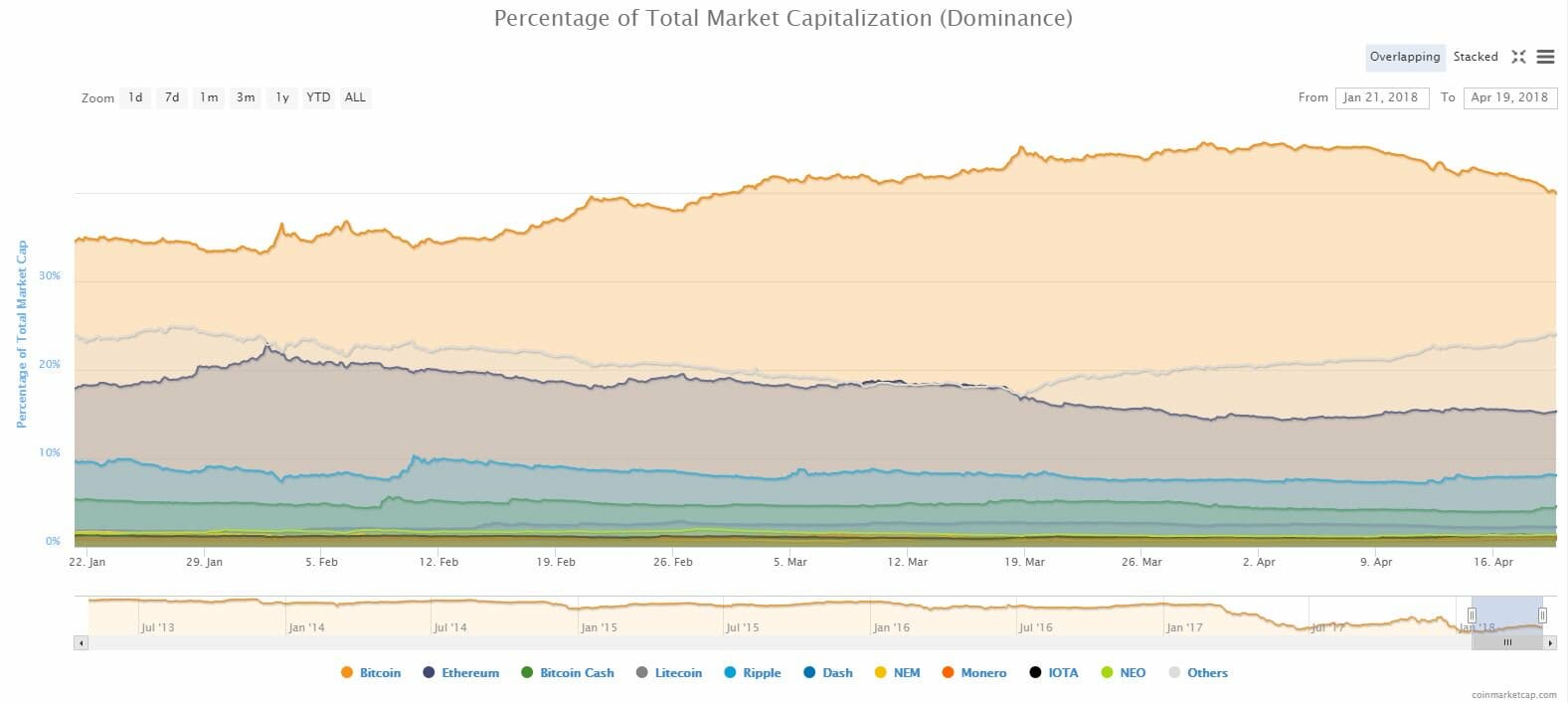
Money is still being rotated out of bitcoin and into lesser-known cryptocurrencies, according to CoinMarketCap’s bitcoin Dominance Rate, an indicator that tracks the percent of the total cryptocurrency market capitalization contributed by bitcoin.
Bitcoin bull trap? Not so, says lesser-known price indicator

Indeed, the above chart shows the BTC dominance rate topped out at 45.62 percent on April 2 and fell to 40 percent yesterday – the lowest since March 1, which shows growing investor interest in other cryptocurrencies.

However, the dominance rate of others (lesser-known cryptocurrencies) has risen sharply from 17 percent to 24 percent in the last four weeks.

If bitcoin witnesses a long-term bearish-to-bullish trend change, then the money may flow back into bitcoin from the lesser-known altcoins, thus boosting the BTC dominance rate.

In this case, the ETH/BTC rally may come to a halt.

Bear trap via Shutterstock

The leader in blockchain news, CoinDesk is a media outlet that strives for the highest journalistic standards and abides by a strict set of editorial policies. CoinDesk is an independent operating subsidiary of Digital Currency Group, which invests in cryptocurrencies and blockchain startups.

Published at Fri, 20 Apr 2018 13:00:55 +0000

Markets[wpr5_ebay kw=”bitcoin” num=”1″ ebcat=”” cid=”5338043562″ lang=”en-US” country=”0″ sort=”bestmatch”]

Previous Article

US Sorghum Boats Looking For New Markets After China Implements Anti-Dumping Measures

Next Article

invest in hempcryptos

You might be interested in …

Oysters | how it's made

OYSTERS | How It’s Made

OYSTERS | How It’s Made Ever wondered how oysters are made? Get the full history and ‘making of’ right here! Subscribe to Discovery UK for more great clips: http://www.youtube.com/subscription_center?add_user=DiscoveryTV Follow Discovery UK on Twitter: http://www.twitter.com/DiscoveryUK

Deutsche Bank Economist Believes a Bitcoin Crash Endangers Global Markets

The continuing frenzy surrounding bitcoin has a number of analysts and economists worried even as global financial institutions are starting to actively participate in the crypto world.


2017 has been a banner year for bitcoin and other cryptocurrencies. Last week saw bitcoin race from $14,000 to over $18,000 in a few hours before coming back down to earth at just over $15,000. While many financial experts are predicting that bitcoin will soar even higher in 2018, there are a number who are a little more gloomy. The latest member of the Gloom Club is Torsten Slok, an economist with Deutsche Bank, who believes that a Bitcoin crash could endanger global markets.

bitcoin Making the List … of Market Risks

bitcoin has been riding high this year, and the launch of futures trading is driving interest to a fever pitch. The CBOE website actually crashed yesterday as it couldn’t handle the massive influx of traffic. One wonders if CME will beef up their site when they launch their own bitcoin futures exchange next week.

Of course, not everyone is tickled pink by the increasing influence of bitcoin and cryptocurrency. Torsten Slok of Deutsche Bank has issued a warning about the ramifications of a bitcoin crash in 2018. Slok released a list of 30 market risks that could impact global markets, and a bitcoin crash came in at lucky number 13. This places bitcoin behind German wages and inflation but ahead of Brexit developments and the Russian presidential election.

How Bad Would a bitcoin Crash Be?

A total bitcoin crash would be devastating to a lot of people, but it may not have the global impact that Torsten Slok envisions. One such reason not to fret is that of scale. The total market cap for all cryptocurrencies is $436 billion at the time of this article’s writing. While a tremendous amount of money, it does pale in comparison to other economic factors. The housing market in the United States alone was estimated to be almost $30 trillion back in 2016. Another example of scale is that the value of all Japanese stocks hit a high of $5.49 trillion back in September.

Another reason why not to panic is that bitcoin is spread across the world and not concentrated in a single economic block, such as Europe. A lot of people would lose a great deal of money in the event of a bitcoin crash, but it should not throw a wrecking ball at a single country’s economy. However, if a bitcoin crash was part and parcel of a greater financial breakdown across multiple markets, then the overall global market would be impacted.

That being said, a bitcoin crash would hurt a lot of individuals, but I wonder if a lot of national governments would welcome such an occurrence. There’s no denying that many governments are not too keen on cryptocurrency as it is currency that lies outside their control, and governments are not thrilled with a lack of control.

As for Deutsche Bank, they’re calling for greater regulation and security on cryptocurrency in order to make it a viable asset class. The bank believes that the imbalance between supply and demand, as well as the volatility of crypto prices, make investing in digital currencies risky. Deutsche Bank says:

If cryptocurrencies are to replace money, then they have to fulfill money’s three core functions: as medium of exchange, a measure of value and a store of value. To do this, cryptocurrencies must be more trusted. Problems here include high volatility and possible price manipulation as well as data loss or data theft.

In the image below are the 30 global market risks as selected by Torsten Slok of Deutsche Bank.


What is your opinion of Slok listing a bitcoin crash on his list? Do you think the cryptocurrency will crash in 2018? Let us know in the comments below.


Images courtesy of Bloomberg, Flickr, Pixabay, and LinkedIn.

The post Deutsche Bank Economist Believes a Bitcoin Crash Endangers Global Markets appeared first on Bitcoinist.com.