October 9, 2026

Capitalizations Index – B ∞/21M

Bitcoin (BTC) To See Rapid 50%+ Correction If History Truly Rhymes –

Bitcoin (btc) to see rapid 50%+ correction if history truly rhymes –

Bitcoin (BTC) To See Rapid 50%+ Correction If History Truly Rhymes –

Bitcoin (btc) to see rapid 50%+ correction if history truly rhymes –

BTC Analysts Fear The Worst

Call us scared, but a key indicator is showing that Bitcoin (BTC) could soon see a massive correction in the coming future. And by coming future, that means the next few days and weeks.

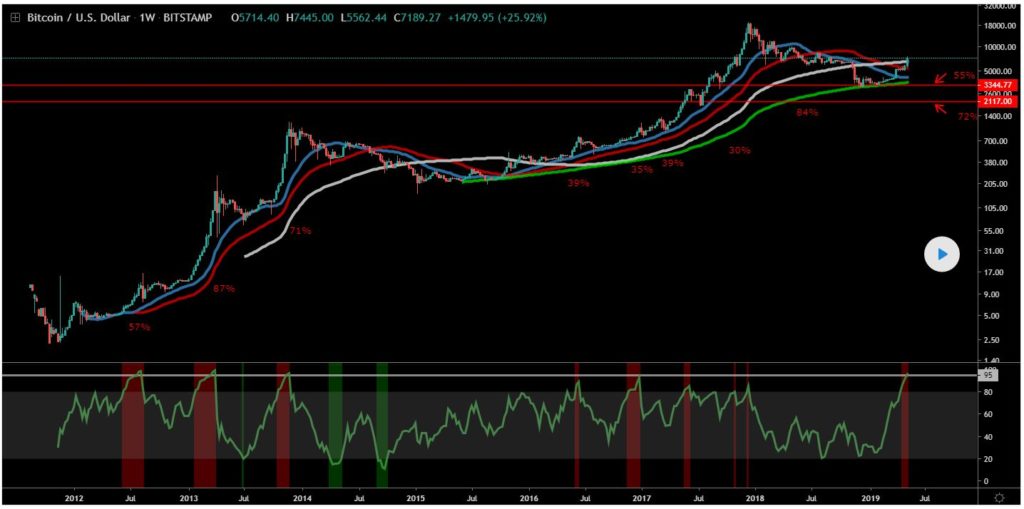
In a recent TradingView post, an analyst going by “Crypt0Bro” revealed that the Money Flow Index (MFI), a well-known way to determine trends, is clearly showing that Bitcoin is overbought. So much so that the reading on BTC’s one-week chart has reached 95, which is nearing the maximum of 100. The only other times that the cryptocurrency has seen such a reading was in mid-2012, early-2013, and late-2013 — which was when BTC was trading decidedly in the double and triple digit range.

While this doesn’t mean anything in and of itself, what happened after does. After MFI reached 95 in the aforementioned historical scenarios, “the immediate price drop was dramatic”. In the first case, the drop was 57%; second, 87%; and third, 71%. And whenever weekly MFI moved above 80 to enter the “overbought” range, at least a drop of 30% was seen in the coming weeks.

As the analyst postulates, if history rhymes, Bitcoin could see a move to $3,345, effectively the yearly lows, or even $2,117. Ouch, right?

He isn’t the only one expecting a drawdown. In fact, countless others have explained that a move lower is likely, albeit not as low as $4,000 or anything lower.

Trader Cantering Clark explains that while the ongoing move seems “incredibly bullish”, BTC is still sitting under resistance, and is too far above its 20-week moving average. The 20-week moving average, according to Clark, has and is likely to continue to act as Bitcoin’s center Bollinger Band, meaning that it should return to that level’s vicinity in the near future.

He explains that as it stands, BTC is a “good three standard deviations from the norm,” with this move being fueled by retail shorts. This hints that Bitcoin may soon see a retracement, returning to more organic and sustainable levels as buying pressure slows in the coming weeks.

And as we suggested in a previous report, history rhyming would see BTC fall by 20% to 25% here, before entering the second phase of accumulation.

Why bitcoin Is Still Bullish

Yet, there may be some signs that Bitcoin is still looking A-OK, and may actually not be poised to head lower.

 As BTC tapped year-to-date highs on Saturday, the daily volume at BitMEX, the foremost crypto futures platform, hit a jaw-dropping nominal $10 billion. Potentially equally as importantly, Grayscale’s Bitcoin Trust surmounted $50 million on Friday, signaling interest in cryptocurrency from accredited investors, most of which are purported to be institutions.

The most important part, this volume surge has been catalyzed by those already in the space. As analyst Joseph Young postulated on Twitter, “existing money in the crypto market [is] coming back due to overall growth in confidence/comfort.”

And as researcher Alex Krüger adds, amid the recent price action, the “Bitcoin” search term has seen not too much of an increase in volume. This directly implies that once consumers wake up to the latest cryptocurrency rally, the run will be even larger and more violent than it is now. But that begs the pressing question — will consumers down the red pill once again?

Title Image Courtesy of Chris Liverani Via Unsplash 

Published at Sun, 12 May 2019 19:05:27 +0000

Previous Article

Binance’s CZ informs customers about resumption of deposit, withdrawal services

Next Article

If History Rhymes, Bitcoin (BTC) May Retrace To High-$5,000s

You might be interested in …

SegWit or Not, Bitfury is Getting Ready for Lightning With Successful Bitcoin Main Net Test

BitfuryLN.jpg

While Segregated Witness (SegWit) activation is looking more likely by the hour, Bitfury is getting ready to deploy a version of the Lightning network with or without the protocol upgrade.

The blockchain technology company, perhaps best known for its bitcoin mining pool of the same name, successfully sent real bitcoins over a test version of the Lightning Network this week. Interestingly, Bitfury’s implementation of the technology is compatible with the current bitcoin protocol and is therefore functional even without SegWit.

“This is a major accomplishment by our technical team and an important step forward for the Lightning Network and the growth of bitcoin,” Valery Vavilov, CEO of The Bitfury Group, said in a statement.

Lightning Network

The Lightning Network is a highly anticipated second-layer scaling solution that allows for cheap and instant (micro)payments. Cleverly leveraging bitcoin’s basic scripting capabilities, Lightning users should be able to make a virtually unlimited number of transactions, where only a minimal proportion of them are recorded on bitcoin’s blockchain, thereby boosting bitcoin’s scalability. Meanwhile, all users remain in control of their own bitcoins at all times, maintaining the trustless properties of bitcoin itself.

“The Lightning Network has the potential to solve bitcoin’s scalability issue and provide instant payment functionality. By demonstrating that the Lightning Network can function now, Bitfury has cleared the way to increased transaction processing and further adoption of bitcoin,” Vavilov said.

Bitfury’s Lightning implementation is based on LND, which is being developed by Lightning Labs.

For its demo, the Bitfury software team created two Lightning transactions. One of these is a straight transaction from one Lightning node to the next, effectively simulating a payment channel between two users. Since it was only a test, Bitfury only made one transaction — but it could have made thousands back and forth at no extra cost.

The other test was a single-hop transaction, which better simulates the main purpose of the Lightning Network. Users pay each other through a mutual third party, without requiring any trust in this third party. While the Bitfury software team only made one transaction on this channel as well, it could, once again, have made thousands back and forth between all three parties, at no extra cost.

Since Bitfury’s test took place on the main net, the funding and settlement transactions are recorded on bitcoin’s blockchain and can be seen by any typical block explorer.

Tests and SegWit

Bitfury’s is not the first successful test of the Lightning Network. Several companies, including Lightning Labs, Blockstream, ACINQ as well as Bitfury itself have experimented with their implementations of the technology. But since most of these companies are working on versions of Lightning that rely on Segregated Witness, these tests were limited to bitcoin’s testnet and Litecoin. Likewise, major wallet service Blockchain has sent “Thunder” transactions over bitcoin’s main net. But while Thunder resembles the Lightning protocol, it isn’t quite as trustless or decentralized.

As such, Bitfury is the first company to get a version of the Lightning Network up and running on the current bitcoin protocol.

“We released this first experimental version of the Lightning Network for bitcoin because we think the Lightning Network is an essential technology for bitcoin and would love to see it made available as soon as possible,” Vavilov said. “We are proud that our developers found a way to adopt the Lightning Network for bitcoin without SegWit. It’s a huge step forward for bitcoin scalability.”

Regardless, the CEO noted that he is hopeful that SegWit will activate on the bitcoin network. With BIP91 currently getting close to its activation threshold, it seems increasingly likely that SegWit could be live within a month. This would allow for a version of the Lightning Network that offers an improved user experience.

Vavilov:

“The Lightning Network will be the most effective when used with SegWit, which is why we are fully committed to SegWit’s implementation, and we will continue working on a version of the Lightning Network that is compatible with SegWit.”  

Bitfury, which started out as a bitcoin miner, has grown to become one of the largest private infrastructure providers in the Blockchain ecosystem. Part of this effort, the company has been supporting the development and implementation of the Lightning Network for well over a year. Bitfury previously also co-designed and successfully tested Flare, a payment-routing solution for the Lightning Network.

Watch the video of Bitfury’s tests here:

[youtube https://www.youtube.com/watch?v=fqT-3xN8npA?feature=oembed&w=480&h=270]

The post SegWit or Not, Bitfury is Getting Ready for Lightning With Successful Bitcoin Main Net Test appeared first on Bitcoin Magazine.