Bitcoin Approaches $7K as Top Cryptos See Double Digit Growth
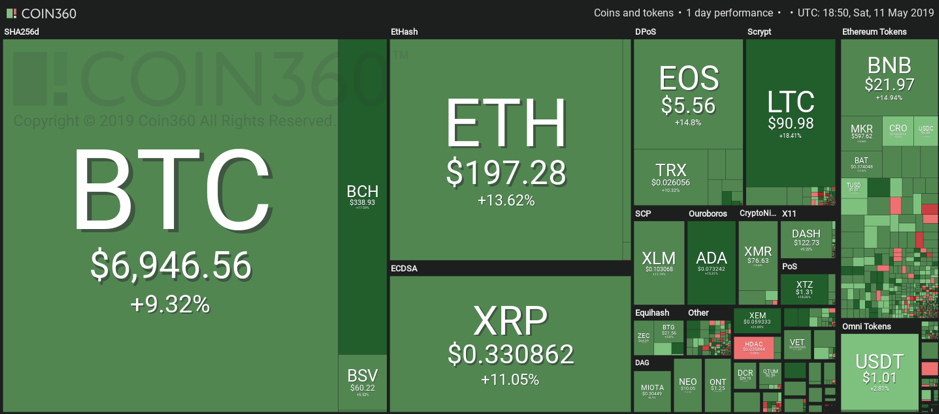
Saturday, May 11 — most of the top 20 are reporting major gains on the day by press time, as () breaks the $6,900 mark.
Market visualization courtesy of
is up over eight percent on the day, at at press time, according to . Looking at its weekly chart, the coin is up nearly 22%, surging in price since the end of the week.
7-day price chart. Source:
Ether () is holding onto its position as the largest by market cap, which currently stands at $20.8 billion. The second-largest , , has a market cap of $13.8 billion at press time.
CoinMarketCap data shows that ETH is up nearly 13% over the last 24 hours. At press time, ETH is around $197. On the week, the coin has also seen its value increase by nearly 21%.
Ether 7-day price chart. Source:
At the Ethereal Summit on May 10, developers that founders and and their respective organizations and the Foundation — each donated 1,000 ether to the Moloch decentralized autonomous organization ().
Third largest crypto XRP is up about 9% over the last 24 hours and is currently at around . On the week, the coin is over 8% up.
XRP 7-day price chart. Source:
Among the top 20 , the coins reporting the most notable gains are (), which is up over 20%, () and Tezos (), which are both up about 17%. (), Coin (), and cash () are also all up 11-15%
At press time, the of all is $212.7 billion, over 17% higher than the value it reported a week ago.
Total market capitalization 24-hour chart. Source:
As Cointelegraph yesterday, financial advisory firm has predicted that could hit $20,000 by 2021.
In other industry , State Assemblyman Clyde Vanel at the Ethereal Summit on May 10 that crypto and firms need to be better at lobbying for themselves and educating regulators.
CCN bitcoin on Track to Replace Gold as Dominant Store of Value: Crypto VC Venture capitalist Lou Kerner says bitcoin is well on its way to replacing gold as the dominant store of value, noting that […]
(Bcash) forked from the bitcoin blockchain to create a new cryptocurrency (BCH), and ahead of the that may do the same thing, a third bitcoin fork is in the making: Gold (Bgold; BTG). But where Bcash and SegWit2X are scaling-related forks — both mainly increase bitcoin’s block size limit — Bgold wants to re-decentralize mining by implementing a new proof-of-work algorithm.
“What was born as decentralized is now centralized,” bitcoin Gold contributor J. Alejandro Regojo told bitcoin Magazine, referring to the current state of bitcoin mining. “With this fork, we want to show how bitcoin can be as ‘Satoshi’ as possible, as social as possible, and as decentralized as possible.”
Mining Centralization
bitcoin Gold was initiated by Jack Liao, CEO of Hong Kong–based mining hardware producer, and was first announced in late August. The open project has been gaining traction and support in the wider cryptocurrency space since, with a as a main hub for discussion and organization. Bgold is currently being developed by the pseudonymous developer “h4x3rotab” along with a small group of volunteers contributing to the project in other ways.
The attention Bgold has attracted is probably in part because anyone who owns bitcoin (BTC) on October 25th will receive the equivalent amount of BTG. While this model has been criticized, particularly because it presents a burden on service providers and users, it has also proven successful. With the launch of bitcoin Cash in particular, users eagerly accepted their batch of “free money,” while exchanges, wallets and other service providers proved relatively willing to integrate the new coin.
Further, the Bgold team believes that this distribution method should also benefit bitcoin over altcoins as it provides an extra incentive to hold BTC on particular dates.
“But the key goal that we are trying to achieve with this fork is to build a perpetually ASIC-resistant version of bitcoin,” said Robert Kuhne, another bitcoin Gold contributor, in explaining the purpose of the project to bitcoin Magazine.
Bgold contributors like Regojo and Kuhne think that bitcoin’s proof-of-work hashing algorithm was essentially broken by the introduction of specialized ASIC (application-specific integrated circuit) mining hardware. In the early years of bitcoin’s existence, individual users were often also miners; this has since become concentrated into relatively centralized operated by professionals.
“And we’re now in a situation where 65 percent of hash power comes from a country that doesn’t like bitcoin,” Regojo noted, referring to China’s recent on cryptocurrencies.
An Uneven Playing Field
And while mining is centralized, ASIC production is even more centralized, the Bgold contributors pointed out. Only a handful of companies currently produce such specialized chips.
This means that anyone who wants to be a miner in any meaningful way is beholden to these companies, Kuhne argued.
“The way the monopoly manufacturer currently operates is abusive to its customers — individual miners — and the industry at large,” he said, referring to major Chinese ASIC producer Bitmain. “Manufacturers can produce ASICs at a tiny cost, but miners have to buy at a high price. This violates the one-CPU-one-vote ethos as described in the bitcoin white paper, because while everyone can buy CPU at the same price, the same is not true for ASIC hardware.”
Regojo and Kuhne see this as a fundamental problem — not something that free market dynamics can realistically resolve. They suggest that the barrier of entry to the ASIC market to compete with existing manufacturers is fundamentally too high to allow for open competition.
“You can’t build a factory without approval from the government and banking system. So there are really only a handful of entities in the world that have total authority over who can and can’t manufacture ASIC machines. And all this could potentially get much worse if and when those institution really start feeling the disruption from bitcoin, which hasn’t begun in earnest yet,” Kuhne said.
As opposed to the bitcoin Cash and (especially) the upcoming SegWit2X forks, bitcoin Gold very specifically does not make a claim to be the “real” bitcoin. Instead, the Bgold project hopes it can prove a valuable exercise for bitcoin; a sort of test case for a hard fork that bitcoin itself may one day require.
Concretely, bitcoin Gold is now implementing the proof-of-work algorithm. This is already used by and is relatively ASIC-resistant.
Full ASIC-resistance, however, is thought to be impossible: Any mining algorithm could be subject to specialized chips. Like, the Bgold community therefore plans to re-deploy a new proof-of-work algorithm hard fork if it is found out that ASIC-chips for Equihash are being produced. (This plan alone, of course, could be a deterrent for any potential ASIC-producer.)
For security, the project plans to implement strong replay protection to avoid loss of funds for unsuspecting or non-technical users. It will also adopt a new difficulty re-target algorithm to prevent the blockchain from stalling: Difficulty is re-adjusted at every block instead of once every two weeks.
While the coin is set to launch two weeks from now, the Bgold codebase is not yet fully developed and ready to be deployed. Implementation of the new proof-of-work algorithm and replay protection, as well as the new difficulty re-adjustment scheme, are yet to be finished.
Nor are all the details for the project even ironed out.
indicated that bitcoin Gold would have a closed launch and a presale of coins. A new batch of BTG was to be mined in the first week after the fork and subsequently distributed to designated investors, not unlike an ICO. Proceeds of this “ICO” were then to be used for development and other Bgold-related purposes.
However, as interest in the project grew, this idea became more controversial. Not everyone involved with bitcoin Gold likes the idea of an additional founders reward — something Bcash, for example, did not have.
Kuhne addressed the issue by stating: “We have heard a lot of feedback from the community, so this proposal will be replaced with an updated and improved plan. But we will not completely rule out the possibility of a modest pre-mine to provide a basic level of funding for the project.”
Disclaimer: The author of this article holds BTC and will therefore also own BTG at launch.
$10 Billion Wealth Advisor: Global FOMO Primes bitcoin for 40% Surge bitcoin is primed for a bull run to $7,000 later this year, says a major global asset management and financial advisory company in comments […]