September 11, 2026

Capitalizations Index – B ∞/21M

Binance’s Biggest Rival: Crypto Giant Coinbase is Trading in 53 Countries

Binance’s biggest rival: crypto giant coinbase is trading in 53 countries

Binance’s Biggest Rival: Crypto Giant Coinbase is Trading in 53 Countries

Get Exclusive Analysis and Investing Ideas of Future Assets on Hacked.com. Join the community today and get up to $400 in discount by using the code: “CCN+Hacked”. Sign up here.

Get Exclusive Analysis and Investing Ideas of Future Assets on Hacked.com. Join the community today and get up to $400 in discount by using the code: “CCN+Hacked”. Sign up here.

By CCN.com: Coinbase, one of the biggest crypto exchanges in the global market reportedly valued at $8 billion, has launched crypto-to-crypto trading in 53 countries including India, South Korea, Hong Kong, and Australia, stepping into the territory of Binance.

The announcement comes after Coinbase’s continuous listing of new digital assets throughout the past several months amidst a 16-month bear market that resulted in an 80 percent drop in the valuation of the cryptocurrency market.

Direct Crypto Trading is the New Norm, Says Coinbase

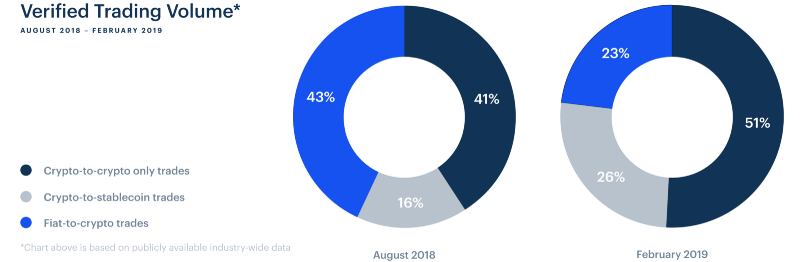
In its official statement, Coinbase said that direct crypto-to-crypto trading has become the new norm, surpassing crypto-to-fiat trades in the past 12 months.

In the early days of crypto, the overwhelming majority of investors used fiat currencies like the U.S. dollar to acquire bitcoin and other cryptocurrencies.

As the adoption of cryptocurrencies increased, over time, the number of cryptocurrency holders surged, reducing the demand for fiat-to-cryptocurrency trading services.

“Direct trading between cryptos is increasingly the new norm and in the last year has overtaken traditional fiat to crypto trading across the globe. Millions of Coinbase customers can now securely and quickly trade between different cryptos and send crypto off-platform at their convenience,” the statement read.
Binance’s biggest rival: crypto giant coinbase is trading in 53 countries

Direct cryptocurrency trading on Coinbase increased noticeably (source: Coinbase Medium)

Ever since its launch in 2017, Binance, the most widely utilized cryptocurrency exchange in the global market, has set its focus on direct trading of cryptocurrencies, expanding across many regions.

Although Binance has launched fiat trading in several countries in the likes of Uganda, Jersey, and Australia through thousands of storefronts, the core business model of Binance revolves around its cryptocurrency-to-cryptocurrency trading platform used by more than ten million users.

In July 2018, in an interview with Bloomberg, Binance co-founder and CEO Changpeng Zhao said that Binance was recording about $1.5 billion in daily turnover from 10 million users.

Since most of the revenues generated by Binance likely stem from its crypto-to-crypto trading platform, Coinbase and Binance were mostly serving different groups of investors and users.

However, the recent expansion of Coinbase to offer direct cryptocurrency trading will see Coinbase and Binance, two of the most dominant exchanges in the market, go head-to-head in the same market.

Sign of a New Phase in Crypto

According to the Coinbase team, as the cryptocurrency market moves to a new phase in which many investors already hold cryptocurrencies and a wide range of new opportunities arise, a new decentralized economy is likely to emerge.

“As crypto moves from the current ‘investment phase’ into what we call the ‘utility phase,’ a host of new use cases will present themselves. This could take the form of decentralized versions of traditional financial services like lending or micropayments or truly novel crypto applications that no one has even thought of yet. The ability to convert from one crypto to another will form the backbone of this new decentralized economy,” the Coinbase team said.

The recent listing of tokens such as Augur (REP), 0x (ZRX), Basic Attention Token (BAT), and others indicate the intent of the Coinbase team to prepare for the arrival of a new phase in the cryptocurrency market.

Its main competitor, Binance, has made progress with Binance Chain, a blockchain protocol designed to support decentralized exchanges (DEX), and Binance already enabled some of its users to experiment with its DEX in March.

Both firms seem to envision a significant increase in the rate in which cryptocurrencies are adopted throughout the medium to long-term, which may lead investors to also rethink about the direction the cryptocurrency industry is headed.


Published at Thu, 18 Apr 2019 11:20:36 +0000
Previous Article

French Gov’t Minister Open to Enabling Crypto Donations for Notre Dame

Next Article

France’s ‘Innovative Legislation’ Misses the Entire Point of Bitcoin

You might be interested in …

The Importance of Continuous Audit and Real Time Disclosure

The Importance of Continuous Audit and Real Time Disclosure Continuous audit and disclosure is an assurance methodology that automates auditing tasks within an organization or system. The method is differentiated from technology-assisted auditing, which is […]

Paycent – The Easiest Way to Connect Crypto and Fiat

Holding cryptocurrency is all very well, but these days it hardly seems to be used to pay for anything. Merchant uptake is slower than the momentum needed to reach the mainstream. The merchants still take cash, but transferring between the two is an extra step that we could do without. Paycent may just be the crypto-fiat bridge we are looking for, with a whole host of other benefits too.

[Note: This is a sponsored article.]


What is Paycent?

Paycent is, in essence, a mobile payment system. It functions as a dual e-wallet which can be funded by both cryptocurrencies and fiat within the same app. It also allows conversion from crypto to fiat and vice-versa, in real time and from within the wallet, acting as an internal exchange.

Over a thousand online merchants and counting already accept Paycent as a method of payment. However, the option of having a debit card linked to your wallet opens up 36 million points of sale in over 200 countries. This includes withdrawing local currency from ATMs worldwide.

[youtube https://www.youtube.com/watch?v=n7fET7C32Y4?feature=oembed&w=500&h=281]

How is Paycent different?

Paycent already has an established fiat network and is collaborating with mainstream financial institutions and governmental regulators, to both expand this network and push into the world of cryptocurrencies. 

They already have regulatory licenses in UAE and the Philippines, along with approval in principal in Hong Kong and Singapore. Negotiations are also underway to host the Paycent Realtime Exchange in Dubai, with the oversight of the Central Bank of UAE. 

In addition to this, Paycent is in tier 2 talks to acquire a physical banking presence in the Philippines. Paycent would function as the online channel for the bank, providing financial services to the unbanked.

They are also in advanced talks with Egypt and Jordan to develop and host a unified digital payment infrastructure for their banking and government services.

Why should I invest? 

Investors in the ICO starting on November 2nd will receive PYN tokens. Holders of these tokens will receive rewards paid in ETH. These rewards will initially be paid quarterly and are as follows: 

  • 33% of the aggregate exchange rate profit for crypto to fiat and fiat to crypto, converted using the Paycent dual e-wallet.
  • 33% of the total interest profit on microloans to Paycent lenders.

Users of the Paycent Debit Card will also receive an additional 0.1% of each spend in PYN tokens. Investors of 100 or 500 ETH or more are eligible for special debit cards which increase these loyalty rewards to 0.5% and 1% of each spend.

These ‘cash-back’ reward tokens will create a secondary distribution of PYN tokens, creating an open market for PYN, with price support and increase.

https://platform.twitter.com/widgets.js

How can I invest?

Paycent already concluded their pre-ICO, reaching the hard cap of 22,500 ETH in 10 days. Around 857 contributors took part from over 41 countries.

The main ICO is being held in 8 separate phases over the course of four years. There is a minimum investment purchase of 15 PYN and investors can participate using Ethereum, bitcoin, or Litecoin.

The first phase of the ICO begins on November 2, 2017, at 9 am Singapore time (UTC+8) and will last until November 30, 2017, or until the Phase 1 hard cap of 30 million PYN has been reached.

Bonus incentives are being given to encourage participation:

  • First 24 hours: 27% bonus PYN
  • Days 2 – 4: 18% bonus PYN
  • Days 5 – 7: 12% bonus PYN 

Subsequent ICO phases are scheduled as shown below, with existing token holders receiving generous bonuses:

Phase 2 (Last week of May 2018)
Hard cap: 35 million PYN
25% bonus to PYN token holders

Phase 3 (2nd week of November 2018)
Hard cap: 35 million PYN
23% bonus to PYN token holders

Phase 4 (Last week of May 2019)
Hard cap: 35 million PYN
21% bonus to PYN token holders

Phase 5 (2nd week of November 2019)
Hard cap: 35 million PYN
19% bonus to PYN token holders

Phase 6 (Last week of May 2020)
Hard cap: 30 million PYN
17% bonus to PYN token holders

Phase 7 (2nd week of November 2020)
Hard cap: 30 million PYN
15% bonus to PYN token holders

Phase 8 (2nd week of November 2018)
Hard cap: 22,045,000 PYN
13% bonus to PYN token holders

For more information about Paycent please visit paycent.com.

Do you think a ‘bridge’ between cryptocurrencies and fiat currency is something that the crypto community needs? Let us know in the comments below.


Images courtesy of Paycent

The post Paycent – The Easiest Way to Connect Crypto and Fiat appeared first on Bitcoinist.com.