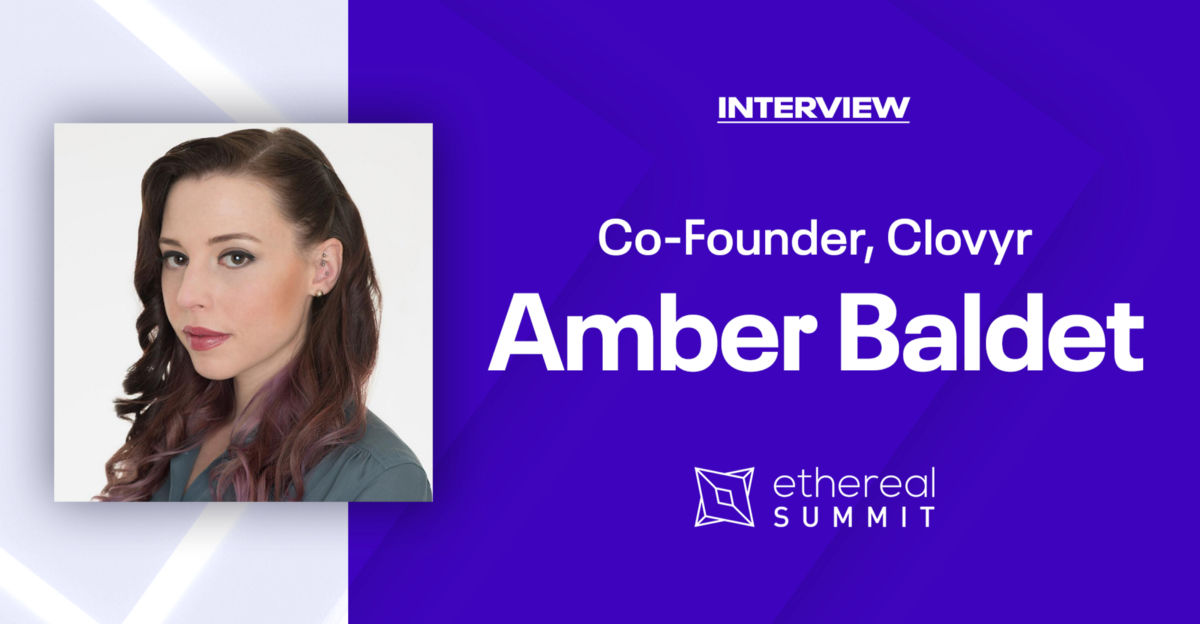
Amber Baldet was already making waves while heading up the program at , where she “brought the hoodies (hacker-coders) and suits (bankers) together,” according to , in leading the team that built , an -based . Last year, though, Baldet showed her ambition in departing America’s biggest bank alongside cohort Patrick Nielsen to found their own startup — — an ecosystem of applications and services that empowers teams of all sizes to experiment and iterate with tech.
In doing so, Baldet has also grown into a leading voice in the industry, and her commentary on the need for open source collaboration, against single chain maximalism, and warning of the dangers of surveillance capitalism have provided guidance to the decentralization movement. While Amber’s 2018 address, titled ‘,’ was one of the most notable talks of the weekend, this year she’ll be returning to Ethereal Summit to offer her take on the state of , data, and the way forward for .
We caught up with Amber to get some insight as to what’s on her mind in 2019…
Is blockchain going to change how companies use data?
Well…. yes and no. Companies are hoovering up data at an increasing pace. Many of them have decided that in order to run machine learning programs, more data is always better, but these data lakes create a lot of technical risk for them. And now that technical risk is creating legal, regulatory and monetary risk as well.
It’s also becoming harder and harder for smaller companies to compete with larger companies within their industry vertical. Increasingly, juggernauts like Google are amassing so much industry specific data that they can credibly compete with the best in class in every industry. Companies are realizing that they’re going to need to collaborate in order to derive the business insights that help them compete.
Federation and decentralization applied to data science isn’t about governance or tokenizing things on a — again, please, don’t put all your data on a ! Rather, we’re talking about being able to build and run algorithms in new ways that can cross trust boundaries while also being more privacy preserving. That’s really exciting and is going to unlock a ton of value trapped up in today’s data silos.
You’ve been discussing surveillance capitalism a lot recently — is the dystopian panopticon smartchip an inevitability?
The genie is out of the bottle. I don’t think people want to become off the grid hermits or give up their smart devices, but we can create new types of products that are more transparent and respectful of how data is being used.
You cannot prevent your telco from having your phone’s location information — connecting to cell towers is how the service functions. Lots of people that seem really focused on “privacy tech” these days need to understand the difference between what is private (free from intrusion) and what is confidential (authorized access, with expectation of consensual use). I am okay with vendors having the data that is created as I use their service, but I’m not necessarily okay with them selling it to a hedge fund or ad-tech company.
For most apps we use, there’s no reason why your data has to be offloaded and stored perpetually. Those are business choices, and venture capital funding and corporate profit models incentivize acting at cross-purposes to your own . We should fix the incentives, because moves too slow and often gets it wrong.
When you were leading Quorum, you talked about Ethereum a lot. Is that still your focus?
When people use decentralized applications, they should be able to focus more on what the app does than what’s under the hood. Even the phrase “decentralized applications” is ambiguous and confusing. I don’t think that code has to be deterministically run on a publicly accessible distributed virtual machine for an application to achieve the goals people attach to “decentralization” (though conversely, legacy software on a vending machine is definitely not a smart contract).
Anything that challenges the increasing aggregation of power in the hands of a few platforms — for infrastructure and retail, or for blogs, for example — can be a piece of a larger story around how we hold accountable the systems we use every day. Being super dogmatic about any one thing being the silver bullet for every technical and social problem seems misguided.
But yes, we still love ! We’re building an awesome developer suite that makes it easier to build on whether you’re building for the public network or a consortium project. It connects tools people know and love with some brand new things, and I think people are going to really like it. We’ll be releasing some dev-ops pieces imminently, and tooling incrementally on top. is still so new that delivering high level abstractions requires a lot of inventing the universe first.
So where do you start with Clovyr?
Initially we’re helping DeFi apps, peer-to-peer payment systems, non-fungible (NFT) games, etc., connect with an audience and making sure that anyone can help run the infrastructure that powers them, not just a handful of tech-savvy people and self-interested companies.
What we’re releasing first is a dev-ops layer that manages infrastructure without a strict central coordinator. Blurring the line between the agency of self-hosting and the simplicity of managed infrastructure isn’t easy, but doing it well means that we get people without much experience running their own servers with one click and not have to worry about maintenance, while still holding their own keys and maintaining their privacy.
People that know how to provision a box — whether at their house or their cloud or their on-prem business — can use to spin up “it just works” packages of different nodes and related apps completely for free with one command line entry. There’s no “community edition,” the software is exactly the same for everybody, and it does all of this locally in your browser. It’s pretty cool stuff. As far as I know, no one has ever done something like this before.
Where do you see the state of Ethereum and blockchain for enterprise?
Right now, the technical landscape is very fractured.There are a lot of companies that built a pilot on some bespoke or vanilla “to be upgraded” version of , and they don’t really know how to move toward production. Rationalizing all of these different implementations and privacy, integration, and models — it’s possible, but it’s slow. is right in the middle of it; if you’re a corporate interested in what we’re working on, please get in touch!
and the (EEA) recently announced their Taxonomy Initiative, of which is a member. Its goal is to develop standard semantics for describing the behaviors and capabilities of digital on any protocol. That is the sort of project where big tech and finance companies can work right alongside startups to build something that is useful for everyone.
Published at Fri, 26 Apr 2019 16:46:47 +0000