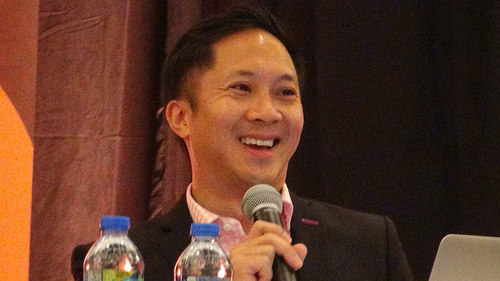
Amazing to have three leading DeFi / / crypto startups serve on the panel:
Berkeley Skydeck has a perfect window view.
Somehow I feel like I’m in , about to learn the coolest magic, at the best academy in Muggle world.
Here are the notes I took at this great event. I hope you will learn the perspectives from the /crypto startup top minds, and maybe some ridiculous asparagus magic spells.
Topics organized as followed:
1 — New Models of Computing — Crypto and Blockchain
and started as a #grass root technology. There is no central authority, no central governance, it’s an economy model runs very differently than the existing world. But it has been running for many years: has 10th anniversary. is 5 year old.
Historically, new models of computing have tended to every 10–15 years. computers are new types of computers where the unique capability is trust between users, developers, and the platform itself.
A16zcrypto has a thesis on Composability:
“ The is a major unlock for composability, as it allows developers to build atop shared infrastructure without fear of lower-level dependencies being yanked from underneath them. This is true because blockchains are both permissionless (what’s great about open source) and stateful (what’s great about APIs like Twilio and Stripe). In looking at the evolution of computing, I’ll sketch out a mental model of four distinct eras, each with varying architectures and priorities with regards to composability:
- Calculator Era — application specific, limited composability
- Mainframe Era — turing complete, high composability
- Server Era — application specific, punt on composability
- Cloud Era — turing-complete, scalable composability”
2 — DeFi — Decentralized Finance
DeFi, Decentralized Finance has grown into one of the most active sectors of in 2019.
: The stablecoins, DEXs, investing, derivatives, payments, lending, and insurance platforms building on . Surprisingly, based on today’s statistics: 2019/04/09.
dYdX tokenizes margin assets. For example the smart contract based crypto assets that allow users to short assets to profit on price decreases, with multiply gains leverage, and even earn interest on long positions. All assets are defined by smart contracts, operating on #decentralized . Margin whitepaper:
Maker is comprised of a decentralized stablecoin, collateral loans, and community governance. MakerDAO’s DAI is basically a stable coin that is pegged to US Dollar.
Celo is an open platform that makes financial tools accessible to anyone with a #mobile phone. Celo is a consumer facing mobile app product that will bring convenience in the emerging markets. Celo has stable pegged to fiat currencies, like the US Dollar, to minimize volatility. in circulation are backed by a diversified, overcollateralized, and publicly auditable crypto-asset reserve.
3 — Decentralization vs Centralization — Company Organization
Decentralization brings not only the new technology, but new way of company organization. It’s interesting to see the panelists shared different opinions on the company organization in era.
The pros and cons of running a Decentralized company:
- Pros: Decentralized company can have members in anywhere globally. Decisions are not made in an executive room like most companies. CEO, CMO, CTO are not even in the same countries. The decentralized company can route the closest team member to meet the customer, anywhere in the world.
- Cons: Efficiency can be an issue for decentralized company. The centralized company has the advantage of iterates fast on product features in one office.
4 — DeFi Killer Products
DeFi (Decentralized Finance), is a hot topic of 2019 on Sand Hill Road. All these 3 startups are DiFi startups with their killer products.
Nowadays the supply chain finance world operates in a complicated way, such as “loan shark” involved to provide liquidity for a cashflow tight business. Maker is experimenting on tokenizing invoice, so in future Walmart and its vendors can have better liquidation and less frictions.
MakerDAO is clearly the leader in advancing Stablecoin technology. The full story “As crypto grows, more asset classes will find their way to global markets by way of tokenization. For example, today a coffee grower in Colombia may have no choice but to engage a loan shark to fund day-to-day operations. That same grower will soon be able to tokenize #Starbucks account receivables and sell them into a global market for instant liquidity. In this way, Dai could simultaneously help alleviate the of international remittance, while the tokenized invoice makes for a new and dependable collateral-type for the Maker credit system.”
dYdX’s killer app is Open-Source Protocols for Decentralized Margin and Derivatives. simply put: As the price of ETH decreases by $1, the price of sETH increases by $1.
Celo’s killer app is mobile first crypto payment, starting with emerging market like south America. USA, are too crowded and regulated anyways. Crypto indeed needs more consumer products like this.
In conclusion, DeFi killer products should have the best usability. The user may not even realize there is in their financial transaction. If the user has to know about gas, solidity, , it’s a failed product.
5 — Security in the Decentralized Future:
Question I asked to the panel:
“AnChain.ai is a AI powered security company. In my pitch deck last year I asked my investors: today people don’t put their life savings into crypto, is it because it’s too slow? or it’s too insecure? In the decentralized future, there is no FDIC, no , who will provide governance? as a DeFi provider what’s your perspective on security? “
1. More Defi will emerge. It will become a competitive market. Soon only those who focus on security can win, because it would suffer from less hacking.
2. Smart contracts need to be secured. For example, via Formal verification from TrailOfBits . FV is still very early stage and ToB will seek to open source their tool soon.
3. Defi startups are small, so they do whatever is best they can do atm, such as code review, smart contract auditing, exchange infrastructure hardening, etc.
These answers resonate well with AnChain.ai’s thesis. Most of our founding team come from cybersecurity industry, like FireEye, Mandiant, McAfee. It’s great to see these great early crypto startups recognize the criticality of security.
With high profile hacks in DAO in 2016, APT hacks in 2018, security in and crypto has been an emerging topic. Read more here: MIT Technology Review, Feb 2019. :
And the very nature of public blockchains means that if a smart-contract bug exists, hackers will find it, since the source code is often visible on the . “This is very different than traditional cybersecurity,” says Fang, who previously worked for the cybersecurity firm FireEye.
Thanks for inviting AnChain.ai to this great a16zcrypto event at Berkeley.
“Defi” in French means “Challenge”. There are definitely challenges to overcome, but that’s just like all great technologies when they were born, electricity, Internet, social network.
Hope you learn enough magic spells in the and crypto world.
Exciting time. Exciting place. Like magic.
Published at Thu, 11 Apr 2019 22:14:43 +0000