The news that the has come as no surprise to many in the crypto community. EtherDelta was a former decentralised exchange which ran on the Ethereum blockchain for trading tokens. The SEC has been seen by many in the community as “picking an easy target” before going after larger cryptocurrency and token exchanges.
However, this blog post is not about legal action. Controversially, we see that EtherDelta was accomplishing some of the virtues the SEC itself hopes to pursue in its securities trading regulation. If look we look at EtherDelta beyond the obvious lack of controls, you will see the true potential power of tokenisation and decentralisation.
If you are new to tokens please read my previous article before diving in here.
What was EtherDelta
EtherDelta was founded in the summer of 2016 as Zack’s hobby project which he ran alone. He wanted to create a proof of concept on how to build a decentralized exchange on the Ethereum blockchain.
During the first half of 2016, only a handful of Ethereum tokens existed. When the opened, the listed tokens fit on a single screen. EtherDelta was the only venue to trade these tokens. The price of Ether was $5. Nobody dared to dream about security tokens, ICOs or anything else yet.
Please note that while I speak about EtherDelta in the past tense, it is still around; run by its new owners, but it is much less significant for the wider token ecosystem nowadays. Zack left the project in late 2017 and EtherDelta had served its role as a pioneer.
What EtherDelta teaches us about the benefits of tokenisation
EtherDelta is a perfect example of how tokenisation will disrupt financial instruments and trading.
Tokenisation brings benefits for both issuers and financial market operators. In this post, we are mainly looking at innovation from the perspective of tokenised markets. I plan to follow up with another post which explores tokenisation benefits for fundraising and corporate governance today.
Firstly, to put things in perspective: .
Faster
EtherDelta provided near real-time settlement of your trade. It ran 24 hours a day and was accessible to anyone with an Internet connection. You clicked a buy button and tokens were delivered to your wallet within the next 2 minutes. You got the immediate custodianship of your assets.
On legacy markets, there is a time difference between striking a deal and the delivery. It is called “T plus X”, where T presents the day of the trade and X represents the number of business days it takes to receive your purchase. To cover this latency and slow movement of money, companies need to hold capital in clearing funds.
The locked capital is never well spent. If the settlement cycle is two days then $3.4 billion is locked up in these funds.
(NSCC 2010, )
Harder
Blockchain transactions are , a term popularised by . Hard money means that the transfer of value happens unquestionably and there won’t be chargebacks.
EtherDelta trades with ether and token pairs, both hard money or hard inventory. The trades are settled by a smart contract, ensuring that the trade happens atomically: the full trade happens or none of it happens. There cannot be partial trades or failures to deliver and there is zero .
Legacy trading is plagued by settlement failures, aptly named as a post-trade risk. happens when it turns out the prospective buyer was out of money or the seller was out of inventory.
“The current settlement failure rate of two percent accounts for about $3 billion in losses every year” DTCC executive director Tony Freeman, 2017.
Higher
An SEC press release highlights that “3.6 million transactions in 18 months” happened on EtherDelta. We can put this to a perspective by comparing it with (AIM), in London. AIM started as a growth company exchange in 1996 and, as of 2017, it was reported that the daily average volume was £3.3 billion.
EtherDelta reached the same amount of trades in 18 months that after ten years of existence.
Further
Listing your token on EtherDelta was free. Anyone could bring their token to be traded. There was little to zero vetting processes for listing. It is speculated that this , and lack of anti-money laundering controls, prompted the regulator interest.
on EtherDelta. This, in comparison is more companies than. Projects all over the world could be on the same line and there was no discrimination in access to markets, for both investors and issuers.
My god, it’s full of tokens (EtherDelta 2018)
Many of these tokens are not viable in the long term. However, this is equally true for all early ventures. Most and : a risk that never can be eliminated without eliminating the progress itself.
In our traditional financial world, Main Street investors lack the same access to deals as Wall Street investors. We suffer from the ” Companies do not go public and privileged private equity investor reap the profits. The SEC itself has called for .
The SEC is also worried about . Liquidity, ways of getting in and out from your investment, always creates additional investor protection. Currently, any form of trading non-public stock is complicated. An order book, even with limited action, would be better than nothing.
Cheaper
EtherDelta was “a man and a laptop” operation. The codebase had only a few thousand lines. The required capital to start and run it was basically nil. All you needed to arm yourself with were hardcore programming skills and some knowledge about capital markets.
EtherDelta was faster, less risky and better performing than most contemporary securities trading venues out there. If a blockchain gives this kind of power to a single developer, we are sitting on the top of a financial cruise missile.
It is not just about squeezing more efficiency out of existing financial machinery. Without barriers creating new trading avenues, we can expect to see new markets where markets have not existed before. This will help regions like Africa where a vast amount of resources, both human and natural, have been untapped due to a lack of access to markets.
Where the world will go from here
Cryptocurrencies and tokens proved that we can have functional investor direct and real-time markets. There is unmet global demand for small-scale investing and trading. Chat rooms and exchanges are filled with people from every corner of the planet to research, discuss and trade tokens. The network effects of public blockchains create vast communities across the borders.
People who are “into tokens” often lack frictionless access to better financial instruments. Instead of utility tokens, with only speculative economic benefits, we should give them the real deal: stocks and bonds in the form of . There is no technical reason we cannot do it.
The security token industry is going to be built from the bottom up. Starting with grass root investing, from startups and community ventures. At the forefront, we will have sectors and regions where significant financial supplements are missing, inefficient or non-existent. A precedent is how developing countries leapfrogged into mobile banking.
The elephant in the digital chat room is the regulation, but I feel creating public secondary markets for these “small-scale securities” will not be such a massive change. The . For pioneering jurisdictions, it is a natural step to extend this crowdfunding regulation to cover secondary markets. Even before that happens, we can rely on exemptions which smart legislators have left us.
Now the race is on – for entrepreneurs and regulators alike. Who will be the first company to write a rulebook for “global small-scale securities exchange”? Who will be the first jurisdiction to approve it? The line behind their homepage will stretch around the world.
Discuss
for any comments or questions.
Planning a security token sale?
TokenMarket has executed more than 30 token sales and raised more than 350M USD for its client.
About the author
Mikko Ohtamaa
Mikko Ohtamaa is the CTO of TokenMarket. He has been working with blockchains and tokens since 2013. He has helped to execute several token sales and now focuses on bringing securities on a blockchain.
・
‘œIt is not just about making money. We didn’t start this company to make PayPal 2.0.’
‘” Jesse Powell
Interview location: Skype
Interview date: Tuesday 13th Nov, 2018
Company: Kraken
Role: CEO
Volatility in crypto is reflected in the businesses which have been built upon it. Only recently have we seen this volatility with Bitmain, where during the bull run of 2017 the business was generated $billions in revenue and profit, but as the market has corrected, both revenue and profit has seen a sharp fall.
The same can be said for exchanges, in 2017 most could not recruit support staff and engineers fast enough, but recruitment in crypto comes with risk. Exchanges are a honeypot for thieves and hackers with wallets containing vast amounts of crypto wealth. Not only must exchanges protect themselves from outside hackers but they too must be prepared for staff compromising data and wallets.
Under the leadership of Jesse Powell, Kraken has grown to a global team of over 800 people. To ensure smooth operations, Kraken must recruit the right people and develop robust processes to protect the security of the company, while ensuring that they maintain a healthy culture.
As an old-school, early days crypto enthusiast, Jesse has led by example, rebelling against the BitLicense and donating $2m to Coin Center to ensure regulations do not swamp the industry.
In this interview, I talk to Jesse about the journey he has been on growing Kraken, the challenges of building an exchange and broader industry issues from regulation to mainstream journalism.
This episode is also on:


We’re excited to present a fresh new look for the easiest and most trusted crypto wallet.
We’ve been talking to you, our users, and compiled a list of the features and improvements you want the most.
With this release, you can now view the value of your coin portfolio in your local fiat currency. You can also check the fiat values for individual tokens whenever available.
And now, all the ERC20 tokens you own show up automatically — no more manually adding custom tokens.
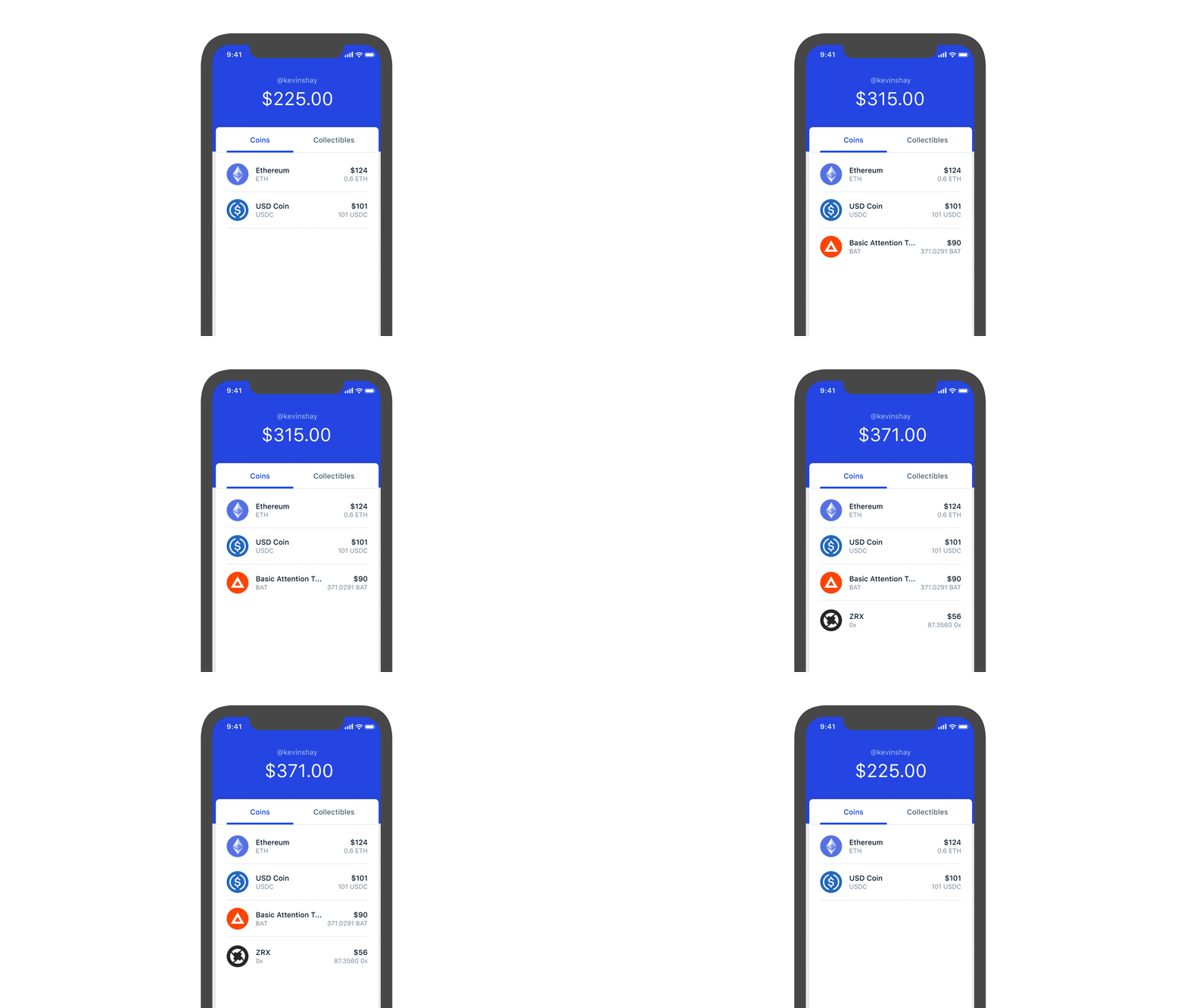 Your coins now show up automatically, with fiat values
We’ve also created a beautiful new gallery for your collectibles, and integrated with and to support hundreds of collectibles. Now you can show off your collectibles from right inside your wallet.
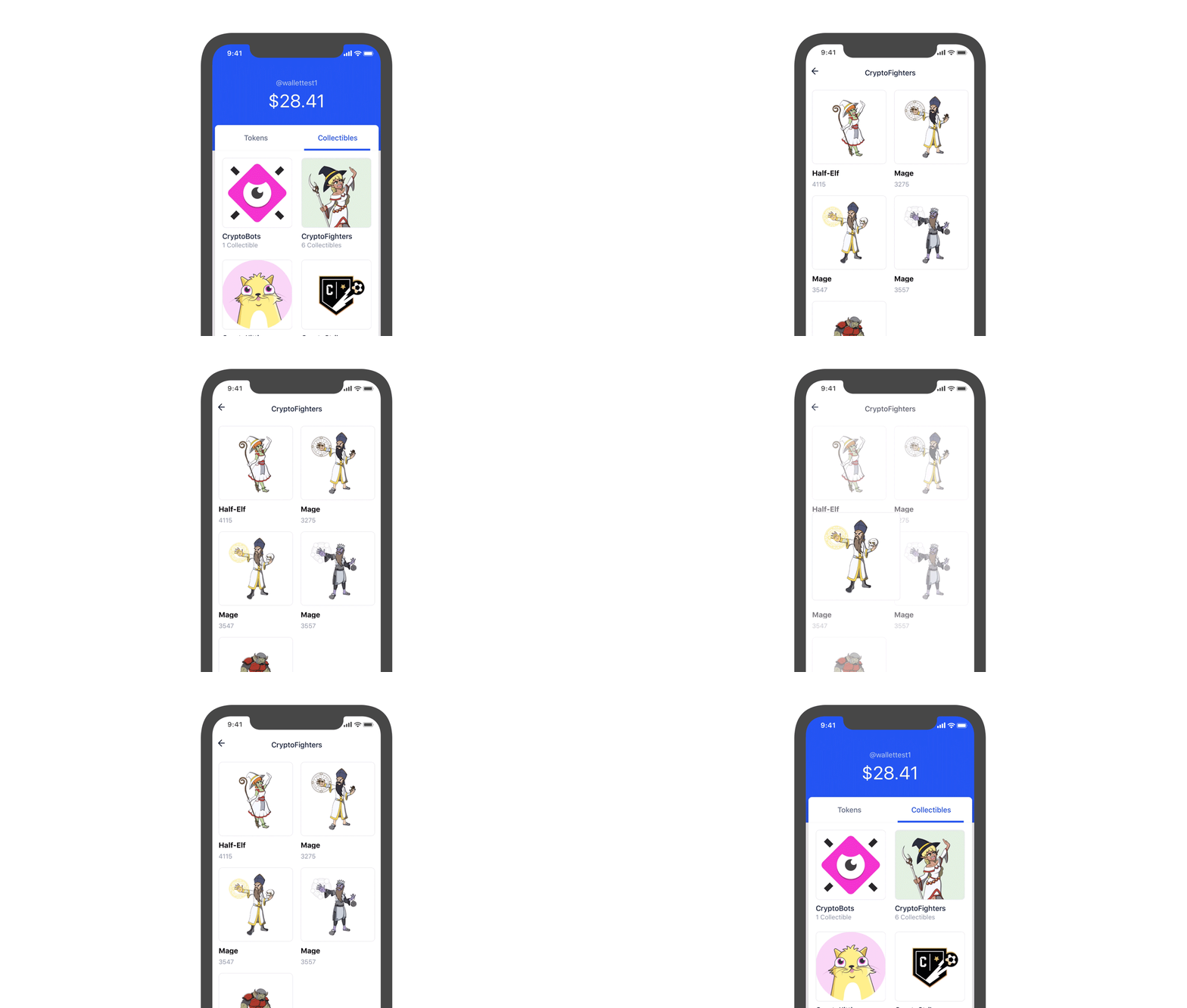 A new experience for your collectibles
And we’ve made a series of other changes under the hood for improved stability, security, and better gas price estimation.
If you use an iPhone, your app should already have updated to the new look. Wallet users on Android phones will see the update roll out over the next few days.
We hope you enjoy using the new, updated Coinbase Wallet. Your feedback helps us make Wallet better for everyone. You can now reach us at wallet.support@coinbase.com. Please reach out with feedback or if you ever need some troubleshooting.
was originally published in on Medium, where people are continuing the conversation by highlighting and responding to this story.

