
January 26, 2026

Capitalizations Index – B ∞/21M

BCH Avalanche Transactions Show Finality Speeds 10x Faster Than Ethereum

Bch avalanche transactions show finality speeds 10x faster than ethereum

BCH Avalanche Transactions Show Finality Speeds 10x Faster Than Ethereum

Bch avalanche transactions show finality speeds 10x faster than ethereum

Over the last few weeks, bitcoin Cash (BCH) developers and community members have been discussing a pre-consensus method called Avalanche. Now BCH proponents have begun to notice the protocol has been applied to the Bchd full node implementation and the proof of concept officially running on the BCH mainnet.

Also read: Mt. Gox Creditors Neither Need nor Deserve This Kind of ‘Hero’

The Benefits of Avalanche and PoW Running in Parallel

The Avalanche proof-of-concept is a consensus algorithm that adds Byzantine fault tolerant proofs to a blockchain network so nodes can differentiate between two conflicting transactions. The protocol communicates with nodes in real time in order to bring consensus in a more efficient manner. This is because Avalanche queries the network of nodes and asks them to come to pre-consensus on which of the two conflicting transactions are preferred.

Bch avalanche transactions show finality speeds 10x faster than ethereum

People are often confused with Avalanche being applied to BCH because it’s also being used in a proof-of-stake (PoS) project designed by Cornell Professor Emin Gün Sirer. On the BCH chain, Avalanche is only being used for pre-consensus and runs parallel with the original proof-of-work consensus mechanism. A number of BCH developers and proponents believe Avalanche will make the BCH network far more robust.

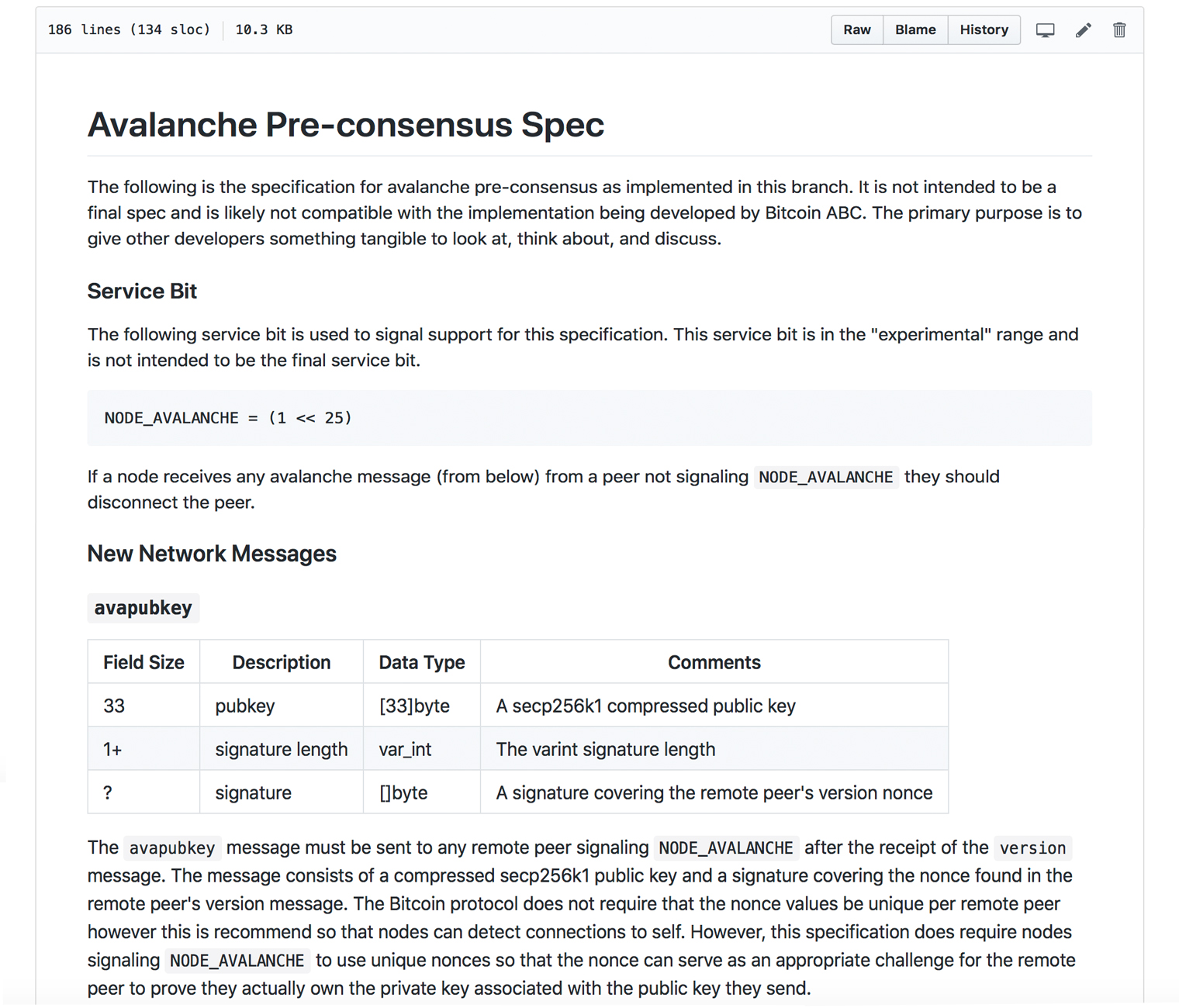
Avalanche discussions have increased over the last week since the protocol is now running on the main network. “Ok, the Avalanche proof of concept is officially running on mainnet,” explained Bchd developer Chris Pacia on Feb. 7. The programmer also left a link to the protocol’s Github repository which gives developers a gist of the Avalanche pre-consensus specification implemented in the Bchd branch.

The Bchd version of Avalanche Github repository states:

[The following specification] is not intended to be a final spec and is likely not compatible with the implementation being developed by bitcoin ABC — The primary purpose is to give other developers something tangible to look at, think about, and discuss.

Bch avalanche transactions show finality speeds 10x faster than ethereum

Irreversible Transactions in Seconds

In addition to the experimentation on the main BCH chain, Bchd developers have published an Avalanche transaction explorer as well. The speed at which BCH transactions are processed shows the transaction’s finality is typically 2-3 seconds or less. Essentially this means the transaction (tx) listed on the Avalanche explorer has reached a point at which it can no longer be reversed by a double spend, even though the tx is unconfirmed by miners.

“If used this way, it would give bitcoin Cash the equivalent of nearly instantaneous confirmations while improving mempool synchronization and reducing the financial incentive to 51% attack,” the Avalanche blockchain explorer details. “As you can see, at present most transactions become irreversible after just a couple seconds — To take this from proof-of-concept to an actual consensus rule will require lots of testing, experimentation, data collection, code review, and soft fork activation rules.”
Bch avalanche transactions show finality speeds 10x faster than ethereum

10x Faster Than ETH and Reorganization Protection

Over the last few days, BCH supporters have also discussed how the transaction finality speeds have been 6-10x faster than the Ethereum network. “Transaction finalized in 1.559723305 seconds — That’s 10x faster than ETH — A serious game changer,” explained BCH developer and Bitbox founder Gabriel Cardona on Twitter. bitcoin ABC developers have also been discussing Avalanche and the protocol is on the roadmap according to the BCH development statistics page on Coin Dance.

In the past, bitcoin ABC developer Amaury Sechet has said the protocol can make synchronization far more efficient. The ABC developer discussed the benefits of Avalanche at the Satoshi’s Vision Conference in Italy last October. There are more advantages explained in a post written by the ABC developer Mengerian, who says not only is transaction finality fast, but the Avalanche protocol “provides a good mechanism for post-consensus defense against blockchain reorganization attacks.” It seems that the proof-of-concept Avalanche is making headway within the BCH ecosystem and the results have been positive so far.

What do you think about the Avalanche pre-consensus model? Let us know what you think about this subject in the comments section below.


Image credits: Shutterstock, Avalanche Transaction Explorer, Bchd website, and Github. 


Verify and track bitcoin cash transactions on our BCH Block Explorer, the best of its kind anywhere in the world. Also, keep up with your holdings, BCH, and other coins, on our market charts at Satoshi’s Pulse, another original and free service from bitcoin.com.

The post BCH Avalanche Transactions Show Finality Speeds 10x Faster Than Ethereum appeared first on Bitcoin News.

source: https://news.bitcoin.com/bch-avalanche-transactions-show-finality-speeds-10x-faster-than-ethereum/

Published at Sun, 10 Feb 2019 22:50:49 +0000

Previous Article

State of California Tackles Drought with IoT & Blockchain

Next Article

BITCOIN ($XBT): ABCDE PATTERN'LL LEAD US BELOW $3K..RE-COUNTED

You might be interested in …

Tokenized Equities Will Boost Market Confidence For Both Issuers and Investors

Small to medium-sized businesses play an important role in the economic development of a country. Their role in terms of production, employment generation, contribution to exports and facilitating equitable distribution of income is very critical. They also supply essential products for mass consumption and exports.

Banks hardly give loans

Despite the importance of this sector to the economic life of any given nation, the universal norm remains that it is difficult for them to have access to much-needed funds for proper development and establishment. Most banks are reluctant to issue loans to small businesses due to the high-risk level associated with emerging businesses. This might be because of the absence of collateral, or as a result of the fact that such businesses hold no proven track records in most cases in order to meet up with the standards set by the banks.

The ICO escape

The advent of the decentralized and unregulated crowdfunding system known as Initial Coin Offering (ICO) happens to provide a huge bailout opportunity for both emerging and existing businesses who may find it difficult to meet up with the standards of the banks and other financial institutions. This ICO model enables a crowdfunding process that cuts through geographical boundaries on a global level. This system makes it possible for different classes of individuals from across the globe to be able to contribute towards a project without much difficulties.

Apparently, the ICO model spreads the risk across numerous contributors who are left with independent tokens that do not necessarily retain any equity from the parent business or company. The token’s values are only determined by general economic forces in the token marketplace. This phenomenon largely exempts the token vendors from any responsibility and is suspected to be one of the major reasons why inconsistencies exist in the ICO ecosystem, and why examples of fraud and dishonesty are rampant.

In essence, traditional pathways leave the entire business environment shortchanged with inefficient and unsustainable financing procedures, while implementing the ICO model opens up a huge potential for the market, but comes with associated loopholes that form a setback to the entire ICO ecosystem.

The balance point

Finding the balance by introducing a system where the shackles of difficulty in fundraising are broken, while investors are protected by retaining tokenized equities of their businesses of interest is the ultimate objective of Stamps Platform.

The Stamps platform is an alternative to the traditional ICO model; Stamps will provide a safe, inexpensive and transparent path for businesses to issue equity in the form of tradable tokens that represent an ownership share of their company. This medium allows businesses to reach a growing community of STAMP enthusiasts interested in emerging technologies and innovative business ideas.

When a business chooses to issue equity tokens through the Stamps platform, they will retain a portion of them, while the rest are gifted to STAMP coin holders, similar to the ever so popular “AirDrop” model. Once a market has formed, the business can then liquidate a portion of their retained equity tokens on the open market to fund their operations as needed. If the market fails to form in an agreed timeframe, the equity will be returned to the issuer.

As you can see there is a very little risk to the issuing business, but this is not a one-sided affair, there are also many benefits for the equity token holders. Just by holding the equity tokens one will be receiving legal ownership rights of the issuing business. There are also bitcoin Dividend Payments, Voting Privileges, Merger/Acquisition Payouts, and all of the legal privileges that come along with holding equity shares.

The STAMP Coin distribution is planned in an ICO with a Soft Cap Raise of $1 mln and a Hard Cap Raise of $89 mln.

The Stamps Platform is designed to achieve the ultimate balance where every participant will be adequately protected, be it the equity token issuer or the holder. A confidence filled market is indeed a potentially robust market.

The post Tokenized Equities Will Boost Market Confidence For Both Issuers and Investors appeared first on NEWSBTC.