January 25, 2026

Capitalizations Index – B ∞/21M

Bank of England Gov: Bitcoin Doesn’t Satisfy the Principles of Currency

Bank of england gov: bitcoin doesn’t satisfy the principles of currency

Bank of England Gov: Bitcoin Doesn’t Satisfy the Principles of Currency

By CCN: Dave Ramsden, deputy governor for markets and banking at the Bank of England, said in an interview with CNBC that crypto assets like bitcoin are too volatile to be a store of value and they do not meet the principles of currency.

Citing the research of the Financial Policy Committee (FPC), Ramsden stated that the high volatility and the relatively high costs of crypto transaction settlement make cryptocurrencies less practical as currency.

Volatility Could be an Issue for bitcoin and Crypto but Time Will Fix It

For any new or emerging asset class, volatility could be an issue for investors.

bitcoin, the first crypto asset to be created in 2009, is still about 10 years old and as is the rest of the cryptocurrency market.

Most other major crypto assets in the market in the likes of Ethereum, the second most valuable asset in the global crypto market, actually came after 2014.

As a new asset class, investors expect volatility in crypto assets and generally consider it a risky investment.

Wences Casares, for instance, the CEO of Xapo and a PayPal director, who has been a supporter of bitcoin and the crypto market for many years, wrote in an essay that he puts the chances of bitcoin succeeding at about 50%.

“In my (subjective) opinion those chances of succeeding are at least 50%. If bitcoin does succeed, 1 bitcoin may be worth more than $1 million in seven-to-10 years. That is 250 times what it is worth today (at the time of writing the price of bitcoin is ~ $4,000),” Casares said.

Many industry executives and investors in the crypto market are in agreeance that there exists a chance cryptocurrencies may fail over the long run if they fail to garner sufficient adoption and struggle to evolve into practical currencies.
Bank of england gov: bitcoin doesn’t satisfy the principles of currency

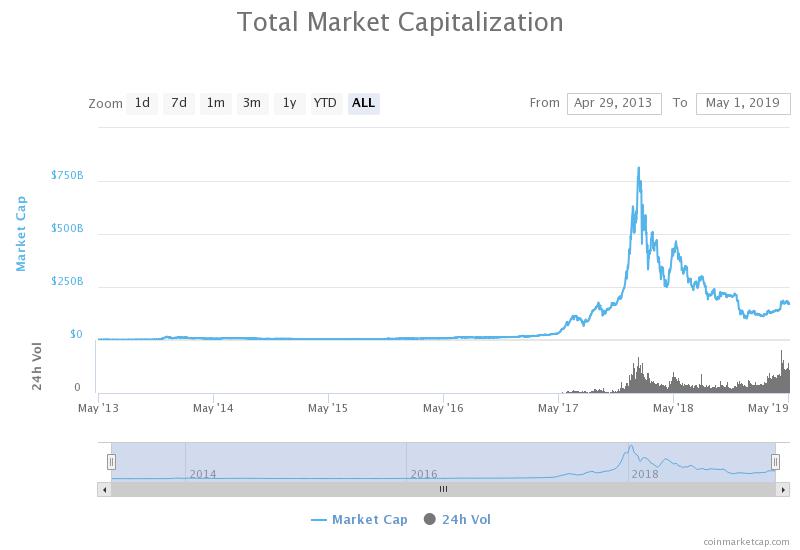
The crypto market has demonstrated extreme volatility in the past year (source: coinmarketcap.com)

The track record of bitcoin over the past 10 years has led investors to become more confident in the chances of its success as a store of value.

The criticism of the intense volatility of bitcoin and cryptocurrencies, in general, is valid. As an asset class at its infancy, extreme volatility at times is expected.

Bank of England Deputy Governor Dave Ramsden said:

“Just a year ago, the Financial Policy Committee looked at crypto assets in some details supported by the fintech hub. The conclusions of the FPC are that crypto assets are too volatile to be a store of value and we’ve seen that in terms of their subsequent movements through last year. And also, as a medium of exchange, the costs of transactions were very expensive so it didn’t really satisfy those basic principles of being a currency.”

How Volatility Would Settle Down

But, as the structure of custodial services supporting crypto assets improves and both high net worth individuals, as well as institutional investors, feel increasingly comfortable in committing to the asset class, it could allow cryptocurrencies to find stability in the years ahead.

At around $170 billion, the market cap of all cryptocurrencies in the global market combined still remains only a fraction of the market cap of a widely utilized store of value such as gold, which is estimated to have a market valuation of more than $8 trillion.

“Overall, because of the small size of the crypto asset market, the FPC is concluded that they didn’t represent a risk to financial stability but it was very important that we kept monitoring them,” Ramsden added, emphasizing the small market valuation of cryptocurrencies.

The maturation of the industry and leading companies that support it could also result in more stability for crypto assets in the long-term as controversial occurrences such as the Tether-Bitfinex scandal would not have a noticeable increase in the price of cryptocurrencies.

Bank of england gov: bitcoin doesn’t satisfy the principles of currency

Published at Wed, 01 May 2019 00:00:16 +0000

Previous Article

Feature: Voucher Program – Starbase

Next Article

Bitcoin (BTC) Dumping To $4,600 Might Be On The Horizon: Analyst

You might be interested in …

Dammit Tether, You Had One Job!

Tether (USDT), the cryptocurrency price stable asset, has lost its peg to the U.S.Dollar, which has everyone asking: is Tether in trouble?


Tether, are you solvent?

Tether is a cryptocurrency project focused on providing price stable assets on the bitcoin blockchain that are pegged to the value of and backed by national currencies. However, their peg seems to have become ineffective as market forces are now pushing the price down.

The price of USDT is currently sitting at $0.91 USD, which has resulted in bitcoin trading at a premium on some of the exchanges that use USDT like Bitfinex and Poloniex.

While this may seem like a great arbitrage opportunity at first, allowing users to purchase BTC with USD and sell it for USDT at a profit, some users are beginning to question Tether Limited’s business model and their capabilities to cover the 1:1 USD peg.

One Reddit user and cryptocurrency trader since 2013 has expressed his concerns regarding Tether and the current price discrepancies:

The problem here is that this is creating a very large price spread between exchanges that quote ACTUAL dollars and those that quote tether. This distinction is not being made clear, which I think is having an unhealthy influence on price rallies in cryptocurrencies. Furthermore, I have doubts that this tether is backed by dollars at all and in all likelihood is a fractional reserve.

Meanwhile, others have also pointed to Tether’s legal page noting one particular sentence that has aroused some suspicion:

There is no contractual right or other right or legal claim against us to redeem or exchange your Tethers for money. We do not guarantee any right of redemption or exchange of Tethers by us for money. There is no guarantee against losses when you buy, trade, sell, or redeem Tethers.

So What’s Going on with Tether?

As many may know, Bitfinex has had some issues with the Wells Fargo bank, which has limited their wire transfer capabilities. At the time, both deposits and withdrawals are not being processed by the exchange.

This problem also extends to Tether Limited, the company that issues the USDT and EURT cryptocurrencies. Tether has addressed this issue in a recent announcement which reads:

Since April 18, 2017, all incoming international wires to Tether have been blocked and refused by our Taiwanese banks. As such, we do not expect the supply of tethers to increase substantially until these constraints have been lifted.

According to the blog post, the company is currently in the process of establishing new banking corridors, which will allow them to resume withdrawals and deposits. The announcement also mentions that no new USDT have been issued and that Tether continues to maintain a 1:1 backing of real-life fiat.

One of the co-founders of Tether has also taken to twitter stating that “there is no way that Tether can run a fractional reserve.”

Why is the USD Peg Not Working?

So, if the USDT has kept its 1:1 USD backing, why is the 1:1 peg not working? The answer seems to lie both with the lack of liquidity created by the wire transfer limitations and the panic generated by the recent news and rumors.

Users that are in a hurry to receive their USD holdings may prefer to sell USDT at a loss than wait. Not only that, but the cryptocurrency community has also “learned its lesson” from the Mt. Gox disaster.

Thus, it’s no wonder that some are interpreting the current USDT limitations as sign to exit by selling their their tokens as quickly as possible for an asset they can easily withdraw and liquidate like bitcoin. In fact, many believe this is one of the major reasons driving the BTC price towards $1,300 at the moment.

In other words, USDT holders that may be interpreting this as a sign of insolvency or outright scam would rather sell at a loss than take the risk of their holdings become worthless.

Still, it is unclear if Tether’s problems are indeed limited to their banking partners or if there are any other unknown issues. If Tether is able to restore its fiat withdrawals/deposits however, then the price should recover back to the normal $1.00.

Do you think USDT will be able to recover back to $1? Could there be any hidden issues with Tether? Share your opinion in the comment section!


Images courtesy of CoinMarketcap, Shutterstock, Tether.to

The post Dammit Tether, You Had One Job! appeared first on Bitcoinist.com.

EOS (EOS) Officially A Top 5 Coin

Ethereum World News EOS (EOS) Officially A Top 5 Coin The crypto-markets are in the green this morning. bitcoin (BTC) is finally back at levels above $9,000 and is trading at $9,180. Ethereum (ETH) is […]