April Fool’s Day Rundown – Nerding Out On Cryptocurrency Pranks And Jokes
Every year on April 1 – April Fool’s Day – members of the crypto sphere try to outdo each other with nerdier and nerdier inside jokes and pranks, and this year has not proven to be any different.
Over the course of the day, we will be adding new April Fool’s stories that are still coming up. Do you want to share a find with us? Send it to us on .
Subreddit /r/bitcoin in 2015 about a return of all (BTC) stolen from now-defunct crypto exchange by a former DEA agent seeking a plea deal. In 2017, (ETH) co-founder wrote a claiming that ETH would change from its (PoW) algorithm to the Proof of Authority (PoA) in 2018.
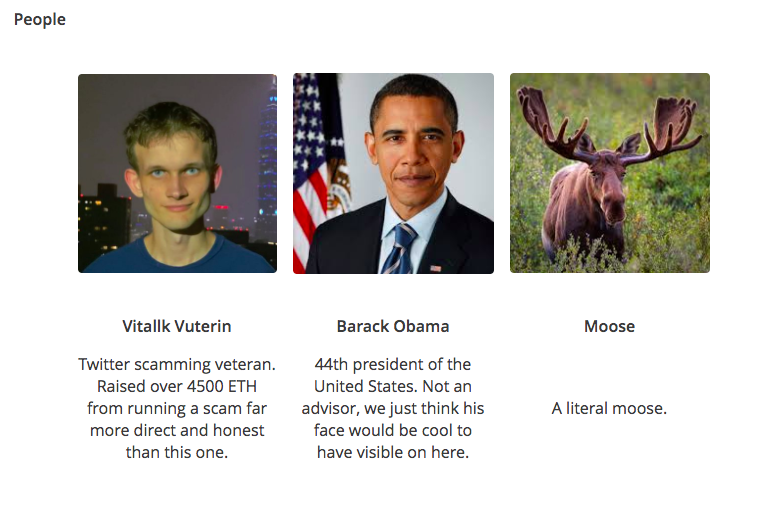
This year, Buterin posted another announcing the launch of an Ethereum “stablecoin” called the World Trade Franc (WTF). The WTF, which Buterin refers to as “combin[ing] all benefits of capitalism and socialism with none of the downsides of either,” is currently being marketed to “sketchy Pacific island nations national governments.” Below is a screenshot of WTF’s “people:”
Jesus Coin, described on Twitter as “THE currency of God’s Son,” tweeted today in another apparent Buterin-related prank about the new addition of Ethereum’s co-founder to their management team:
I have great news Vitaly Buterin has joined us. Retweet , get another 10,000 JC and let’s pass moon and get straight to heaven!
— Jesus Coin (@Jesuscoinico)
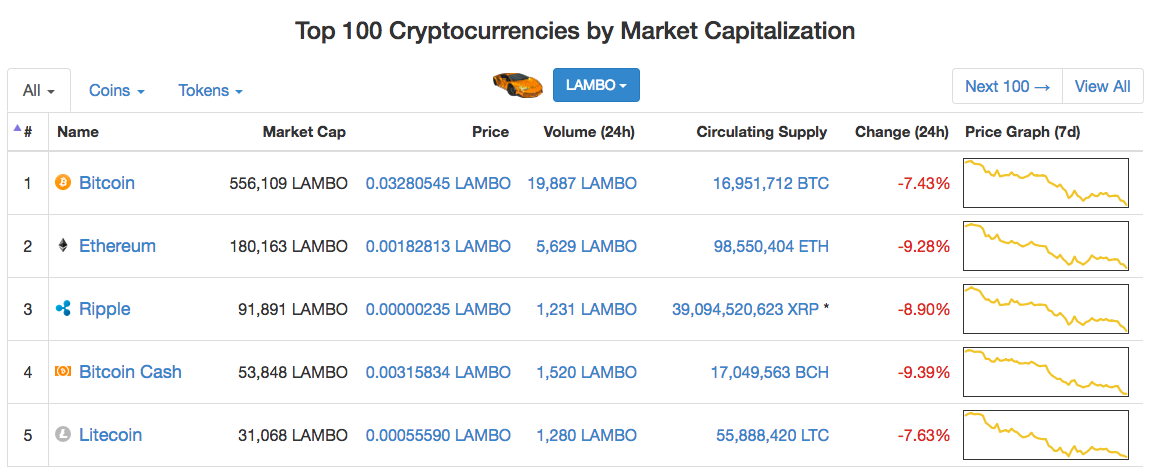
, a popular cryptocurrency market cap ranking resource, added a “Lambo” currency reference for its listed assets, showing how many “Lambos” each currency is roughly worth. As bitcoin is currently trading for around $6,561, one Coinmarketcap’s “Lambo” is equal to exactly $200,000.
user drowssap5 has also gotten into the April Fool’s spirit, that had finally released their , with the following caveat:
“Just kidding. They wouldn’t do that.
Happy April Fools day!”
, a service for adding money to prepaid phones with bitcoin, posted on both Twitter and their blog today that they are changing their name to “S**trefill,” even going as far as to change their to mimic their “.”
“S**trefill’s” writes that due to a decrease in demand for spending bitcoin, they are switching their focus over to “s**tcoins,” or coins that “are not perceived as having such a “high long-term value.” The launch of S**trefill’s new token, S**tCoinCash, will support a equivalent called the Crackening Network, according to the Medium post.

Financial news site Finance Magnates posted a legitimate looking “” on launching its own cryptocurrency with a “massive” (ICO) that would rival both. The fake “Facebook Coin” would require “data such as name, address, phone number, mother’s maiden name and name of first pet,” and would advertise itself on the site, in spite of Facebook’s .
A slew of prank cryptocurrency launch announcements have also come out today, with blogging site Tumblr’s , design site Houzz’s , and grocery store chain Sam’s Club’s .
Meanwhile, crypto commenter @WhalePanda tweeted earlier today that the real April Fool’s joke is :
The real joke today is the price.
— WhalePanda (@WhalePanda)
In a similar fashion to Finance Magnates’ fake Facebook ICO story, Blockchain Center has jokingly reported on “.” The search engine’s coin, called Googol (GG) according to the prank article, is not powered by Blockchain – instead, all transactions are to be recorded in a “brilliant” SQL database “distributed all over the world.”
The FanChain Stamp Database – FanChain (FANZ) – Medium The FanChain Stamp Database is now live on a public GitHub repository. The living, ever-expanding database provides the metadata that makes each FANZ token unique. […]
A new documentary film called The Blockchain and Us was released last week exploring how Blockchain technology can change the world in a meaningful way.
Documentary: ‘The Blockchain and Us’
A documentary film dubbed “” by Manuel Stagars has been released last week. The 8-part documentary focuses on what blockchain technology is and the social and economic impact it can have in the world, if its potential is successfully harnessed.
The preview description reads:
Economist and filmmaker Manuel Stagars portrays this exciting technology in interviews with software developers, cryptologists, researchers, entrepreneurs, consultants, VCs, authors, politicians, and futurists from the United States, Canada, Switzerland, the UK, and Australia.
The 30-minute long documentary features cuts from several interviews with industry leaders like Christian Decker from Blockstream, Perianne Boring Founder & President at the , Taylor Gerring Co-Founder at , Matthew Roszak Co-Founder & Chairman of , and many more.
The documentary does not focus on the technical aspects of blockchain technology and should not be viewed as an introductory video. Instead, the film seeks to give a high-level view of the blockchain “far from ” and “starts a conversation about its wider implications” in several aspects of our society.
Chapter 1: First Contact With The Blockchain
In the first segment, the interviewees describe their first contact with blockchain technology. An experience that has changed many lives but usually starts off with a pinch of disbelief. Most people were quick to dismiss bitcoin and the blockchain once they run into it for the first time, but many return to it after understanding how it works and the potential it has to change the world.
Matthew Roszak Co-Founder & Chairman of Bloq, shared his experience:
I did what most people do the first moment they are exposed to bitcoin. I discounted it. I thought this was silly internet money, you could mine it, it’s like a golden goose and it took me about an year to really re-explore the technology…
Chapter 2: Blockchain Technology
Here, the documentary delves into a high-level explanation of what blockchain technology is and what makes it tick, and what we can do with it.
R. Jesse McWaters Financial Innovation Lead at the World Economic Forum, explained:
You have the ability to create records that are indelible. You have the ability to transfer value by making updates to those records. And you have the ability to automate updates to the records through these things called smart contracts. That means potentially that you could transform the structure of financial services.
Chapter 3: Influence Of The Blockchain
This chapter focuses on how blockchain technology can influence various industries and aspects of our society like financial inclusion, identity, and IoT.
Rik Willard, Founder & Managing Director at Agentic Group, said:
As the blockchain became more influential in our thinking we began to realize that it was a profound shift in how the Internet could be used to create new forms of value and how it could be used to enfranchise and include people in global finance.
Chapter 4: New Business Opportunities
Chapter 4 talks about the infrastructure that is being built around blockchain technology, the business opportunities that arise from it and how traditional industries are dealing with and adapting to this disruptive new technology.
Paul Meeusen, Head Finance and Treasury Services at Swiss Re, stated:
We are all, also in the financial services industry trying to recognize that we don’t have to be defensive but we rather have to embrace not just this technology but this enabler that it brings us to access a vastly underutilized or undiscovered market that we have to do business with on an eye-to-eye level.
Chapter 5: The Blockchain and Banks
This segment explores how big financial institutions will implement blockchain technology through slow upgrade processes and how some of these institutions are reluctant to accept this technological shift, while others are actively researching and testing the technology to stay ahead of the curve.
Caitlin Long, Chairman of the Board & President at Symbiont.io, explained:
I know how big financial institutions work. They’re not going to do something reckless with technology. This is people’s money and livelihood they’re working with.These are slow upgrade processes. These systems, once they get implemented, will run in parallel with the old systems for a while before you have a switch over to the new one. That’s standard in technology upgrade. knew this was going to take time. But there are antagonists, players who are threatened. It’s the AT&T/Verizon/Kodak analogy again. Their business model is threatened by this and they’re going to do things to slow down and water down the transformational networks. There is a game theory approach to how the technology is being rolled out in the markets, for sure.
Chapter 6: The Blockchain And Financial Inclusion
An estimated 74% of the world population (according to the World Bank) do not have access to basic financial services provided by Banks. Chapter 6 explores how Blockchain technology can drastically change the financial inclusion landscape and allow people to interact with the world economy in a much more meaningful way than micro-finance institutions and other alternatives.
Eric Van der Kleij, Founder OF Adeptra, London Tech City, Level39 and adviser to the UKGovernment expressed his opinion on the subject:
I don’t like to think that we’re creating so much prosperity for the less than one percent. I like to think of purpose-led businesses. By the way, that’s the trick, I think, for large corporations: to understand that the cost/efficiency of embracing this new technology will potentially widen their accessible markets at a cost, that’s reasonable. That in itself will create prosperity in different areas. Something that we should think about.
Chapter 7: The Real Revolution
Blockchain technology can be considered the fourth technological revolution. With it come the same concerns, which is the loss of jobs due to automation. Blockchain technology has the power to cut out institutions that act as intermediaries or “middlemen”, including banks themselves.
This chapter delves into this concern and how various people perceive it. Dolfi Müller, Mayor of the City of Zug stated:
It’s called the ‘fourth technological revolution’ and I think we are at the beginning of such a revolution just now. That’s why we don’t close our eyes. Some people say ‘There will be much trouble, people will lose their work,’ and so on. I’m sure it will happen but it’s better we face it than deny it.
Chapter 8: The Blockchain and Us
In the eighth and final chapter of the Blockchain and Us documentary, interviewees express their thoughts on how blockchain technology can be implemented on a larger scale and how it can affect our lives. From an idea to a full-scale revolution, blockchain technology is here to stay and has the potential to change the world in a meaningful way.
Guido Rudolphi, Founder of Cryptocash:
Everything will change. In my opinion, the possibilities are endless.
The documentary can be seen .
Full interviews can be seen .
Do you think Blockchain can truly change the world for the better? Share your thoughts below!
Images courtesy of Angel.co, Linkedin, Blockchain-newyork.com, Caitlin-long.com, Twitter, Shutterstock