August 15, 2026

Capitalizations Index – B ∞/21M

Altcoins See Red, While Bitcoin Shows Dogged Resilience

Altcoins see red, while bitcoin shows dogged resilience

Altcoins See Red, While Bitcoin Shows Dogged Resilience

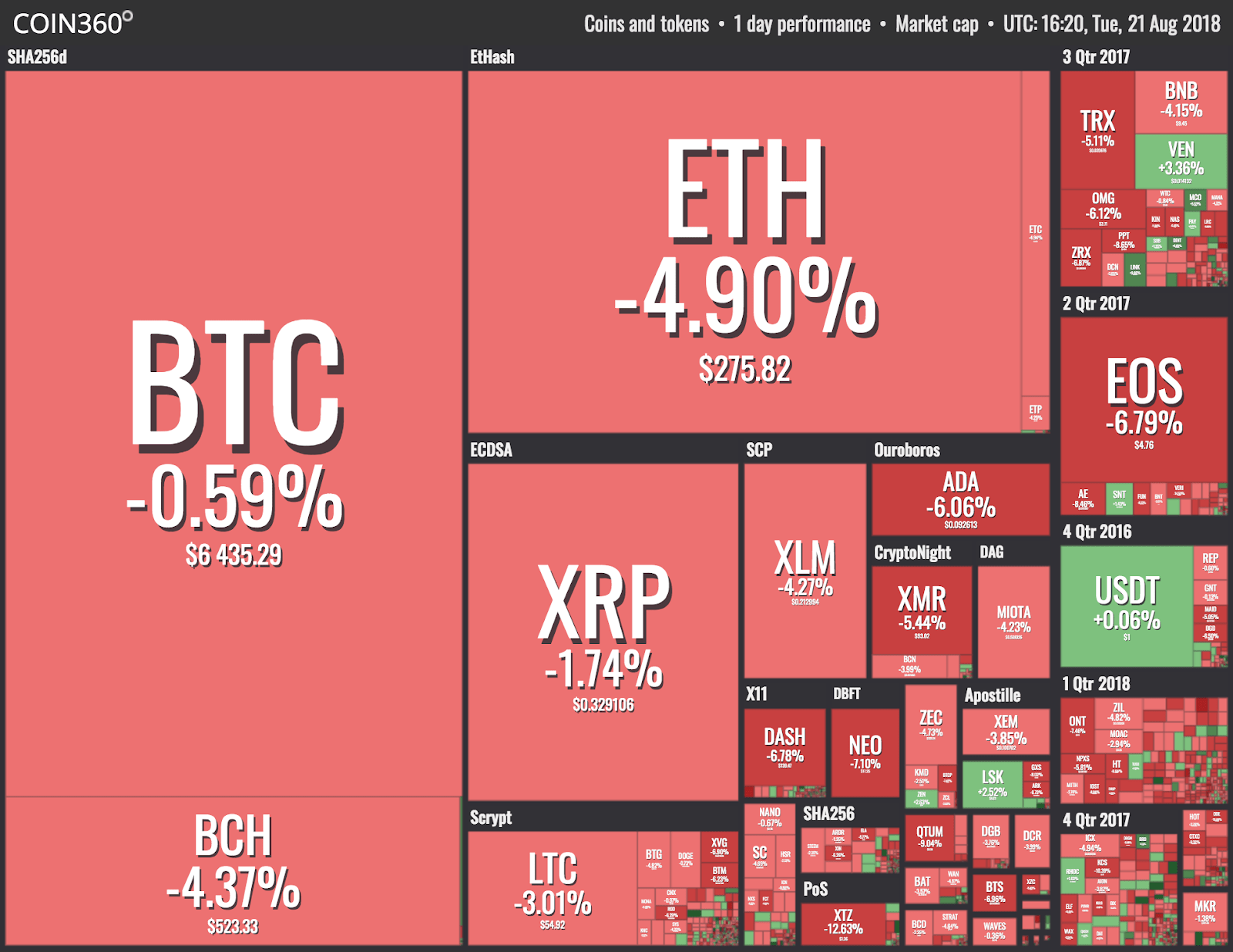
The crypto markets are somewhat bearish today, August 21, with virtually all of the top twenty coins by market cap seeing losses of 3-6 percent on average, as Coin360 data shows.

bitcoin (BTC) continues to show relative resilience – the top coin nonetheless continues to trade below the $6,500 price point. Despite a short-lived market recovery August 17, most of this week has seen distinctly lacklustre price performance across the board. The hangover from mid-August’s market crash continues.

Market visualization from coin360

Market visualization from Coin360

bitcoin (BTC) is seeing virtually no change over the past 24 hours at press time, trading at around $6,400, according to Cointelegraph’s bitcoin price index. Despite a brief plummet down to $6,260 yesterday at midnight, the coin has pushed back to trade within the $6,400-5000 range for most of today.
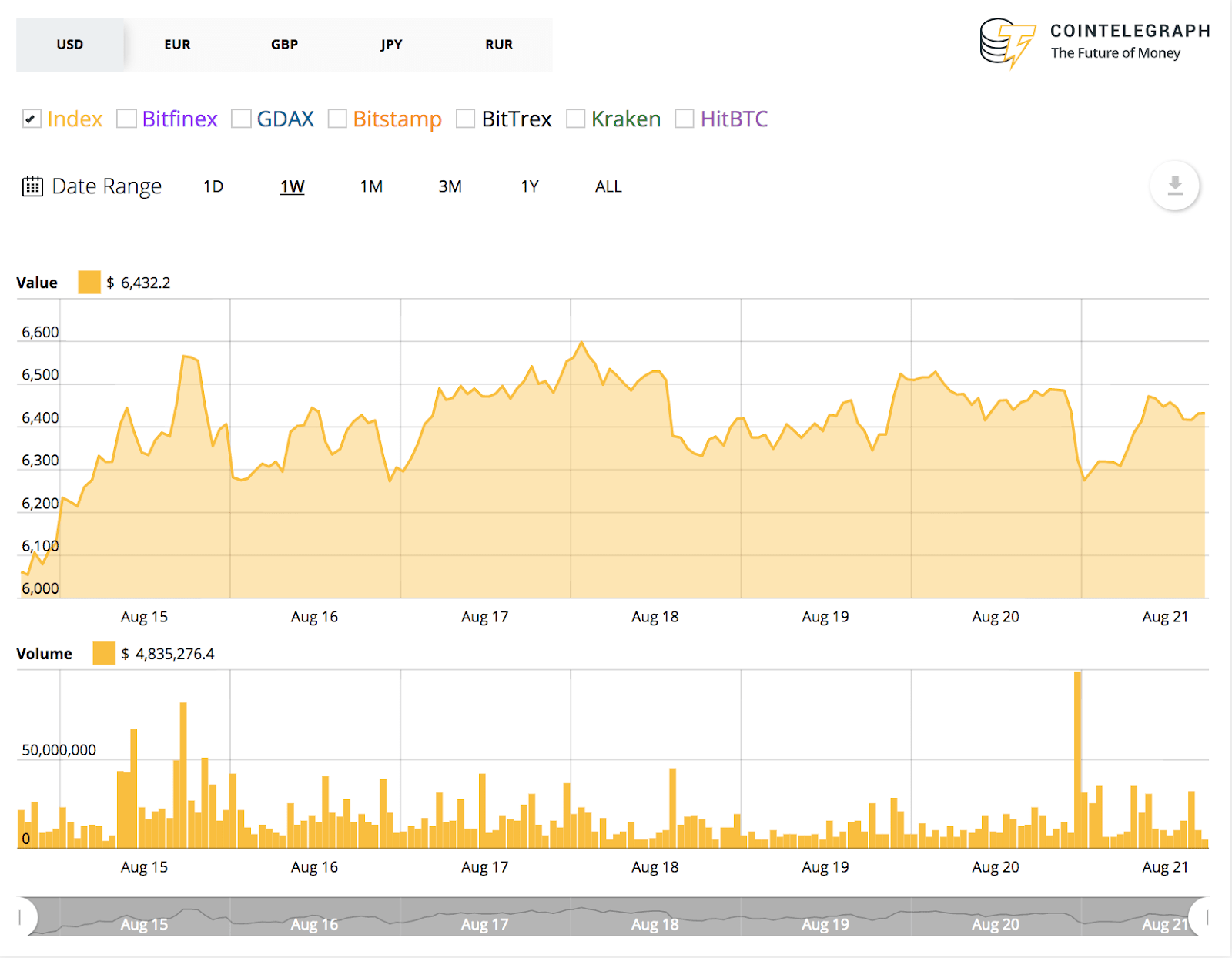
Bitcoin’s 7-day price chart

bitcoin’s 7-day price chart. Source: Cointelegraph Bitcoin Price Index

On its weekly chart, bitcoin has secured a 6.3 percent gain – the asset’s monthly losses remain at a stark 13.4 percent. Nonetheless, as eToro analyst Mati Greenspan suggested in a Tweet this week:

bitcoin has been in a steady range for the past 6 months. In this graph, we can see buyers stepping in above $5000 a coin. The 200-day moving average (blue) is providing resistance on the top. A stable price is necessary to maintain a store of value & we’re on the right track.”
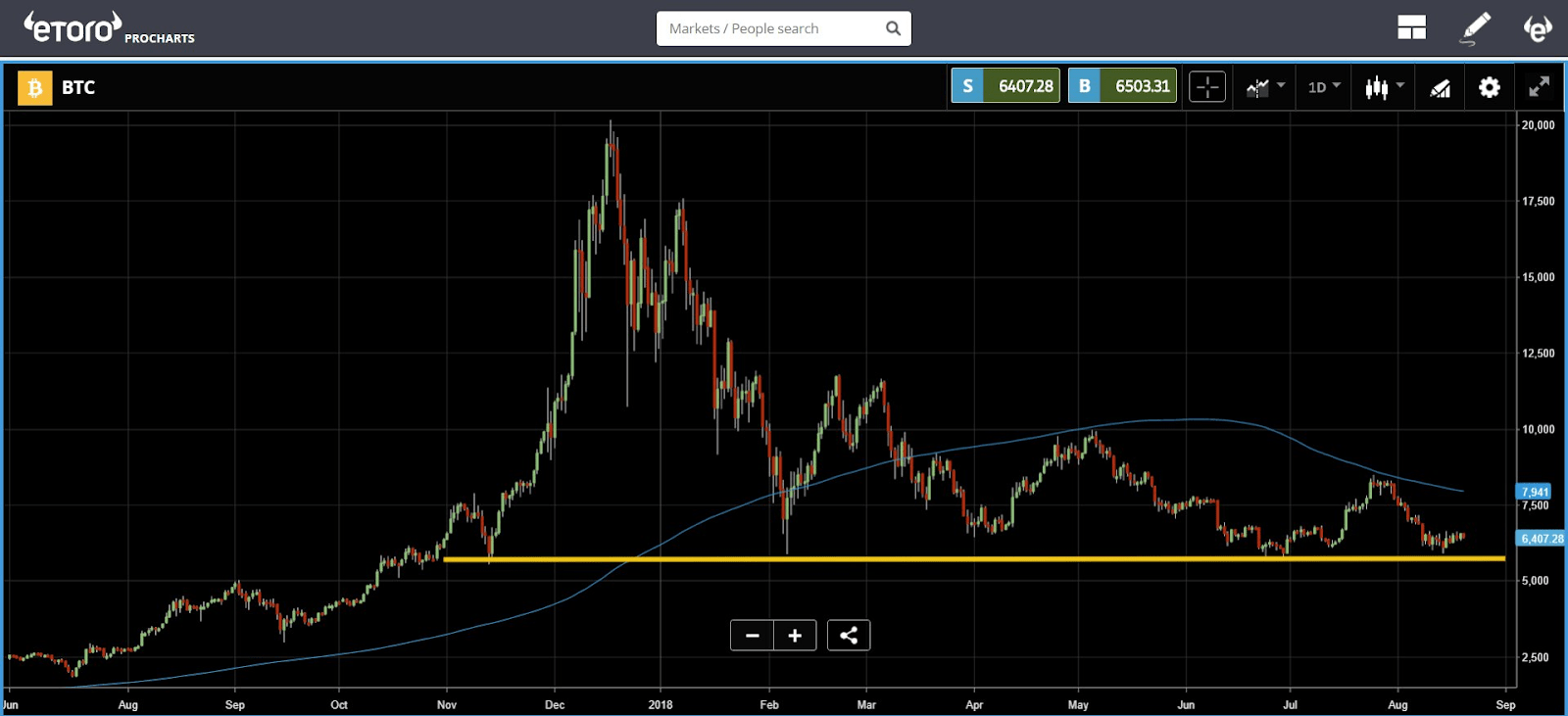
Mati greenspan’s technical analysis of bitcoin’s 6-month price chart

Mati Greenspan’s technical analysis of bitcoin’s 6-month price chart. Source: eToro

Ethereum (ETH) is trading around $277.5 at press time, down around 4 percent on the day. This is the second consecutive day the altcoin has traded well below the $300 mark.
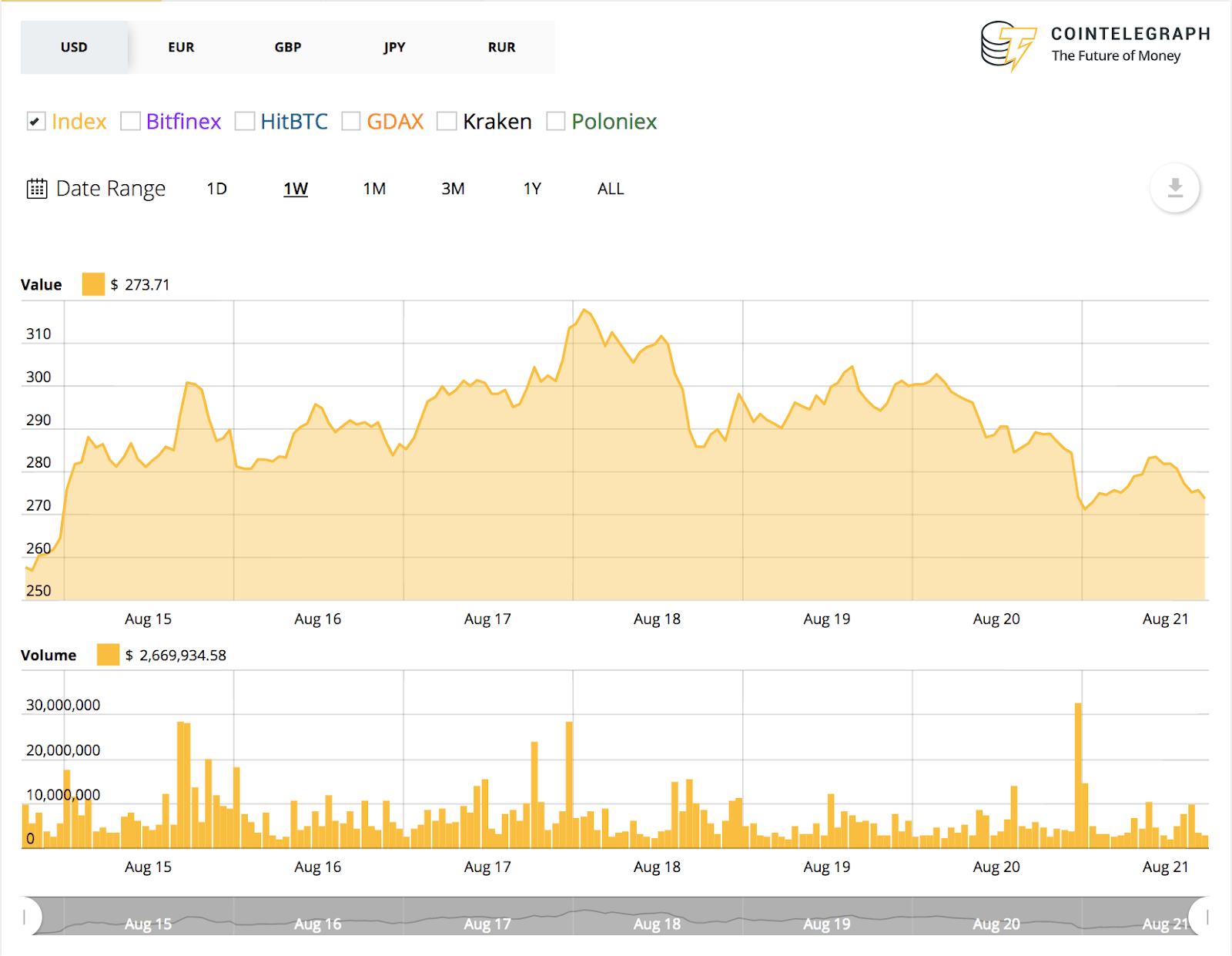
Ethereum’s 7-day price chart

Ethereum’s 7-day price chart. Source: Cointelegraph Ethereum Price Index

Ethereum is seeing an 8 percent gain on its weekly chart – this being relative to the altcoin’s price point below $260 August 14. On the month, however, Ethereum remains down by a staggering 40 percent.

Since plummeting below $300 August 13, Ethereum continues to trade at levels not seen since early November 2017.

Almost all of the other top twenty coins on CoinMarketCap’s listings are in the red, with the exception of VeChain (VET), ranked 19th, which is up 4 percent on the day.

EOS and IOTA (MIOTA), are down 5.5 and 4.3 percent to trade at $4.80 and $0.51 respectively at press time. Cardano (ADA) has seen a comparable dip, down 5.2 percent at $0.09.

bitcoin Cash (BCH), also decisively in the red, is down 3.4 percent and is trading around $528 at press time. Fresh analysis from blockchain intelligence firm Chainanalysis has indicated that BCH use in commerce is on the decline – dropping from $10.5 million in March to $3.7 million in May, which Chainalysis has attributed to “concentrated ownership” styming wider adoption of the asset.

Stellar (XLM), currently trading at $0.22, is faring considerably better than other cryptos, down a scant 0.2 percent and trading sideways most of the week:
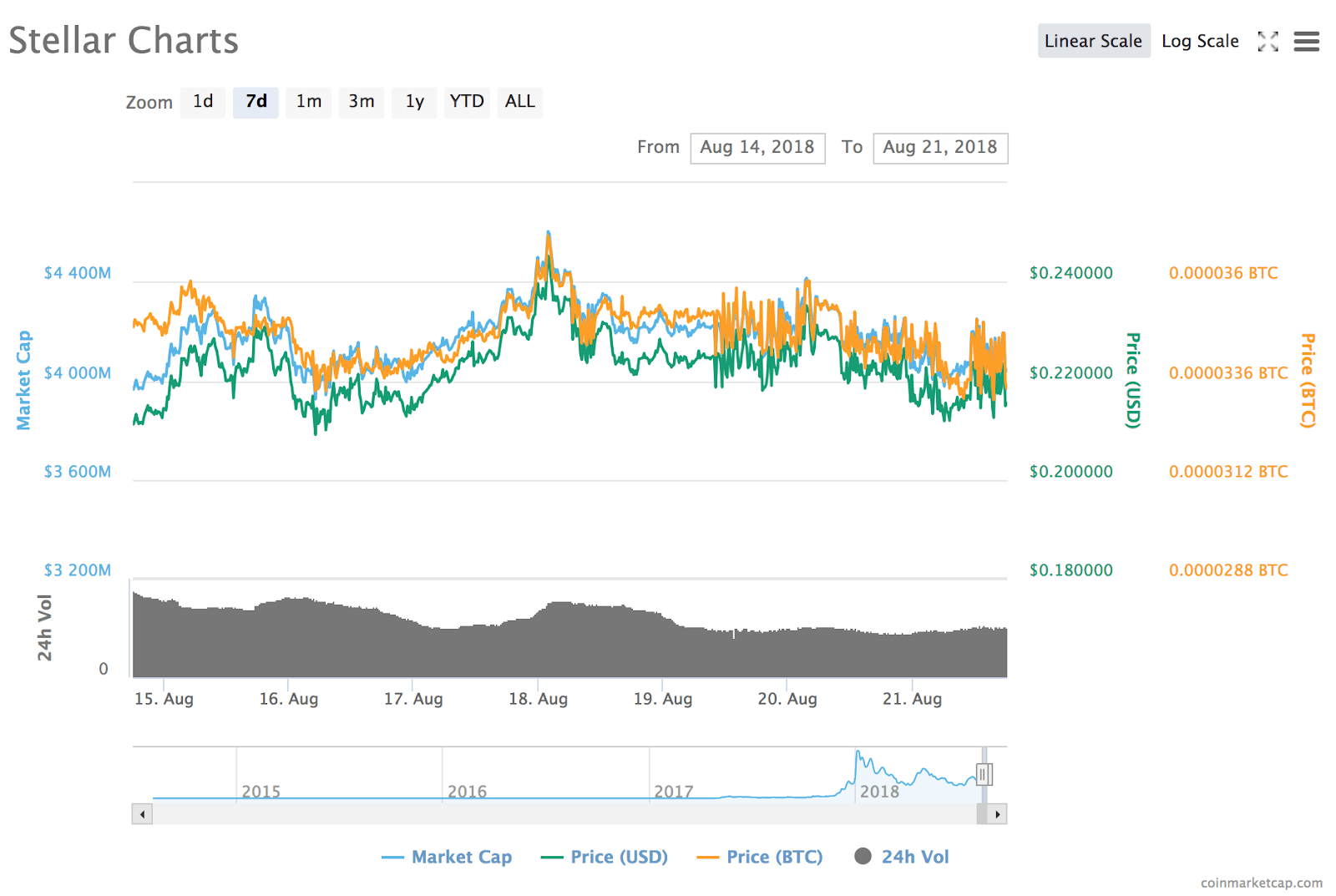
Stellar’s 7-day price chart

Stellar’s 7-day price chart. Source: CoinMarketCap

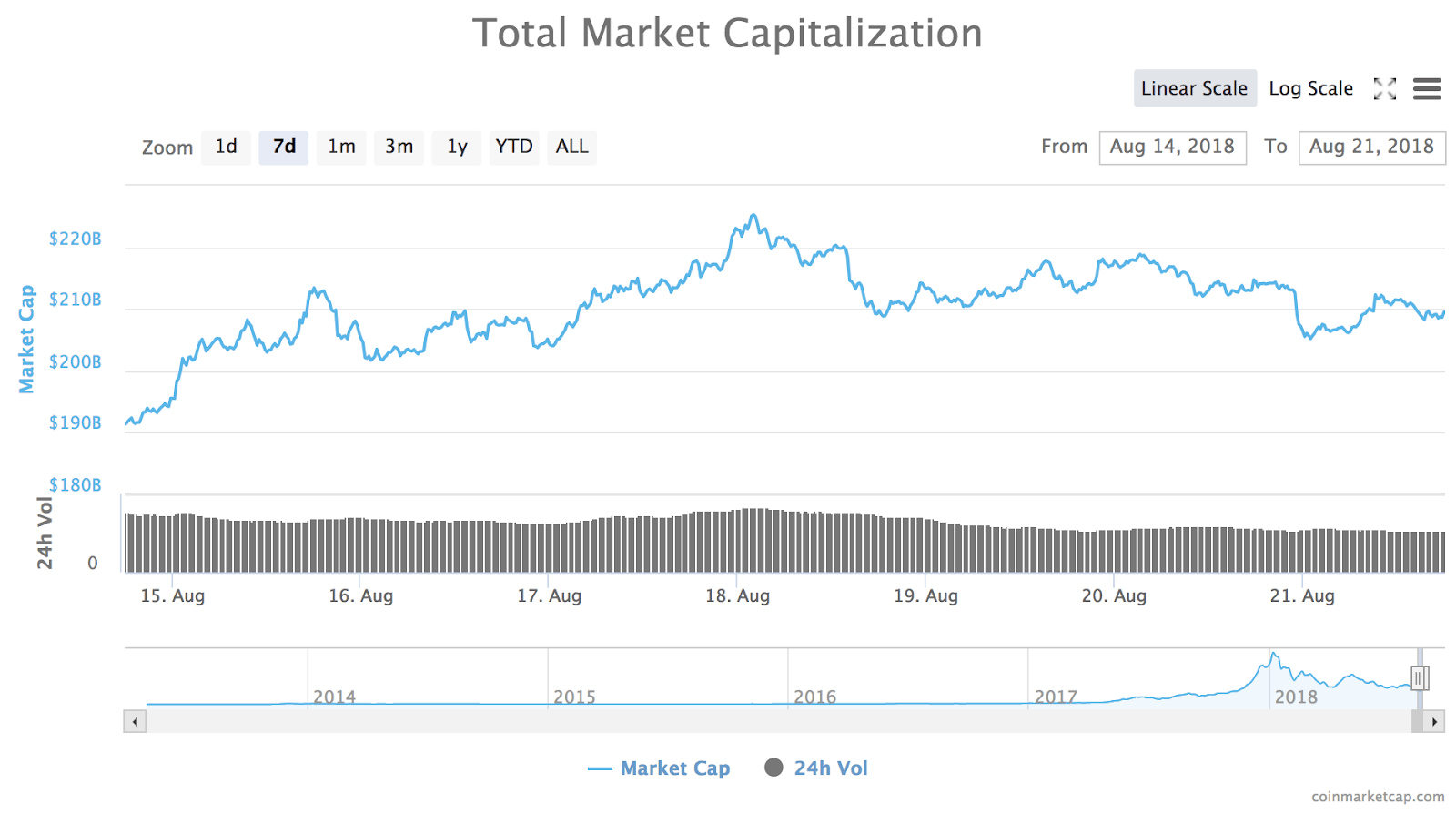
Total market capitalization of all cryptocurrencies is around $209.8 billion at press time, slightly up from an intraday low at $205.7 billion and comfortably above its squeeze to $191 billion a week ago:
7-day chart of the total market capitalization of all cryptocurrencies

7-day chart of the total market capitalization of all cryptocurrencies from CoinMarketCap

While the market continues to show strain, discussions are this week underway in South Korea to potentially reverse the country’s ban on initial coin offerings (ICOs). The parties involved are even reportedly keen to press ahead with the creation of South Korea’s own ‘Blockchain island’ that would vie with the blockchain-friendly trajectory adopted by Malta.

Meanwhile, fresh research has suggested that the volume of the global automotive blockchain market is set to reach $1.6 billion by 2026, based on a financial analysis of key market players including Ethereum (ETH), Ripple Labs Inc., IBM Corporation and R3.

Published at Tue, 21 Aug 2018 17:54:00 +0000

bitcoin

Previous Article

Enigma – The Rivers Of Belief

Next Article

Herb Alpert – Rise (HQ Audio)

You might be interested in …

March 11th - bitcoin market update

March 11th – Bitcoin Market Update

March 11th – bitcoin Market Update EN English (UK) EN English (IN) DE Deutsch FR Français ES Español IT Italiano PL Polski SV Svenska TR Türkçe RU Русский PT Português ID Bahasa Indonesia MS Bahasa […]

Cryptocurrency and Blockchain Tech Market Could Reach $10 Trillion in 15 Years, Says RBC Analyst

RBC

In a report published on January 3, 2018, Royal Bank of Canada (RBC) Capital Markets analyst Mitch Steves confidently stated that the cryptocurrencies and blockchain technology applications market could increase thirteenfold in 15 years, reaching $10 trillion.

Steves’ report, titled “Crypto Currency & Blockchain Technology: A Decentralized Future  A Potential Multi-Trillion Dollar Opportunity,” has been sent to RBC’s clients. A short summary has been shared on Twitter.

In a video published by CNBC, Steves, who often covers high technology stocks including Nvidia, whose value has been boosted by cryptocurrency mining, defends his bullish expectations on blockchain technology and its applications. According to Steves, cryptocurrencies represent only a part of the $10 trillion pie, the bulk of which is in the rest of the ecosystem existing around blockchain technology and cryptocurrencies.

“I think what people misunderstand about the cryptocurrency space is that it’s not only a store of value, but it also allows you to secure the internet,” says Steves. Blockchain-based cryptocurrencies will permit creating decentralized versions of value storage services like Dropbox or iCloud. The $10 trillion figure represents one third of the current size of the market for value storage.

Steves argues that blockchain technology will permit creating a “Secure World Computer,” a decentralized world computer without a third-party intermediary, intrinsically more secure because there won’t be centralized servers that can be hacked, and suggests that next-generation killer apps will be built on top of this secure layer.

The smart move for investors, according to Steves, is to get involved with cryptocurrencies directly. As far as traditional stocks are concerned, Steves mentions public companies like AMS and Nvidia, whose chips power cryptocurrency mining hardware, and the private companies that make ASIC chips for bitcoin mining. At the same time, Steves warns that cloud service providers are likely to be the most impacted from blockchain technology, with negative results if they don’t manage to adapt.

According to Steves, the value of the blockchain technology market is also growing due to international remittances — the sending of payments overseas is currently estimated at half a trillion dollars per year — “fat protocol” layers that increase in value as the applications grow, and throughput scaling efforts, such as the Lightning Network, which “appear on track to deliver scaling that accommodates higher transactions/second, ultimately driving higher utility and network value.”

While warning that the cryptocurrency space has many risks, Steves argues that the opportunity appears vast, with constant technology updates, and a multi-trillion dollar market will likely emerge.

In a recent, related article published by the RBC, Frédérique Carrier, managing director and head of investment strategy for RBC Wealth Management in the British Isles, argued that, while cryptocurrencies are unlikely to replace traditional money, blockchain technology could have wide-ranging implications in many industries and for investors in the medium-to-long term.

The potential of blockchain technology “makes it a technology well worth watching closely, which we intend to do,” notes Carrier, adding that RBC is experimenting with blockchain technology in its personal, commercial and capital markets businesses. RBC recently announced the implementation of a blockchain-based shadow ledger for cross-border payments between the U.S. and Canada.

The post Cryptocurrency and Blockchain Tech Market Could Reach $10 Trillion in 15 Years, Says RBC Analyst appeared first on Bitcoin Magazine.