April 14, 2026

Capitalizations Index – B ∞/21M

Almost All Top 100 Coins in Red, Bitcoin Holds Weekly Gains After Dipping Below $5,500

Almost all top 100 coins in red, bitcoin holds weekly gains after dipping below $5,500

Almost All Top 100 Coins in Red, Bitcoin Holds Weekly Gains After Dipping Below $5,500

Almost all top 100 coins in red, bitcoin holds weekly gains after dipping below $5,500

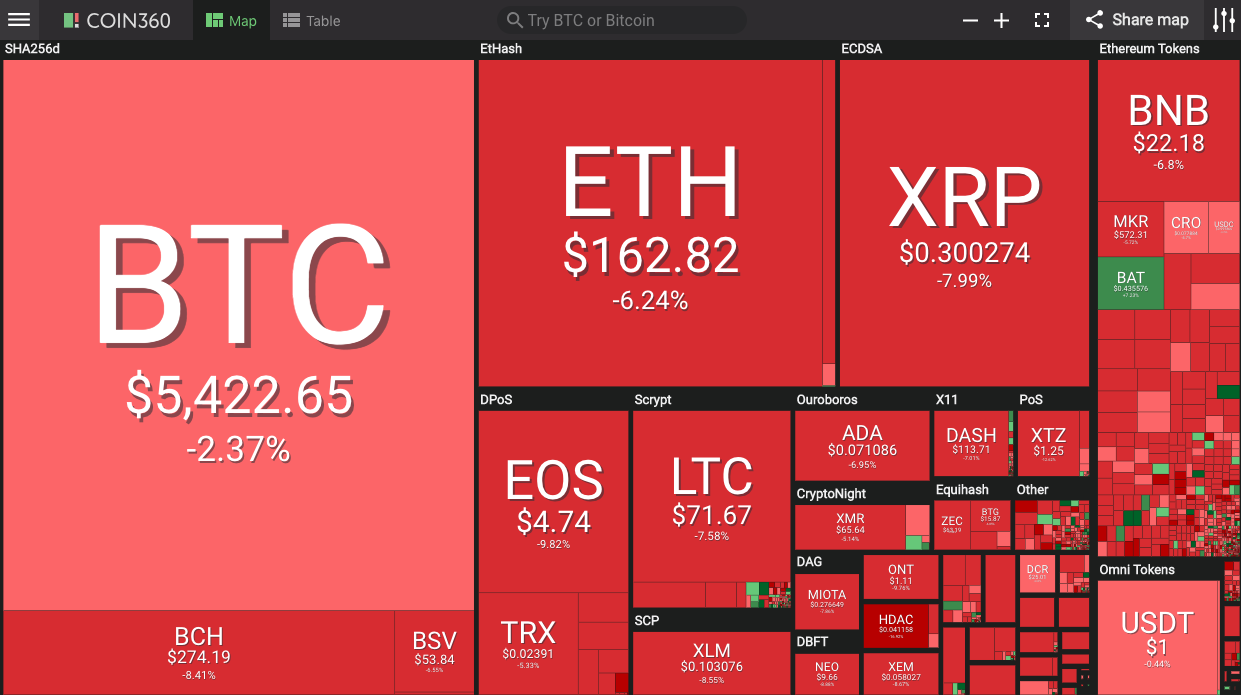
Wednesday, April 24 — after hitting new highs for 2019 yesterday, cryptocurrency markets have again reversed to red, with virtually all of the top 100 coins by market cap seeing major losses on the day, according to data from CoinMarketCap.

A former entrant of the top 20 coins by market capitalization, ontology (ONT) is seeing the biggest losses over the past 24 hours at press time among the top 30, down more than 11%. Basic attention token (BAT), which has recently overtaken ontology to enter the top 20, has surged 6%, also up around 30% over the past 7 days.

Market visualization from Coin360

After briefly reaching above the long-anticipated threshold of $5,600, bitcoin (BTC) has now retreated to below $5,500. The biggest cryptocurrency is down 1.9% over the past 24 hours at press time, trading at $5,490, and still up around 4.9% over the past 7 days. Bitcoin hit a new 2019 record at an intraday high of $5,641, while the intraday low amounted to $5,447, according to CoinMarketCap.

Bitcoin’s dominance on crypto markets has continued to surge, up from 53.5% in the beginning of the day to the current 54.7%, which is a new market share record for bitcoin since December 2018. Earlier on the day, bitcoin’s market cap has almost touched $100 billion for the first time since mid-November 2018.

Bitcoin 24-hour price and market cap chart. Source: CoinMarketCap

Ether (ETH), the second-top cryptocurrency by market cap, tumbled 5.5% to $164.9, also seeing a drop of around 0.9% over the past 7 days.

Ether 7-day price chart. Source: CoinMarketCap

XRP, the third-top cryptocurrency by market cap, is down 7.3% and trading at $0.301 at press time, also down 8.8% over the past 7 days.

XRP 7-day price chart. Source: CoinMarketCap

The total market capitalization amounts to $177 billion at press time, down from yesterday’s high of $185 billion. Meanwhile, the daily trade volume has risen significantly to around $55 billion from yesterday’s average of $49 billion.

Total market capitalization 7-day chart. Source: CoinMarketCap

Earlier today, South Korean electronics giant Samsung was reported to be developing an ETH-based blockchain along with its own cryptocurrency token, allegedly dubbed the Samsung Coin.

Yesterday, blockchain development firm Lightning Labs officially announced the release of the first alpha version of its Lightning Network (LN) client for the main bitcoin network.

Also yesterday, Cointelegraph reported that crypto payments processing startup Moon launched a web browser extension that allows e-commerce shoppers to use their LN bitcoin wallets for purchases on websites like Amazon.

While the crypto markets have slipped today, the United States stock market hit new highs over the day, while the Nasdaq (NASDAQ) Composite rose 0.2% to hit an intraday high. Yesterday, Cointelegraph reported that Nasdaq was allegedly testing trading of a bitcoin-based product. At press time, the Dow Jones Industrial Average (DJIA) and S&P 500 (SPX) are up 0.05% and 0.01%, respectively.

Oil prices reportedly hovered around six-months highs after the reportedly rising United States’ crude stockpiles countered fears of a tight supply resulting from OPEC output cuts and U.S. sanctions on Venezuela and Iran. Over 24 hours to press time, the OPEC basket is up around 1.3%, while West Texas Intermediate (WTI) crude oil and Brent crude tumbled to 0.8% and 0.4% respectively, according to Oilprice.com.

Meanwhile, gold prices rose from the previous session’s four-month low, as a U.S. dollar rally relented and equities softened today, CNBC reports. Spot gold is up about 0.4% to $1,277 per ounce at press time, while U.S. gold futures gained around 0.6% to 1,280 per ounce.

Published at Thu, 25 Apr 2019 05:27:31 +0000

Previous Article

Japan Has Crypto Regulation Handbook Ready for Members at Next G20 Summit

Next Article

Lightning Labs Launches Its Easy-to-Use Desktop App

You might be interested in …

Malaysia Remains Open to Crypto Trading

With the majority of Asian nations attempting to regulate cryptocurrency exchanges, the number of those declining to clamp down is dwindling. Malaysia is among those nations that are currently free from regulatory laws and are not imposing a ban on crypto.


According to the Malaysia Reserve, the country’s finance minister said that the central bank will not impose a blanket ban on cryptocurrencies as such action will only curb innovation and creativity in the financial sector, particularly fintech. In an interview with the news outlet, he stated:

The government is fully aware of the need to strike a balance between public interest and integrity of the financial system.

Public Protection

Similar to action in Thailand, Malaysia wants to inform and protect the public from making rash investments in the nascent crypto markets. The ministry said that the monetary authority is taking a cautious approach with digital currencies, including bitcoin, to ensure safety measures are in place to protect the interest of the public.

The statement went on to say:

It is not the intention of the authorities to ban or put a stop on any innovation that is perceived to be beneficial to the public. However, similar to any financial and investment schemes, there is a need to have proper regulation and supervision to ensure any risk associated with such schemes are effectively contained.

Malaysian Government to Introduce Regulatory Framework for Cryptocurrencies

No Regulation

Currently, Bank Negara Malaysia (BNM) does not regulate cryptocurrencies. However, it will ensure that exchanges comply with requirements to conduct customer due diligence and report suspicious transactions to the authorities. This is a similar stance to that taken in South Korea, where authorities have laid out plans to regulate how exchanges handle their clients to prevent money laundering and criminal activity.

The Malaysian finance ministry went on to state:

Financial innovation will not only enhance productivity of economic activities, but also make financial intermediation more seamless, it is imperative for the authorities to have a thorough understanding on digital currencies before embarking on any policy actions. This is particularly relevant to recent innovation like bitcoin, which remains unregulated globally and not battle-tested against shocks, unlike more conventional mediums of exchange.

With a global market capacity rapidly approaching $700 billion and the majority of crypto trading taking place in Asia, governments and central banks in the region need to get ahead of the game.

Will Asian nations continue to lead the way in the crypto markets? Add your comments below. 


Images courtesy of GoodFreePhotos, Pixabay, and Bitcoinist archives.

The post Malaysia Remains Open to Crypto Trading appeared first on Bitcoinist.com.