October 12, 2026

Capitalizations Index – B ∞/21M

Alibaba Doppelganger Surges 100% in Mindless Crypto Pump

Alibaba doppelganger surges 100% in mindless crypto pump

Alibaba Doppelganger Surges 100% in Mindless Crypto Pump

Alibaba doppelganger surges 100% in mindless crypto pump

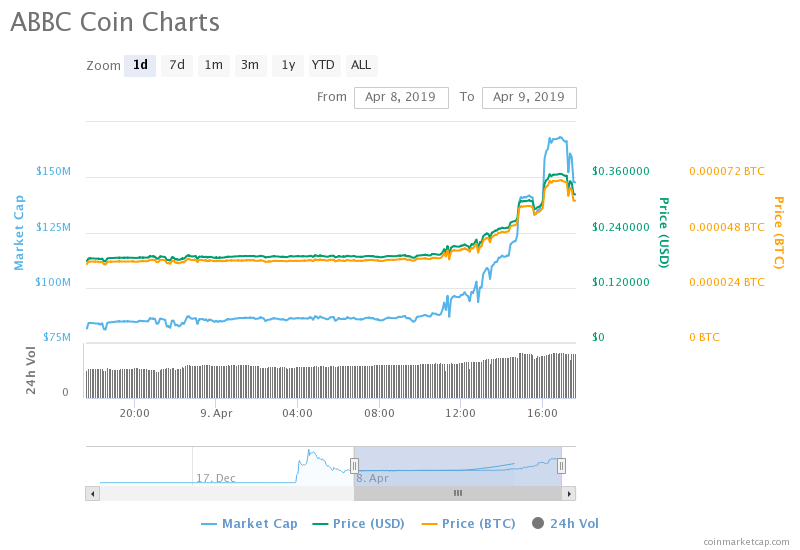
ABBC Coin  – the cryptocurrency formerly known as Alibabacoin – on Tuesday surged as much as 106.17-percent to reclaim its mid-March high.

The ABBC-to-dollar rate jumped as high as $0.367 ahead of the Asian session close. The pair later corrected lower by circa 14-percent towards a floorless area, indicating that the asset was overbought. As the US session matures, ABBC could see an extended selling correction, mostly because the market lacks fundamentals to support the uptrend any further.

ABBC COIN RISES OVER 100% AGAINST US DOLLAR | SOURCE: COINMARKETCAP.COM

On the whole, the ABBC rally attracted just $46 million worth of daily volume, even though the cryptocurrency’s market cap leaped by more than $60 million. It is difficult to understand how the total daily volume, which generally includes both the buying and the selling trades, came in below the entire ABBC market cap surge at the same time.

The largest slice of ABBC’s trading activity took place against bitcoin on crypto exchange TOPBTC (about 16.50-percent of the total volume). The supposedly Australia-based cryptocurrency exchange does not hold a stellar reputation among customers, mostly for allegedly offering a poor fund withdrawal system and slow customer support. ForexBrokerz reviewed:

“They are not a member of ADCA, the local organization of companies in the space. Their trading software appears decent, but the support for very alternative and for a lack of a better word ‘dead’ coins is troubling. That being said, the countless claims this exchange is actually a scam are the most troubling factor.”

This Crypto Rally Lacks Fundamentals

The only major event preceding the ABBC rally was related to Alibaba. The Chinese e-commerce giant reportedly agreed to settle a trademark dispute with the ABBC Coin Foundation, though that occurred almost a month ago and saw ABBC agree to stop trading on the Alibaba brand.

On the whole, the latest ABBC boom does not seem to have any legs to stand on. It makes the surge rather dubious, one crypto investors should think twice about before gambling their hard-earned funds.

Published at Tue, 09 Apr 2019 17:47:53 +0000
Previous Article

China Scare, Bitcoin (BTC) Mining Ban? Bulls to Overcome

Next Article

Bitfinex Drops Minimum Balance to Trade on Crypto Exchange

You might be interested in …

Don't trust bitcoin

Don't trust bitcoin

Don't trust bitcoin EN English (UK) EN English (IN) DE Deutsch FR Français ES Español IT Italiano PL Polski SV Svenska TR Türkçe RU Русский PT Português ID Bahasa Indonesia MS Bahasa Melayu TH ภาษาไทย […]

Who Created Ethereum?

Who Created Ethereum?

While working on a number of bitcoin projects, a 19-year-old programmer from Toronto, Vitalik Buterin, conceived the idea for Ethereum. Ethereum was intended to be a robust platform that allows developers to build blockchain applications. Buterin was inspired by some of the shortcomings he faced when trying to build applications on the bitcoin blockchain. He believed that the potential of blockchain technology was not limited to financial applications and quickly set out to create a blockchain that could support more common computations.

Vitalik Buterin was first introduced to bitcoin and cryptocurrencies in 2011. That same year he co-founded Bitcoin Magazine and wrote many articles explaining his views on the digital currency’s future. He later worked on Mastercoin and some alternate coins based on the bitcoin codebase. This work led him to believe the bitcoin blockchain was limited in scope.

The Ethereum white paper was released in 2013, and it documented a new open-source protocol for creating decentralized applications.   

Ethereum was officially announced on the Bitcointalk forum in 2014. In addition to Buterin, Ethereum was co-founded by Mihai Alisie, Anthony Di Iorio and Charles Hoskinson. Buterin also announced that he was working with developer Dr. Gavin Wood and Joseph Lubin. Wood soon released the Ethereum yellow paper, which covered the Ethereum Virtual Machine (EVM), the runtime environment that executes all of the smart contracts on the network. Lubin would go on to found ConsenSys, a venture studio focusing on decentralized applications.

The Ethereum Foundation held an ether crowdsale in July 2014 during which they sold 60 million tokens. 12 million ether (ETH) tokens were created so the Ethereum Foundation could expand its development and marketing efforts. The Frontier was the first release of the Ethereum network. It was released a year after the crowdsale and provided a bare-bones mechanism for developers to interact with and build apps on the network.  

Both the Ethereum network and community have grown substantially over the last year. The Ethereum Enterprise Alliance, an initiative working to connect the world’s largest companies to the Ethereum network, recently announced 86 new partners including Microsoft, Intel and BP. Similarly, a multitude of new blockchain projects leveraging the Ethereum blockchain have gained attention and capital.

Ethereum broke into the mainstream in early 2017 when the price of ETH increased by 1000 percent over the course of a couple months. This led to a similar rise in the price of alternative blockchain tokens, dubbed “altcoins.” A slew of new investors quickly entered the space as Ethereum was covered by large media outlets including CNBC, Reuters and Quartz. Investors and developers are awaiting the release of Metropolis, the next update to the Ethereum network promising to abstract a lot of functions and pave the way for user-friendly application designs.

The post Who Created Ethereum? appeared first on Bitcoin Magazine.