August 3, 2026

Capitalizations Index – B ∞/21M

Airdrop Mishap Causes Korean Exchange to Accidentally Send BTC to Customers

Airdrop mishap causes korean exchange to accidentally send btc to customers

Airdrop Mishap Causes Korean Exchange to Accidentally Send BTC to Customers

Airdrop mishap causes korean exchange to accidentally send btc to customers

Exchanges

A South Korean crypto exchange mistakenly sent its customers BTC and other cryptocurrencies due to an error during an airdrop. Some users immediately sold the coins, causing the prices of a number of cryptocurrencies on the exchange to sharply fall. The exchange said, however, that the majority of customers have agreed to return the assets.

Also read: Indian Supreme Court Moves Crypto Hearing, Community Calls for Positive Regulations

Airdrop Error

Airdrop mishap causes korean exchange to accidentally send btc to customersSouth Korean cryptocurrency exchange Coinzest reportedly sent its customers BTC and other cryptocurrencies while trying to airdrop WGT tokens. The exchange posted a notice on its website that at approximately 18:30 p.m. Korean time on Jan. 18:

The WGT token airdrop process caused a computer error that incorrectly reflected the deposit details of some customers’ assets … we took measures to immediately check the server to prevent any additional damage as a result of the sales and purchases of some misappropriated assets by some customers.

The exchange’s computer program “allocated a particular cryptocurrency to the event,” Sedaily explained on Monday, noting that “Coinzest originally tried to airdrop 30,000 WGT coins, but accidentally entered data to airdrop other coins.”

Airdrop mishap causes korean exchange to accidentally send btc to customers

An official of the exchange said that about 400 members were supposed to receive WGT tokens, Hankyung publication reported, adding that other cryptocurrencies such as BTC and ETH were sent to members’ wallets. The news outlet elaborated that “about 10 members tried to sell about KRW 600 million worth [~$530,000] of cryptocurrencies or to withdraw money in Korean won even though they recognized the mistake of depositing money and computer errors. [Therefore] there has been a problem of rapid price decline.”

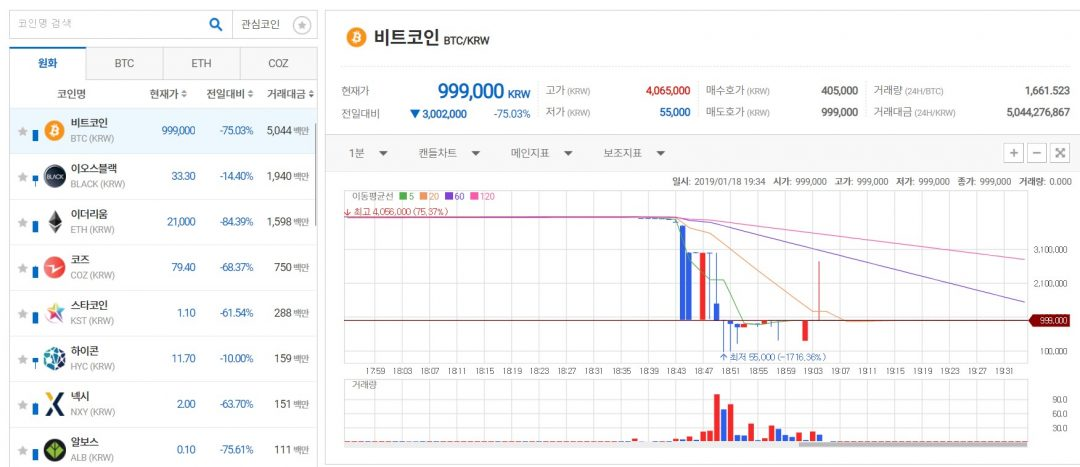
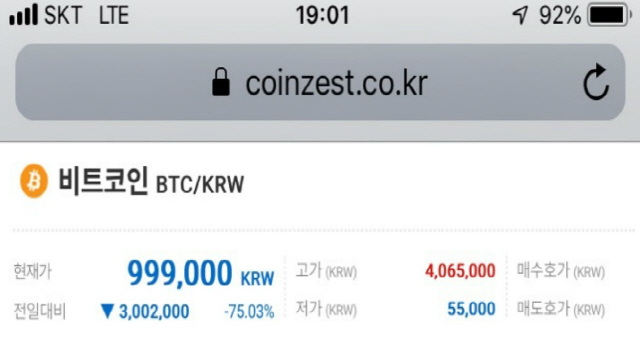
The price of BTC and a number of other cryptocurrencies on Coinzest subsequently plummeted at about 7 p.m. Korean time on Jan. 18, with BTC’s price falling to 999,000 won (~$883) from over 4 million won.
Airdrop mishap causes korean exchange to accidentally send btc to customers
Prices of cryptocurrencies on Coinzest at about 6 p.m. Korean time on Jan. 18. Image credit: Blockinpress/Coinpan.
Airdrop mishap causes korean exchange to accidentally send btc to customers
Image credit: sedaily

Asking Customers to Return Assets

After detecting the problem, Coinzest immediately halted trading and performed a server checkup, according to a notice on its website. It then resumed trading the next day. “The asset and transaction information was restored to 18:33:18 on the 18th, the last time a normal transaction occurred before the computer error occurred,” the exchange clarified. Hankyung detailed:

Coinzest immediately contacted the customers and asked them to return their assets. The majority of the members promised to return [them].

Coinzest CEO Jeon Jong-hee was quoted by the publication as saying, “I am extremely sorry that I have caused an unexpected computational error to customers … I am very sorry for my customers.” He added that his exchange’s emergency response system will be strengthened to prevent the problem from recurring.

Airdrop mishap causes korean exchange to accidentally send btc to customers

An official of another cryptocurrency exchange commented that the fact that a staff’s mistake can lead to this error means “there is always a possibility of tampering with the exchange system,” Sedaily reported. He further asserted that the government will not be able to trust exchanges to manage transaction records.

In April last year, another South Korean crypto exchange, Cashierest, suffered an internal system error that allowed its users to withdraw more coins than they requested.

What do you think of Coinzest’s airdrop error? Let us know in the comments section below.


Images courtesy of Shutterstock, Coinzest, Blockinpress, and Coinpan.


Need to calculate your bitcoin [BTC] holdings? Check our tools section.

Published at Tue, 22 Jan 2019 09:50:32 +0000

Previous Article

Bitcoin's journey to either $3600,1D SMA50 or channel resistance

Next Article

Binance’s Changpeng Zhao: BTC [BTC]’s price had definitely overshot in 2017

You might be interested in …

Bitcoin News 9 January 2017

bitcoin News 9 January 2017 bitcoin News Today – The weekend saw the price moving around the $850 to $920 mark… seems to be starting to consolidate after the drop in price post the news […]

BIP91: The SegWit Activation "Kludge" That Should Keep Bitcoin Whole

BIP91: The SegWit Activation "Kludge" That Should Keep Bitcoin Whole

bitcoin’s long-lasting scaling debate appeared to be heading toward a climax lately, with two proposals gaining significant traction. At one end of the fence there is Bitcoin Improvement Proposal 148 (BIP148), a user activated soft fork (UASF) originally proposed by the pseudonymous developer “shaolinfry.” On the other, there’s SegWit2x, an agreement forged between a significant number of bitcoin companies and miners.

The good news is that both of these proposals have a short-term solution in common: both plan to activate Segregated Witness (SegWit) this summer. The bad news is that the activation method of the two has differed, which could lead to a coin-split.

As of today, it seems this schism will be avoided — at least initially. The SegWit2x development team plans to implement BIP91, a proposal by Bitmain Warranty engineer James Hilliard that cleverly makes the two conflicting activation methods compatible.

Here’s how.

BIP141

The current implementation of Segregated Witness is defined by BIP141. This version is included in the latest Bitcoin Core releases, and is widely deployed on the bitcoin network. BIP141 is activated through the activation method defined by BIP9. This means that 95 percent of all blocks within a two-week period need to include a piece of data: “bit 1.” This indicates that a miner is ready for the upgrade. As such, SegWit would be activated if the vast majority of miners are ready for it.

Or that was the intention. So far, only some 30 percent of hash power is signaling support for the upgrade. There is a lot of speculation as to why this is the case, but it almost certainly has nothing to do with (a lack of) readiness.

That’s why other activation methods are increasingly being considered.

BIP148

BIP148 is a user activated soft fork (UASF), specifically designed to trigger BIP141.

On August 1st, anyone running bitcoin software that implemented BIP148 will start rejecting all blocks that do not include bit 1, the SegWit signalling data.

This means that if a mere majority of miners (by hash power) runs this software, they will reject all blocks from the minority of miners that does not. As a result, this majority of miners will always have the longest valid chain according to all bitcoin nodes on the network. Consequently, all deployed BIP141 nodes will see a chain that includes over 95 percent of bit 1 blocks, meaning SegWit would be activated on the network.

However, if BIP148 is not supported by a majority of miners (by hash power), bitcoin’s blockchain could split in two. In that case, there would effectively be two types of bitcoin, where one activated BIP148 and the other did not. This may resolve over time — or it may not.

SegWit2x

SegWit2x (also referred to as “SegWit2MB” or “the Silbert Accord”), is the scaling agreement reached by a numer of bitcoin companies and over 80 percent of miners (by hash power), drafted just before the Consensus 2017 conference.

For some time, the details surrounding SegWit2x were not very specific. As the name suggests, all that was really known was that SegWit was included in the agreement, and that it included a hard fork to double bitcoin’s “base block size” to two megabytes.

And, of course, SegWit was meant to be implemented using a different activation method. Like the original BIP141 proposal, SegWit2x was to be activated by miners through hash power. But where BIP141 requires 95 percent hash power support, SegWit2x would only require 80 percent. Moreover, SegWit2x readiness would be signaled using another piece of activation data: “bit 4” instead of “bit 1.”

This makes SegWit2x largely incompatible with BIP141, and especially with BIP148: Different nodes would be looking at different activation bits, meaning they could activate SegWit under different circumstances and at different times; and that would mess up SegWit-specific block relay policy between nodes, potentially fracturing the network.

BIP91

Now, it seems BIP91 has provided the solution.

BIP91 is a proposal by Bitmain Warranty (not to be confused with Bitmain) engineer James Hilliard which was specifically designed to prevent a coin-split by making SegWit2x and BIP148 compatible.

The proposal resembles BIP148 to some extent. Upon activation of BIP91, all BIP91 nodes will reject any blocks that do not signal support for SegWit through bit 1. As such, if a majority of miners (by hash power) run BIP91, the longest valid bitcoin chain will consist of SegWit-signaling blocks only, and all regular BIP141 SegWit nodes will activate the protocol upgrade.

Where BIP91 differs from BIP148 is that it doesn’t have a set activation date, but is instead triggered by hash power. BIP91 nodes will reject any non-SegWit signalling blocks if, and only if, 80 percent of blocks first indicate within two days that’s what they’ll do.

This indication is done with bit 4. As such, the Silbert Accord can technically be upheld — 80 percent hash power activation with bit 4 — while at the same time activating the existing SegWit proposal. And if this is done before August 1st, it’s also compatible with BIP148, since BIP148 nodes would reject non-bit 1 blocks just the same.

This proposal gives miners a little over six weeks to avoid a coin-split, under their own agreed-upon terms. With a SegWit2x launch date planned for July 21st, that should not be a problem… assuming that the miners actually follow through.

The post BIP91: The SegWit Activation "Kludge" That Should Keep Bitcoin Whole appeared first on Bitcoin Magazine.