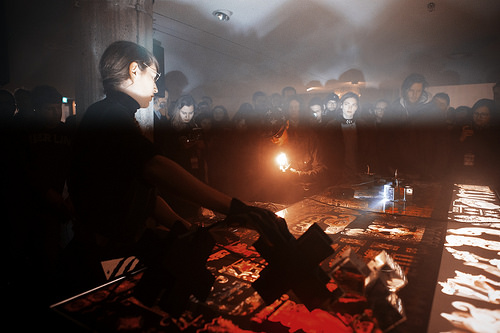
afterglow Festival Opening 2014 Photo: Elena Vasilkova / transmediale
MSHR Performance
transmediale 2014 afterglow opened its doors on January 29, 2014, at Haus der Kulturen der Welt. The official Opening Ceremony was celebrated in the company of special guests and speakers, among them cypherpunk writer and critic Bruce Sterling. During the evening, the works produced by the hackers-artists of Art Hack Day Berlin : Afterglow opened to the public in a special exhibition opening. Accompanying the Opening Ceremony and exhibition opening were the interactive big-data producing installation by CRITICAL INFRASTRUCTURE (Jamie Allen & David Gauthier), installation and performance by MSHR as well as screenings of works by Borja Rodríguez Alonso, Pavel Ziemilski and Luther Price. Furthermore, Geraldine Juárez performed "Hello bitcoin," an action of literal cryptocurrency burning.
By transmediale on 2014-01-29 21:58:54 [wpr5_ebay kw=”bitcoin” num=”1″ ebcat=”” cid=”5338043562″ lang=”en-US” country=”0″ sort=”bestmatch”]

Support the show, consider donating:BTC: 17foNL7cdvPXPyiazDGuKfrjjdJQjwUTv1 ()ETH: 0x8cdb49ca5103Ce06717C4daBBFD4857183f50935 ()
For decades, science and academia have leveraged distributed computing to solve massive computational problems. Distributed grid computing schemes allow donors to volunteer their desktop computer’s idle resources toward scientific projects in physics, biology, and chemistry, where large amounts of parallel computing resources are necessary. Relying on software like BONIC, these networks provide features such as built-in fault tolerance and result verification. And with the proliferation of mobile and IoT, the potential for massively distributed grid networks has never been greater.
Gilles Fedak, a researcher at the French computer science research body Inria, joins us to discuss a new project which aims to build a high-performance distributed cloud infrastructure marketplace. Relying on mature grid computing technologies, iExec utilizes Ethreum to organize a peer-to-peer marketplace of computing resources, allowing anyone to rent their idle resources to grid networks. If it succeeds to execute on its vision, this game-changing project could revolutionize distributed computing through cost reduction and the commoditization of resources.
Topics discussed in this episode:
Gilles’ background as a distributed computing researcher
Distributed computing and it’s applications in science and industry
The problems we see in distributed computing networks
The iExec project and its vision for a distributed computing resource marketplace
How iExec works as an Ethereum smart contract
The different components and participants of iExec
The iExec token and upcoming crowds ale
The project’s business model and roadmap
Links mentioned in this episode:
Sponsors:
Jaxx: Wallets that Unify the Blockchain Experience Across Devices –
Ledger: Smart card security for your Bitcoins – Get 10% off your first order when you use the code EPICENTER –
This episode is also available on :
Watch or listen, Epicenter is available wherever you get your podcasts.
Epicenter is hosted by Brian Fabian Crain, S?ƒbastien Couture & Meher Roy.
Crypto Mom Chides SEC Over Failure to Keep up With Cryptocurrency Innovation Commissioner Hester Peirce of the United States Securities and Exchange Commission (SEC) believes the Commission could do better in keeping in touch with […]
Camiseta de Basquiat en bitcoin DETALLES DEL PRODUCTO – Color blanco/negro – 100% algodón – 150 g/m² – Manga ensamblada – Punto fino para un mejor mantenimiento de la forma – Parte trasera lisa TALLAS […]