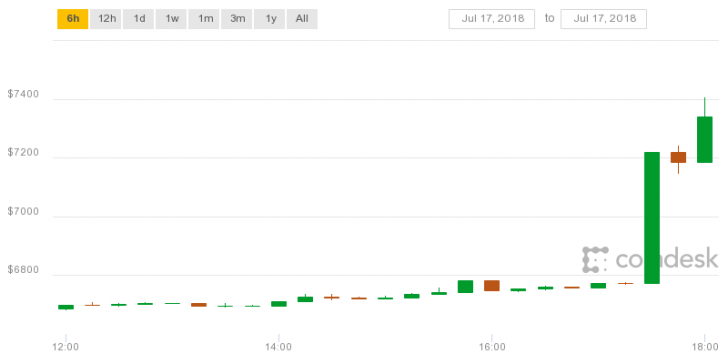
Above $7K: Bitcoin's Price Shot Up $600 in 30 Minutes
bitcoin’s price shot well above $7,000 Tuesday in a dramatic move that took the cryptocurrency to a level it hasn’t seen in more than a month.
As of press time, the world’s most valuable cryptocurrency by market capitalization was trading at $7,368.22, up more than $600 from the day’s open at $6,726.40. Indeed, the market moved quickly, posting the gains over the course of 45 minutes.
CoinDesk’s bitcoin Price Index () registered a market high of $7,408.28 amidst the sudden spike upward. The last time the price was this high was on June 10, BPI figures reveal.
At press time, bitcoin is the biggest gainer among the top 10 cryptocurrencies by market capitalization and is reporting a 16.19 percent week-to-week price increase, according to price tracking site .
Other major cryptocurrencies are following suit – a usual occurrence when bitcoin prices surge. Names like XRP, EOS, and litecoin (LTC) are all printing gains above 6 percent.
Per , the total market capitalization for the cryptocurrency market hit roughly $287 billion in light of the market uptick.
The leader in blockchain news, CoinDesk is a media outlet that strives for the highest journalistic standards and abides by a . CoinDesk is an independent operating subsidiary of Digital Currency Group, which invests in cryptocurrencies and blockchain startups.
BTCMANAGER Crypto Funds Are Still on the Rise Despite Bear Market A new report has found that 20 percent of hedge funds launched in 2018 have been geared toward investing in digital currencies and tokens. […]
Greek graduates may soon be able to prove their qualifications by way of a blockchain.
GRNET, the national research and education network of Greece, is working on a pilot project with blockchain research and development company IOHK to verify student diplomas on Cardano, a blockchain that.
The project is notable because it is the first official use case of Cardano, a cryptocurrency and soon-to-be smart contract platform currently under development by IOHK.
The GRNET app will be built on Enterprise Cardano, a private or permissioned ledger version of Cardano. Unlike a public blockchain, where anyone can join in and participate, a private blockchain allows only a restricted set of users to validate block transactions.
So far, three Greek universities are participating in the project. While IOHK is providing the decentralized database, GRNET is providing the web front end and support and will bring together other universities participating beyond the pilot.
Funding for the project comes in part from , a European program for research and innovation. Development of the prototype is already under way, Aggelos Kiayias, IOHK’s chief scientist, told bitcoin Magazine.
Why Diplomas?
Given IOHK’s deep ties with academia, it is no surprise to find the company working on a project that involves universities. But why diplomas?
Putting diplomas on a blockchain takes the paperwork out of the process and makes it easy and simple to check if someone holds a degree.
Typically, when a student graduates, they receive a paper copy of a diploma signed by the dean and co-signed the university’s registrar. All of the students’ transcripts and records are stored in the university’s centralized database.
To confirm that a graduate has the degree they claim to have, an employer has to check the official diploma or call the university. The labor-intensive process makes it too easy for unqualified applicants to slip under the radar.
Putting documents and records on the blockchain eliminates opportunity for fraud in that it allows graduates and universities to “issue a proof that a qualification exists that is undeniable,” said Kiayias. “This is a point of reference that can be agreed [on] by everyone.”
Cryptographic Proof
But to protect student privacy, instead of putting an entire diploma on the blockchain, GRNET plans to put only a cryptographic hash of a diploma on the blockchain.
Digital documents are easy to alter in ways that are undetectable to the human eye. But as long as the digital version shown to an employer hashes to the same output as what is stored on the blockchain, that proves the document is the original, unaltered version.
“We cannot put any plaintext on the blockchain, as diplomas and transcripts are personal information. We only put hashes; we may put entire diplomas and transcripts, but they will always be encrypted,” Panos Louridas, GRNET consultant and associate professor at Athens University of Economics and Business, explained to bitcoin Magazine in an email.
This is not the first effort to store diplomas on the blockchain. In October, to verify digital diplomas using the blockchain.
But Louridas claims the GRNET pilot is different from prior projects in that it stores the entire chain of verification steps on the blockchain. Each step would be recorded as its own immutable transaction on a separate block in the blockchain.
“You don’t really need a blockchain to store diplomas: a simple system with some digital signatures by the host institution would do,” he said. “We want to be able to record that somebody has asked for proof of a degree, that the proof has been granted, that the proof has been forwarded to a verifier, and that the verifier can verify that the degree is valid, and nobody can dispute any of the above steps.”
The three Greek universities taking part in the pilot include, and.
¡¡PesetaCoin la Criptomoneda Española Mejoras y Avances!! La PesetaCoin es un proyecto que busca incentivar la Criptoeconomia en España. El avance mas importante para cualquier criptomoneda es que pueda ser adoptada por comercios y personas […]