January 23, 2026

Capitalizations Index – B ∞/21M

A Brief Guide on how to Create Lightning Network Invoices

A brief guide on how to create lightning network invoices

A Brief Guide on how to Create Lightning Network Invoices

Lightning network capacity increases by 10 btc in two days, total now at 50 btc

In this article, BTCManager will go through the information contained in a Lightning Network invoice and do a quick recap of how to create an invoice using bitcoin’s Lightning Network.

Lightning Network Invoices

Being able to create invoices on the Lightning Network is a novelty that was only recently made possible, but should prove to be a relatively useful innovation. According to BlockFuse, the importance of invoices is that they are capable of streamlining and facilitating payments and as such, it is a much-awaited feature that is finally operational.

The sole purpose of invoices on the Lightning Network is mainly to facilitate payments. An invoice will generally contain the required information to allow for transactions between two parties. Once a Lightning Network invoice is created it is stored on a node which is responsible for managing and storing a Lightning Network invoice database.  

The Lightning Network is a second layer payment protocol that works on top of the bitcoin, Litecoin and Monero blockchains and was created to deal with the scalability issue. The Lightning Network allows for fast transactions between participating nodes and features a peer-to-peer system for making micropayments of cryptocurrency through an alternative network of bidirectional payment channels without delegating custody of funds.

The Lightning Network also decreases transaction cost since the fees are much lower than on-chain operations.

Creating Invoices on the Lightning Network

A Lightning Network invoice is divided into two main parts; the human-readable part and the data part. Let’s understand how can we read simple information from the Lightning Network invoice.

The first part of the invoice refers to the network, so this is represented by “lnt” which refers to the bitcoin Test Network. The following information refers to the number of tokens that are being sent which is represented by “1u,” meaning one token unit.

The two parts of the invoice are separated by the number one, and the following strain refers to the rest of the information related to the transaction itself.

These include:

  • When the invoice was created.
  • The node ID which receives the payment.
  • The time of the invoice expiration. Contrary to bitcoin invoices, Lightning Network invoices have an expiry.
  • A description of this invoice.
  • A backup bitcoin address.
  • A route to make the payment.
  • Other relevant information such a transaction signature

To start using Lightning Network invoice payments, one can use the Lightning Network Daemon which contains the invoice protocol.

Lightning Network Invoices for Business

Some options allow Lightning Network invoices to be leveraged for businesses and applications.  

Fall Back Address Function

As said before, the fall back addresses allows for a bitcoin (BTC) address to be used as a fail-safe if a transaction fails. By enabling this function all Lightning Network transactions that fail will be issued in an on-chain payment directly to the bitcoin blockchain.

Description

The Lightning Network invoices allow for a memo line to be added.  This can be used to keep track of where payments are coming from and why.  

Description Hash

This allows for information regarding the payment to be attached to the receipt when you make the payment by scanning the QR code, your Lightning Network wallet stores the description hash. A small business can then upload the itemized receipt to a website which one can look up at a later time by providing the description hash.

AddIndex

AddIndex adds a sequence number to all invoices to keep track of their status. This function is well suited for subscriptions as it can keep track of invoices for which haven’t been paid.

Users can also send invoices using a QR Code.
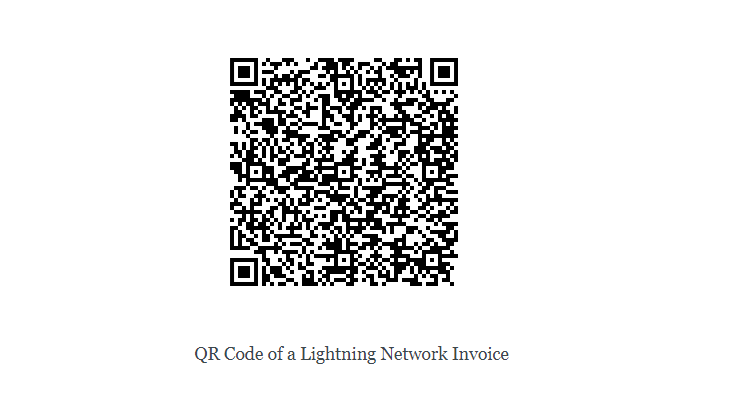
Ln invoice qr code

(Source: BlockFuse)

To be valid, the invoice needs to have the following information:

  • Destination: The public key of the person receiving the Lightning Network payment.
  • Payment_hash: The hash of the preimage that is used to lock the payment.
  • Num_satoshis: The number of satoshis to be paid.
  • Expiry: Time when your node marks the invoice as invalid.
  • Timestamp: Time when the invoice was created.  
  • Cltv_expiry: Delta to use for time-lock of CLTV extended to the final hop

This is the required information that must be present for an invoice to be valid, but there are a lot of details that can be included, such as a description or a fall back address which acts like a security feature in case the Lightning Network transaction fails.

Lightning Network invoices have shown to behave flexibly as they are capable of providing a lot more information regarding payment. For now, Lightning Network invoices are still a little bit difficult for the average joe to handle, but pretty soon the industry should see new developments that will enable easier ways to use the feature.

Like BTCMANAGER? Send us a tip!
Our bitcoin Address: 3AbQrAyRsdM5NX5BQh8qWYePEpGjCYLCy4

Published at Mon, 01 Apr 2019 10:00:51 +0000

Previous Article

Bitcoin 🔴 24/7 Live 🚀 Cryptocurrency, Bitcoin, Ethereum & Altcoin Trading Price Index🚀

Next Article

Ripple-Powered XRPL Labs Set to Launch New XRP Payments App

You might be interested in …

CORION Announces ICO Details for its Revolutionary Platform & Stable-Rate CryptoCurrency

CORION (https://www.corion.io) full-service blockchain platform powered by a revolutionary new stable-rate token, today announced final details for their public crowdsale to begin on June 18th and end July 30th, 2017.

[Note: This is a press release.]


CORION Platform Offers the Easiest Way to Enter the Crypto World

Built on Ethereum Classic, the CORION stable-price token eliminates the guesswork that comes with fluctuating prices. Its algorithm enables special automated inflation-deflation control, assuring the stability of the CORION token as a stable means of payment worldwide. CORION’s white papers can be found here.

Participants in the CORION crowdsale will gain access to the CORION Platform, and have stable-price digital tokens deposited in their multifunctional CORION Wallets immediately, allowing instant, low-cost payments. Early investors will receive a 25 percent bonus the very first day, 20 percent bonus during the first week, a 15 percent bonus the second week, and progressively lower bonuses throughout the campaign. Investors will also be incentivized by CORION’s affiliate reward of 1-5 percent.

Funds raised through CORION’s  crowdsale will be distributed to further developments and investments managed by the CORION Foundation (50 percent), to the Stability Fund managed by the Foundation (25 percent), to the team members for their two year of work (16 percent), future developers and associates working on the CORION Platform (4 percent), and marketing, promotions, and growth (5 percent).

CORION’s Marketplace allows anyone with a minimum purchase of 3,000 CORION tokens (a $2,400 investment) to join the community as a Service Provider and start their own business and start acquiring customers. The marketplace provides an excellent tool to promote any business online or offline anywhere in the world. From there, the mainstream crowd is engaged through affiliate programs and shopping communities that generate demand for usage of the platform. As business grows, so does the token supply, thus fuelling the system  and allowing users to earn daily rewards from staying active within the community.

The CORION Platform also features a built-in automated inflation and deflation control system that ensures the stable price of the coin to carry out transactions. If the price of CORION rises above $1 on the main exchanges, (i.e. there is a demand for more tokens), the system will release a maximum 2.5 percent additional tokens daily. On the other hand, if the price of CORION drops below $1 on the main exchanges, (i.e. there are more tokens in circulation then the system needs), no tokens will be emitted. To make sure the system works, set fees are calculated after each transaction and later burned to make sure they never appear in the system again.

Miklos Denkler, CEO of CORION, explains:

One of the biggest deterrents for new cryptocurrency users is the hassle of monitoring the hugely fluctuating prices of cryptocurrencies. With CORION, the price of the token remains stable, giving community users all the freedom to buy and sell in the marketplace without a major financial risk. We look forward to introducing CORION to a larger audience through this token crowdsale and putting investments towards funding this truly revolutionary platform.

For more information on CORION and its upcoming crowdsale, please visit: https://www.corion.io

About CORION

CORION is a multifunctional platform for businesses and individuals to join and build a worldwide decentralized network based on mutual benefits, simplicity, security, cost-effectiveness and speed. The Platform provides and hosts secure, convenient, and instant financial transactions using CORION, the stable means of payment. CORION encourages users to build businesses and services on it and it is ideal for beginners and anyone looking to enter into the crypto world. For more information, visit https://www.corion.io

The post CORION Announces ICO Details for its Revolutionary Platform & Stable-Rate CryptoCurrency appeared first on Bitcoinist.com.