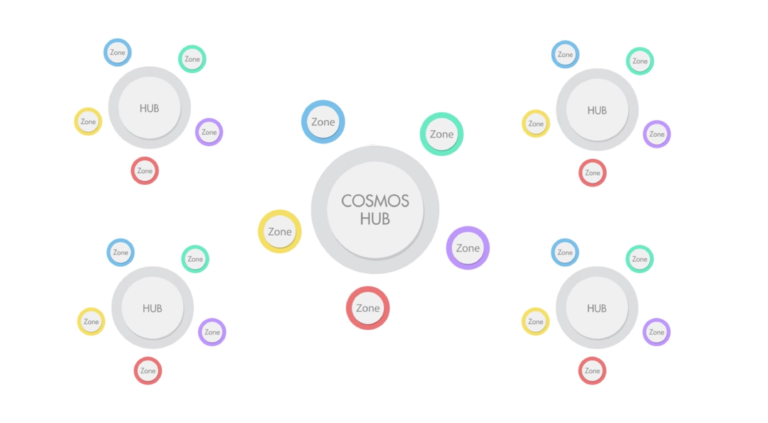
Cosmos, a highly anticipated blockchain itself designed to improve the interoperability between any number of other blockchains, has officially released a live software.
With the mining of its first block at 23:00 UTC, the project has launched Cosmos Hub, the first in a series of blockchains intended to make up the Cosmos ecosystem.
At present, users of the network will not be able to swap tokens between blockchains or otherwise connect to Cosmos Hub with existing blockchain networks until validators officially vote to activate what is called the Inter-Blockchain Communication (IBC) protocol.
The first phase of today’s Cosmos network launch comes after nearly three years of planning and development. Having debuted the concept for the blockchain interoperability platform back in summer 2016, Cosmos later raised over $16 million in an initial coin offering (ICO) in 2017.
Since then, Tendermint Inc. – a for-profit entity behind the core technology of the Cosmos network – has been releasing preliminary developer-focused products.
Speaking to CoinDesk, Tendermint Inc director Zaki Manian explained:
“We want to take the blockchain development cycle from idea to implementation down from years to months. This is how we’re trying to transform the blockchain space.”
As such, Manian said that the Cosmos Software Development Kit (SDK), which debuted back in , is already being used by high-profile crypto companies such as the exchange.
In addition, Tendermint Core – the blockchain networking and consensus mechanism underlying the Cosmos Hub – is another key tool that Manian envisions will help “fundamentally remove barriers to innovation” in the blockchain space and ultimately help “compose an entirely new system of finance.”
“Out of all these building blocks, [you’ll be able to compose] an entire … open system of finance that operates to scale and can be composed of individual, specialized chains that do different things,” Manian said.
Unleashing validators
Today’s launch was a significant step toward that broader, expansive vision – one that Manian points out will “take years to fully manifest.” The main purpose of Cosmos Hub launch is to establish the broader ecosystem of validators, entities that stake tokens on the network, while Manian’s team continues to work toward cross-blockchain capabilities.
Cosmos hubs via YouTube.
“In order to make this whole vision of connecting blockchains work, there needs to be a set of operators who have skin in the game to coordinate this blockchain network,” said Manian.
Normally, in a proof-of-work (PoW) system similar to bitcoin or ethereum, these validators are miners who compete for block rewards by operating computer servers and expending large amounts of electricity.
Validators in a PoS system, on the other hand, are “selected” by the system based on a separate metric of staked tokens in order to participate in block creation and transaction finalization.
“In proof-of-stake, the costs and rewards [of the system] are internal,” said Manian. “So, we had to come up with a very sophisticated system of distributing rewards, of distributing the speculator taxation system, of punishing people for malicious behavior, of punishing people for going offline.”
He added:
“All of it has to be internal to the system and that’s why proof-of-stake is such a significant engineering feat over proof-of-work.”
And while Cosmos participants successfully tested this system of validation with roughly 200 computer servers called nodes in a former dummy environment called , there had never been real value at stake by participants before today.
“[Today’s launch] is about unleashing those live economic incentives and having value at risk for the first time and then letting this set of economic incentives that we’ve designed select who the [validators] are,” said Manian.
According to Manian, this is a crucial foundational step that Cosmos developers are cautious about getting right.
He told CoinDesk: “Building interoperability. Establishing mechanisms for workers of some kind to custody bitcoin or ether or ERC-20 assets and manifest synthetic versions of them in [the Cosmos] environment. If you don’t know who your validators are none of this is possible.”
Next steps
For now, Cosmos users are not allowed to transfer their holdings of the native network currency – ATOM tokens – just yet.
Since ATOM tokens are intended to act as “the collateral that people put at risk to be [validators] in the system” according to Manian, these tokens will be strictly used as the “mechanism for selecting membership into the system.”

Zaki Manian via Tendermint
But once both the system and the validator set are deemed to be in stable condition, token holders will vote on when to enable live ATOM transfers.
Thereafter, a secondary vote will be held to connect new blockchains also called “zones” to the Cosmos Hub and begin swapping heterogeneous cryptocurrencies and non-fungible tokens (NFTs).
“In these early days, we can expect to have issues, updates, and bugs,” the InterChain Foundation – a non-profit organization dedicated to support Cosmos network development – warned in a , adding:
“The existing tools require advanced technical skills and involve risks which are outside of the control of the Interchain Foundation and/or the Tendermint team. … Please exercise extreme caution!”
Staking as a service
Manian told CoinDesk there are 70 validators at Cosmos Hub launch committed to securing the network. Some of these validators are focused on staking tokens as a service to wider ATOM holders.
In a sense, this is almost like leasing out crypto assets in order to earn returns and may encourage new users to flock to the Cosmos ecosystem.
Shayne Coplan, founder of the Union Marketplace for such service providers scheduled to launch in April, told CoinDesk that over the next few months a “cross-network layer of reputation” for these validators will emerge.
“If you look at these different staking service providers, a lot of them are performing on several networks at any given time,” Coplan said, referring to other staking networks such as and the Tendermint-based network . “Now with Cosmos being another very valuable chain with staking and delegation, it’s going to place a major emphasis on cross-network reputation for validators.”
The rewards these stakers and holders gain are generally earned in the ATOM token but in future may also be earned in wrapped forms of alternative cryptocurrencies such as bitcoin and ether.
While Union Marketplace has quietly collected around 230 validators across all its various staking networks as it gears up for launch, Coplan expects the Cosmos launch, in particular, will inspire more players to experiment with these types of services.
“There’s a huge range of people interested in these types of staking services, from retail investors to investment funds,” Hendrik Hofstadt, co-founder of the validator startup Certus One, told CoinDesk. “Quite a few larger funds have reached out to us.”
Plus, Certus One’s Telegram group for retail ATOM users signed on 60 members within the first 24 hours of opening, Hofstadt added.
Meanwhile, Joe Pindar, co-founder of the validator startup Block3, told CoinDesk this type of ecosystem opens up a new type of investment opportunity.
Speaking to how Cosmos rewards stakers on a continual basis, which he compared to income investing, Pindar added:
“You actually start getting revenue or income from those rewards and start to appreciate more and more ATOMs, which I think is a different investing model and I’m excited to see how that plays out.”
Leigh Cuen contributed reporting.
Earth from space via Shutterstock
Published at Wed, 13 Mar 2019 23:10:04 +0000