“Paging @bitcoin. These tweets don’t help anyone.”
At first glance, the tweet, from investor and entrepreneur Nick Tomaino, might not be distinguishable in the all-out that crypto Twitter – and all crypto social media – has become.
But while the situation has , Tomaino’s tweet comes at what might be a new boiling point, following what was arguably the account’s most controversial message in history.
The bitcoin Core (BTC) community relies on internet hate mobs, trolls, sockpuppets, censorship, DDoS attacks, vote manipulation, harassment and character assassinations.
The bitcoin (BCH) community is welcoming, supportive, and appreciates freedom.
Which do you prefer?
Issued Wednesday, the tweet found @bitcoin sending a message to its more than 800,000 followers that, as Tomaino’s tweet shows, even impartial observers would admit was incendiary, attacking the group that maintains the cryptocurrency’s most widely used software and promoting an alternative cryptocurrency that .
But for some, the tweet was merely a confirmation of what was already clear – the account has passed over to new ownership that appears to have the intent of pushing a controversial view.
Indeed, for several months, the current @bitcoin administrator has arguably been promoting bitcoin cash instead of the original cryptocurrency, posting content that, at the very least, seems subversive to today’s mainstream view of technical development.
And this has marked a sharp change from years past.
Launched in 2011, @bitcoin has long been tweeting basic cryptocurrency tips and news, and the anonymous account has had several administrators over the years.
CoinDesk itself even leased the handle from 2013 to 2016, but amidst leadership changes, any agreements with any individual that may have been in place have long since gone missing. (Emails to and executives have gone unreturned.)
Still, the recent tweets aren’t just happening in isolation, coming at a time when Twitter has seen a dramatic uptick in cryptocurrency scams across the platform broadly, from to a general increase in .
Escalating the situation, dozens of crypto accounts were or “shadowbanned” this week, meaning their posts have in some cases disappeared from searches and followers’ feeds.
RoBhat Labs co-founder Ash Bhat, who makes social media tools to identify bots and propaganda, told CoinDesk that he believes the social media giant is failing to protect its user experience from manipulative campaigns and bots.
Bhat said:
“You essentially have voices and opinions being amplified that don’t represent the human user base. From Twitter’s bottomline perspective, this is horrendous.”
Message received
Adding interest to the story is that, far from ignoring the problem, Twitter’s leadership has been outspoken about the role it’s now playing in cryptocurrency discourse.
In a in November, Twitter touted its place in the conversation, highlighting the notable individuals that have tweeted about bitcoin, while pointing to charts and data that indicated the size of the conversation was among its fastest-growing.
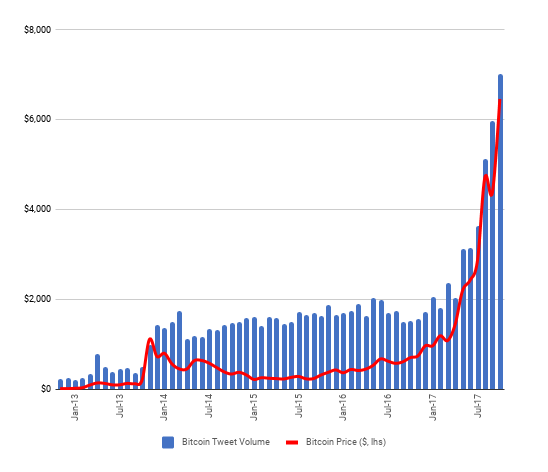
“We’re seeing bitcoin ($BTC) conversation volume alone exceeding that of the FANG stocks (Facebook $FB, Apple $AAPL, Netflix $NFLX, Google $GOOG) on a daily basis,” the company wrote.
Against this backdrop, Twitter appears to be taking steps to defend its position amidst the recent controversies.
Twitter CEO Jack Dorsey posted a series of tweets last week expressing concerns about the platform’s ability to offer a beneficial service. On Thursday, suggesting one way to curtail digital coin scams would be to , or at least open the option to all accounts.
Creating a norm where people need to verify facts about themselves would almost be reminiscent of , which is controversial and widely criticized.
Still, Twitter’s formal statement about cryptocurrency scams was less clear about what might be ahead.
“We’re aware of this form of manipulation and are proactively implementing a number of signals to prevent these types of accounts from engaging with others in a deceptive manner,” the company told CoinDesk in a press statement.
But both comments provide evidence that, in shutting down and shadowbanning multiple crypto-related accounts, the company acknowledges it finds itself in the middle of determining just what accounts for malicious behavior when discussing emerging technology.
Some bitcoin traditionalists, like bitcoin Core advocate Peter Todd, for example, are reporting @bitcoin for allegedly misrepresenting bitcoin, and Twitter’s response to Todd has been that @bitcoin’s tone violated the platform’s policies.
Moderation or censorship
But as the exchange between Todd and Twitter shows, when it comes to cryptocurrency, it can be tricky to distinguish moderation from censorship.
Eliminating bots is almost a universal goal. However, restricting people, organizations and anonymous educational accounts like @bitcoin are a different matter entirely. How should Twitter define deception or manipulation when discussing amorphous ideas?
Todd believes the line between shilling and spreading misinformation is elusive at best.
“Suppose I’m a IOTA supporter. I can silence my critics by falsely reporting them, and hoping Twitter’s AI interprets that as a reason to shadowban someone … The @bitcoin account is a great example: knowing if that should be banned is a seriously tricky problem that requires a lot of industry-specific knowledge,” he said.
Cryptocurrency analyst and investor Brad Mills is another Twitter user who discovered the dangers of algorithmic moderation firsthand.
For months, he has played an active role in the debate about what defines bitcoin as an idea, but shortly after Dorsey tweeted Twitter will curb cryptocurrency scams, Mills’ account was abruptly suspended for two days.
Still, as his comments showcase, determining well-intentioned and malicious behavior can be difficult, especially when from an outside perspective, both appear the same.
He told CoinDesk:
“The people who seem to have been banned were heavily in the debate about bitcoin versus bitcoin cash. But the other interesting thing is we’ve all been reporting those phishing accounts like crazy. So, we probably have both received reports, blocked by people on the other side of the debate and we’ve been giving an access of reports and blocks to all those phishing accounts.”
The result is that Bhat believes Twitter needs to be more active about getting user feedback to help algorithms distinguish bots from opinionated people.
However, Kat Lo, a PhD student researching online moderation at the University of California Irvine, agreed, going so far as to argue that deploying both software and a team of human moderators with industry-specific knowledge could provide a better solution.
“A major obstacle in many of these cases is that a lot of moderation judgement relies on context, and most moderation systems intended for large-scale platforms don’t incorporate significant context into their review process,” she said.
Splitting along party lines
But the problem isn’t unique to bitcoin.
Other cryptocurrency communities, such as those that have formed around ETH, XRP, NEO and other large cryptocurrencies, voluntarily promote the products and services of investable assets, often in a way that borders on outright spam.
But Todd went on to showcase just how difficult it would be for even humans hired by Twitter to moderate the ongoing debate. To Todd, an outspoken bitcoin maximalist, any and all crypto assets that aren’t based on bitcoin’s pioneering proof-of-work are likely scams.
In this way, Todd doesn’t mind some level of shadowbanning, just as long as it favors his preference, and that means having a lot less people constantly promoting specific tokens.
“Those accounts are annoying and detract from my Twitter experience,” Todd said. “Hiding their tweets to me would be a benefit, and something I’d like.”
One Twitter user who experienced a temporary shadowban on Tuesday, @Joebwankanobee, told CoinDesk subjective moderation doesn’t help cryptocurrency communities.
In fact, the lack of censorship is precisely why he prefers Twitter over other platforms.
“While I understand that’s frustrating, I also firmly believe that someone should be doing their own research on something and that they alone are responsible for the moves they make with their money,” @Joebwankanobee said.
And there is reason to support his belief that Facebook has been perhaps too restrictive – in January, the social media giant announced a new policy banning advertisements for bitcoin, initial coin offerings and other types of cryptocurrency.
Decentralizing communication
But Twitter’s specific problem might go a bit further than Facebook’s.
After all, in some cases, the specific messages that are falling afoul of users may amount to advertisements, but they’re also statements supposedly being made by individuals.
As such, some cryptocurrency fans have come to believe the problem lies with centralized media infrastructures in which management and moderation falls to a central authority, in this case Twitter and Facebook.
Muneeb Ali, co-founder of the decentralized internet project Blockstack, told CoinDesk:
“Twitter’s response to banning bots has been to ban real accounts, some with tens of thousands of followers, leaving innocent people defenseless against imitators and ultimately stifling freedom of speech … Twitter is a public utility that is too precious to remain centralized.”
Already, Ali said, developers are working to build that would run on the open-source technology it is developing.
As the situation with crypto Twitter shows, decentralization may be able to offer benefits. The main “defense” Twitter users have against censorship today is to get verified and reactively appeal restrictions, but these options favor celebrities and brands over regular individuals.
But such solutions might not help any problems today.
With Twitter yet to clarify how it finds and defines abusive behavior related to cryptocurrency, many users will be left with the fear of losing their brand platforms by participating in a game without clear rules or referees.
image via Shutterstock
The leader in blockchain news, CoinDesk is a media outlet that strives for the highest journalistic standards and abides by a . CoinDesk is an independent operating subsidiary of Digital Currency Group, which invests in cryptocurrencies and blockchain startups.
Published at Sat, 10 Mar 2018 12:30:26 +0000
Features[wpr5_ebay kw=”bitcoin” num=”1″ ebcat=”” cid=”5338043562″ lang=”en-US” country=”0″ sort=”bestmatch”]