( (4/6)
(Next to be published: 6 Conclusion (6/6))
5.1 Work vs Utility vs Security Tokens
By purchasing part ownership in the MyFiles and MyFamily Hiveware apps, the ICO investor is not investing in Hiveware Inc. As such the tokens produced by the MyFiles and MyFamily apps are not security tokens. Not being a security token, a prospectus does not have to be filed with the (SEC).
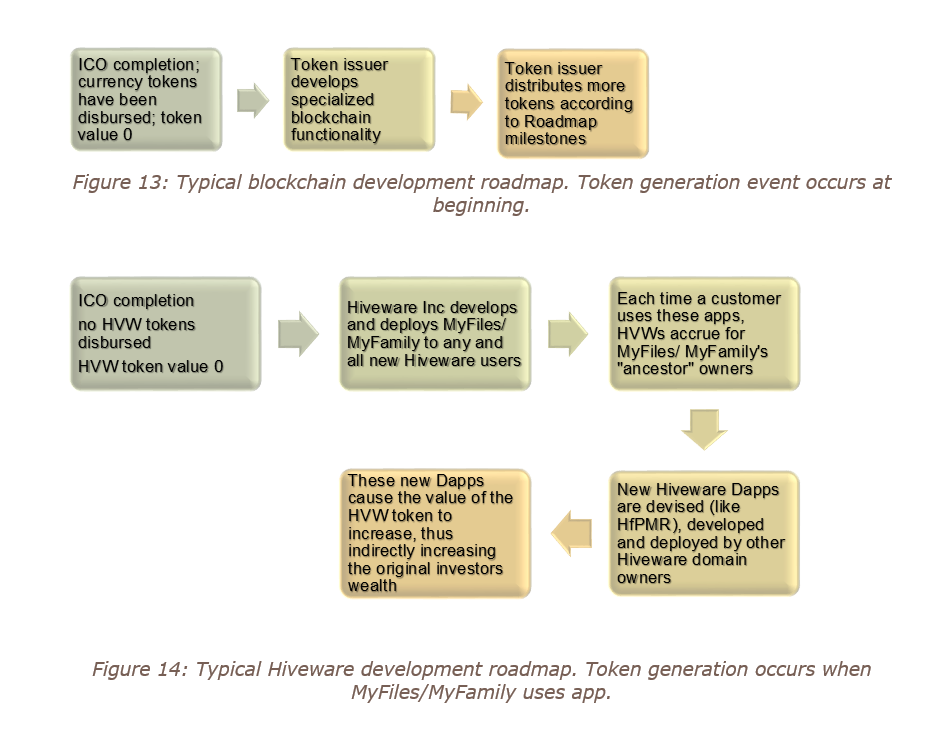
If the HVW is not a security token, is it instead a utility token? Utility tokens grant future access to a company’s product or service. Utility tokens are digital coupons for the services being developed and are generated at some generation event during an ICO as can be seen in Figure 13. Utility tokens are Altcoins (term defined by the industry) and all strive to be utility tokens in order to avoid SEC regulation. These tokens are created out of “thin air” and are still subject to much regulatory debate.
But the Hiveware ICO is not an Altcoin, but rather a new capability on the ICO market called an Altplatform (term defined by Hiveware Inc). Being an Altplatform does not issue tokens, but the Dapp instead generates tokens in tandem with the service’s use in practice. As users of the Dapp do Dapp-work, tokens are generated and ancestor owners are remunerated as return on their investment in that Dapp. Figure 14 shows the sequence of events for the Hiveware ICO. At sale time the Hiveware ICO investor only receives part ownership of an app, but no tokens.
Let’s say the service app being sold in this ICO was a Hiveware music app and the customers were paying for the number of times they listened to a particular music track. Obviously then, the owners of the music app would receive twice as much remuneration in HVWs if the customer played the track two times instead of just once.
5.2 Hiveware Cryptocurrency Exchange
Hiveware makes money by running Hiveware apps that create hivewares (HVWs). Granted, the hivewares term is unusual and will take getting used to, but it is arguably better than for example hivecoin since coinage is and arguably will disappear as crypto currency becomes pervasive. The initial value of a HVW is of course zero. In the transition to becoming a (unit) on its own, people will mentally convert to fiat currencies in the same manner as a person in America has to convert weather report temperatures in Celsius to Fahrenheit to understand them, or meters to yards. In this transition period and as Hiveware Dapps become widespread, crypto currency exchanges will take care of the buying, selling and valuing of currency-to-currency exchanges and investors will be able to move funds in and out of HVWs at will. For example, HVW ↔ USD or USD ↔ ETH ↔ HVW, and even HVW ↔ ETH ↔ BTC ↔ USD, etc., as is the case today. That is, in crypto token parlance, HVWs are . And because HVWs are not traceable on a single-file blockchain like bitcoin, the HVW is a contender for being as fungible as gold.
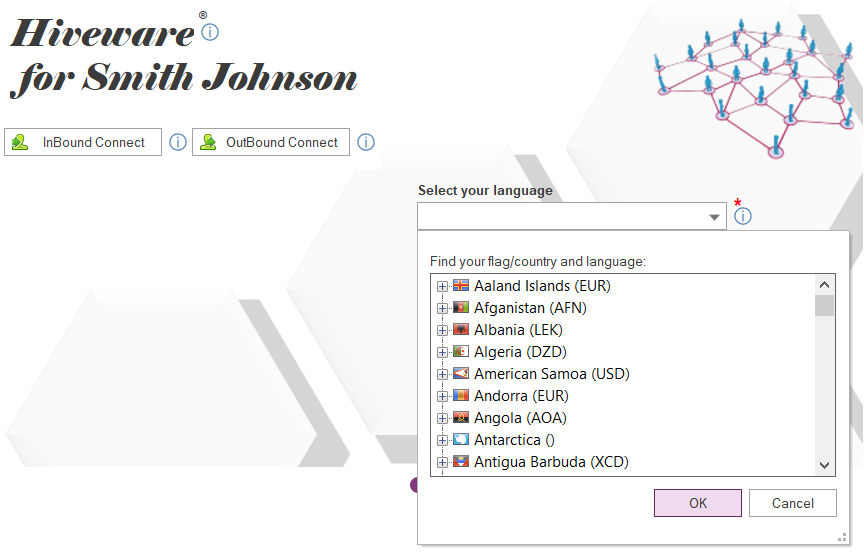
The hives in the Hiveware design may choose to operate in any fiat currency they wish, where the Accounting Ledger panels (a grouping of controls in a ) would show both the fiat and HVW quantities. Cross-hive cross-fiat transactions would naturally be in HVWs. Figure 15 shows a partial list of currencies new Hiveware users may choose from at signup time.
Let’s return to the fictional business venture described in Hiveware Philosophy. The story assumes the HVW has good value because there are now 1000s of Hiveware apps on the internet creating ownership and doing internet work creating value. Let’s also say there are programmers who will program for HVWs and thus skip exchange risk and fees. One of those friends and family backers (FnFB) might decide to use his HVWs they received from their investment in MyFiles and MyFamily to compensate the programmer to create a new HVW-producing tool which the FnFB would be the owner of (work for hire). The HVWs the programmer would receive would be an investment by the FnFB and the HVWs that resulted from the new program would be the output of this capital investment in programming effort. The government would still be happy because capital gains would be paid. Note that in this case, the USD fiat currency previously used to pay the programmer, would be skipped.
5.3 Wealth-generating Hiveware Apps
To invest in Hiveware means you have to buy into the Hiveware development model of gradual development (No Technical Debt) which has been established by building the Hiveware engine up front which took years. But because Hiveware does not use HTML or the Web in its code base, another way of spreading the use of Hiveware had to be devised. Chosen were two apps that would 1) automatically go viral and 2) at the same time accomplish the next phase of Hiveware development, and 3) earn currency with potential future value for their new investor owners. These apps are stepping stones to the next phase of Hiveware development.
5.3.1 Built-in Hiveware Apps
The following built-in apps each has a dual function. Both are the first decentralized apps (Dapp, term defined by the industry) built on top of the Hiveware engine. The first Dapp below implements the secure movement of encrypted files such as owned and deliberately shared libraries and text files to other devices without losing ownership or compromising security. Its dual function is to offer the public cooperative file-sharing among one’s electronic devices with absolute control over access rights without worry about storage space limits or annoying backups. And the other Dapp below serves to solve the authentication problem. Its dual function is to offer the public a genealogy Dapp that solves the problem today’s monolithic genealogy apps have of competing data input from non-role owners.
5.3.1.1 Hiveware for MyFiles
The first public Hiveware Dapp is Hiveware for MyFiles. MyFiles will let any user store his files on his storage hardware with non-server backup using his own devices. Since Hiveware inherently controls ownership, only the Hiveware-controlled files and folders of one device at a time will be read-writeable. The obvious benefit of MyFiles is you can access your files from any of your devices anywhere without making a copy of it, and Hiveware makes sure any changes you make on one device get pushed elsewhere so that you psychologically only experience your single virtual copy of any one file. You experience full manipulation capability while other non-owners are denied access. No one else can access your files or even read your file’s names if so desired. In more practical terms you would be able to store a particular file in more than one hierarchical tree without making a copy of it. For example, c:\Family\George\Vacations\Italy\George at Magiannos.png and c:\Great Restaurants\George at Magiannos.png would be the same file instead of being a copy. In unix-flavored systems this is called a file which doesn’t exist in Windows.
5.3.1.2 Hiveware for MyFamily
The MyFamily Dapp’s unique market trait will be each viewer would be seeing his ancestry from his or her point of view. All genealogy data changes would naturally be initiated by their rightful owners and these changes would be sent to the other relatives. The Hiveware code would automatically fix-up this naturally sprawling tree until all have received the update and all are seeing the same thing.
The second unique trait will be how this inter-connective tree will serve as a unique form of internet participant identity verification. Each connected family member in essence is a standing verification that the subject in question is indeed who he/she says he is and is not some imposter.
5.3.2 Future Sale of Hiveware for <hiveware top domain> Apps
Once these two Dapps have been completed and launched and begin accruing HVWs for their owners, development of the following Hiveware domains: can begin. Figure 16 shows how the ICO projects are pre-requisites for the rest of Hiveware’s app development.
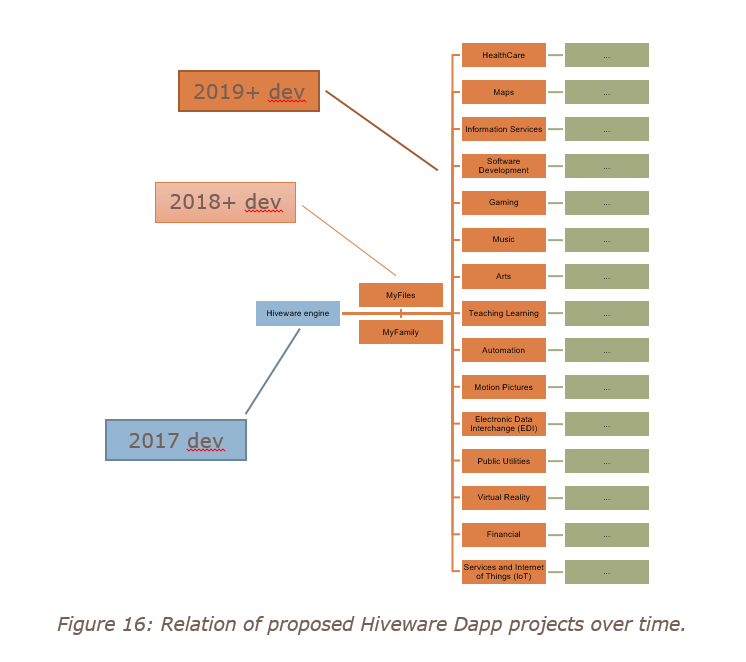
It should be clear from this document that the HVW wealth generated by MyFiles and MyFamily is only the beginning. As new Hiveware domains come online and are successful, the market value of the HVW would rise, thus the ICO investor’s HVW wealth would appreciate (i.e., a-rising-tide-floats-all-boats).
But will they all be developed at once? No. Once the ICO development cycle completes, and the number of Hiveware users starts to increase, presumably there will be a desire for other software entities to enter into a Hiveware development cycle. They would pick a domain and begin developing (cf. “”). Hiveware Inc Dapp development services would be available to aid these Hiveware domain startups.
But for discussion sake, let’s say the initial ICO development is complete. What would one of these ventures look like? From the Hiveware for Patients top domain, let’s create a hypothetical app, Hiveware for Patient Medical Records (HfPMR). In Figure 17 are slides of the Hiveware Dapp design illustrating its patient-centric-ness which does not exist today.
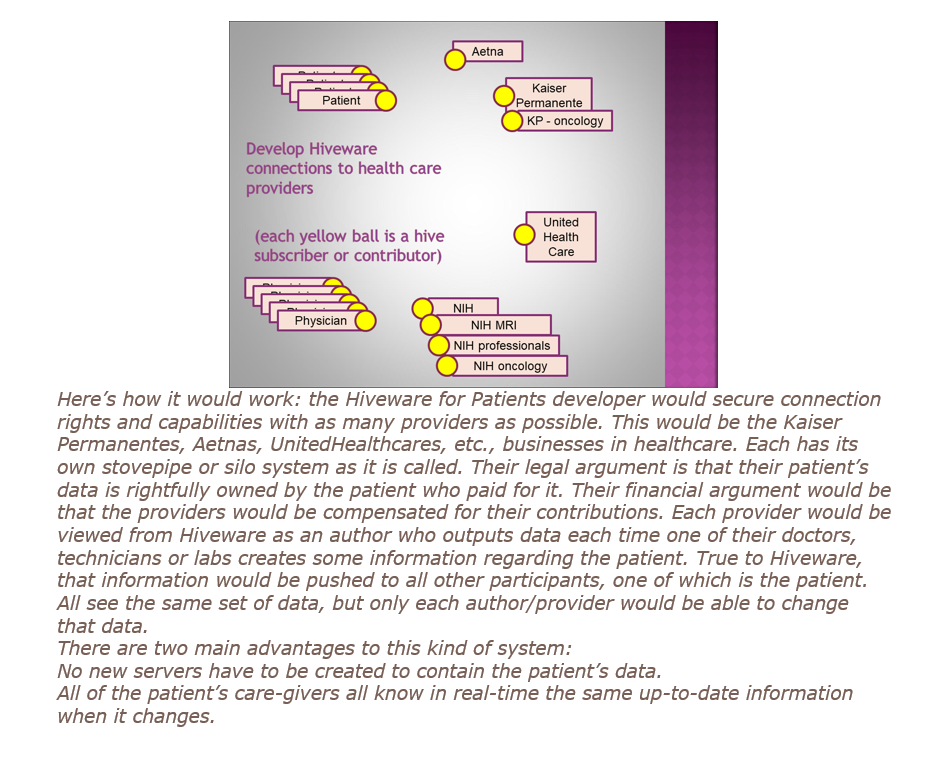
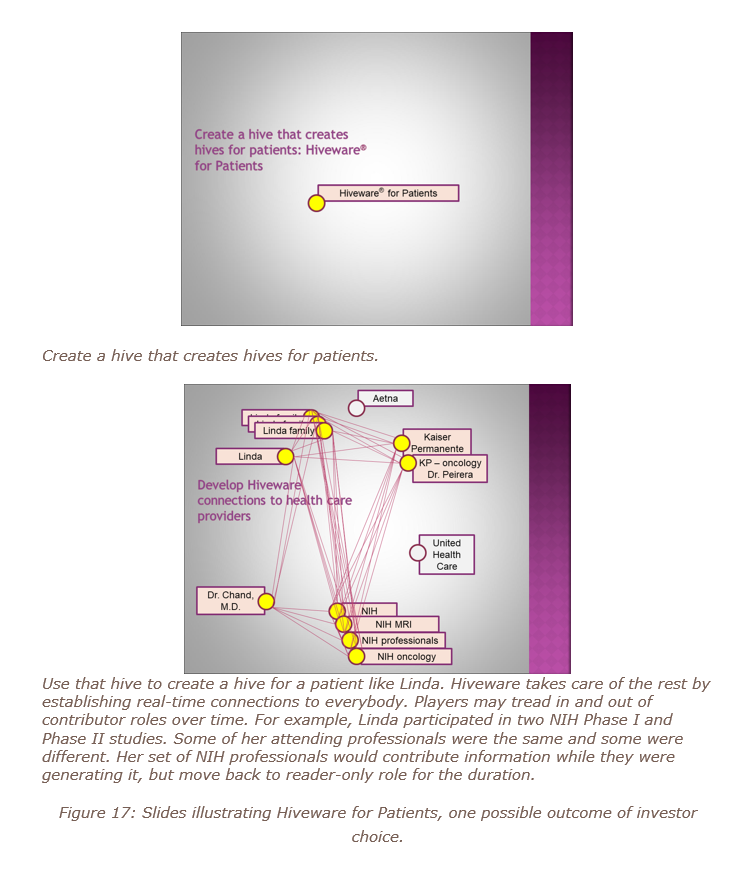
As an example of how HfPMR would work, let’s take one field, LDL cholesterol, and show how that number is treated. The patient, John, takes his yearly physical and has his blood analyzed. Let’s say that John’s LDL was 190 last year and 200 this year. Let’s also say that LabCorp in Gaithersburg, MD, has the facilities and does the analysis. All three are running the same HfPMR Dapp but only one instance owns the changing-of-190-to-200 number. I’ll name these three instances HfPMR(John), HfPMR(GeneralPhysician) and HfPMR(LabCorp). Only HfPMR(LabCorp) owns that piece of data because only HfPMR(LabCorp) can modify that field. The lab technician has his HfPMR(LabCorp) app running on his computer and the blood analysis machine outputs its results directly into HfPMR(LabCorp). Immediately, HfPMR(John) and HfPMR(GeneralPhysician) would see 200 in the field on their computers. John and the GP don’t have to keep checking to see whether “the results are in” because maybe the number is now red. And he could maybe mouse-hover over the LDL field and see that LabCorp is the one who performed the analysis and when. And so on.
5.4 Hiveware’s Funding Dilemma
If developing Hiveware were easy, then someone else would have done it already. But no one has because starting from scratch in today’s startup environment as Hiveware development has done, is not an option for investors.
So who would invest in a startup like Hiveware? Certainly not banks whose only investment criterion is number-of-customers. And not venture capitalists either. Since the dot-com bubble burst, venture capital has concentrated on looking for Google-class 100X opportunities which don’t exist anymore. As a result, there has been a lot of investment capital to invest for example in frivolous ventures like and , but no capital for complicated technology development, not even with a patent. That is why Hiveware, years ago, was forced to take the long road and complete the entire engine before going “public”. Today there is even more un-utilized investment capital and the cryptocurrency revolution has shown the world that money and idea-based investment can, or at least wants to, work together.
Hiveware does not have any customers today. This sounds counter-intuitive to business growth, but for Hiveware to work, the engine had to be developed first. Developing the Hiveware engine meant that the problems of distributed storage without reliance on server farms and distributed online authentication and distributed ownership not dependent on data location had to be conquered. It has done this. But the only way to see that it has, is to develop Hiveware Dapps that run on that engine. Once MyFiles and MyFamily are developed, their users will be Hiveware’s first customers. These users’ multitudinous actions will be what will produce the first HVW wealth for their ICO investor ancestors. Each one of these user’s MyFiles and MyFamily micro-actions constitutes a micro-good or service which incurs micro-debts in micro-HVWs, the other ledger side of which are micro-credits in micro-HVWs, which get promulgated up the ancestor chain.
5.5 Hiveware Revenue Model
A unit of Hiveware work is measured in HVWs. In actuality, they are merely persistent (i.e., indestructible) counters (ledger units) in the Hiveware system where these counters are Hiveware’s unit (money) of account. These counters are the heart of the Hiveware system and in today’s virtual currency parlance they would be referred to as simultaneous-parallel-contextual-chains technology. The unit of work the HVW is measuring is determined by each hive or individual owner.
For this ICO, revenue will be determined by the breadth of acceptance of Hiveware for MyFiles. Since everyone who owns a computer knows how to store, find and move files, then the market by design is quite large. Since there aren’t any competitors on the horizon for now, the unit of work will be 1/1000th of a HVW for each change. In other words, quite cheap. A MyFiles change is defined as adding a file (drag and drop) to a Hiveware folder. For every 1000 files, therefore, the user would accrue 1 HVW’s worth of internet work/value. His ancestors (Hiveware Inc plus ranked ICO investors) would therefore receive a portion of 1 HVW.
5.5.1 Investment Revenue
Here is another way of estimating revenue just from MyFiles.
For Hiveware for MyFiles, the potential number of HVWs created would be roughly 2 billion computer owners (i.e., Facebook’s current number of users) adding an average of 100 files to the control of MyFiles on their computer times 1/1000 is 2 million maximum HVWs. Also, there can never be more HVWs generated than there are computers with files on them times the number of files each user has under MyFile’s control, which qualifies MyFiles as being a limited resource (Finite Supply and Fake Scarcity).
Since these two apps are the object of development for this ICO, investors are in effect purchasing HVW options. As these apps become available and people start using them, the HVW counters start accruing, thus converting investor options into vested HVWs. In short, the vesting schedule is the natural rate at which the investor HVW options are realized by the continually deployed MyFiles and MyFamily apps. A Hive Explorer dashboard will allow each investor to watch their HVW options become vested in real time.
5.5.2 Revenue Calculation
The initial contract for MyFiles and MyFamily would be 50–50% meaning the HVW revenue in HVWs would be evenly distributed between Hiveware Inc and this ICO’s investors ranked by investment amount. For the equation-minded reader, the following describes how the MyFiles ancestor is remunerated for downstream MyFiles activity:

In words, the number of files a user puts under MyFiles control is the sum of the differences over time.

The second equation indicates how many users there are over time and the proportion of revenue that would go to each ancestor up the chain over time. The factor is the MyFiles app owner’s guess at what the market will bear for this service in the long run.
Likewise, MyFamily’s maximum number of HVWs would also be synchronous with the number of people in the world times the average number of content and context changes people would make to their particular families. MyFamily’s revenue equations would be similar to MyFile’s except the HVWMyFamilyPerUser equation’s number would be much smaller than MyFile’s because only family members would be able to make changes to their own node in the tree. These equations are currently illustrative and will only be made legal when ancestor/descendent contracts are signed.
5.6 Growth Potential
Event-driven mesh is one of Gartner’s 10 strategic technology trends of 2018. Blockchain is another. Although bitcoin, with the blockchain as its underlying platform, has proven that the virtual currency movement can be successful at least in a speculative sense, it has not proven its technically is up to the task of transaction performance needed or has the ability needed to scale to billions of transactions a second. The Hiveware platform is 100% event-driven synchronous mesh which is the fastest possible architecture.
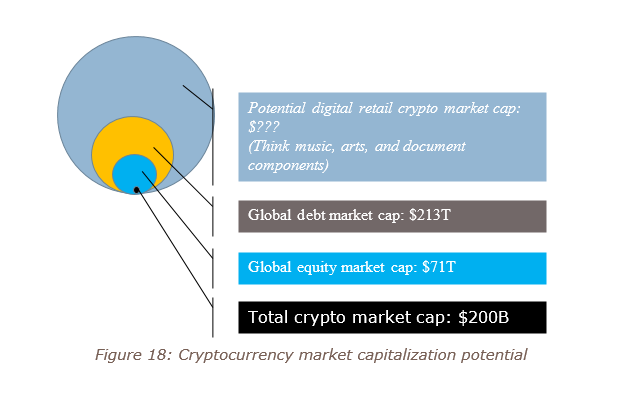
Figure 18 suggests that while the blockchain market is still quite small, and is currently moving into the equity market, the next market could well be the debt market[1].
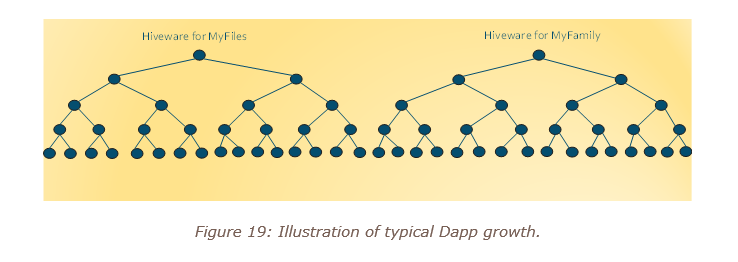
Figure 19 indicates how the ICO’s apps are projected to grow organically where each descendant ball is an app user doing work with his app and where each unit of work results in a fraction of a HVWs flowing back up to each ancestor.
[1] “Dharma: An open protocol for generic tokenized debt agreements” by Nadav Hollander.
 5.7 Token Sale Parameters
Every ICO sale sets out the parameters for its sale. Accordingly, here are the parameters for the sale of the Hiveware apps MyFiles and MyFamily. In Hiveware parlance, this ICO’s investors plus the shareholders of Hiveware Inc become the “ancestors” of these “descendant hives” where each ancestor owns at the outset of the ICO his/her percentage of these descendant hive’s future revenue which will accrue in HVWs.
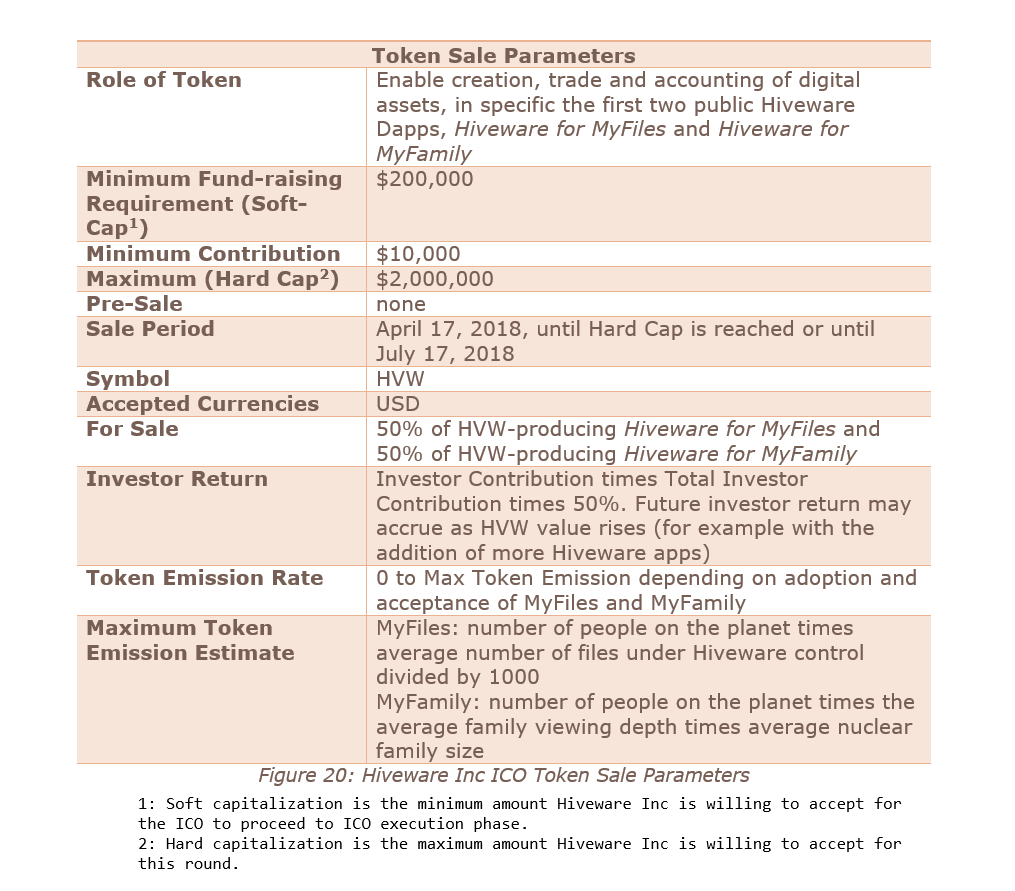
Hiveware Inc will use funds from the ICO to develop and launch the built-in MyFiles and MyFamily apps, which in turn will popularize Hiveware. Hiveware Inc is asking the investors permission to use the No Technical Debt method for development. Proof that this method works is found in the fact that the Hiveware engine exists, the code for which can be made view-only available to any potential investor should they require more assurance during due diligence.
All ICO investors will become pro rata-owners of the MyFiles and MyFamily Hiveware domains in accord with their pro rata portion of the entire investment pool.
5.8 ICO Investor Contracts
Blockchain has taught us that contracts can be made online indelibly by placing the contractual information permanently on the bitcoin blockchain. Anyone can verify the voracity of these s and multiple Altcoins have cropped up to facilitate these transactions like . The promise of smart contracts is that agreed-upon behavior is accomplished when certain conditions are met. The classic example is, “a pizzeria promises 30-minute delivery for a pie or money back guaranteed” where any number of things can go wrong that would change the transaction.
Hiveware has built-in smart contract functionality since any functionality such as (for illustrative purposes only) returning a customer’s pre-payment if the pizza was delivered late, is a simple reverse transaction between Hiveware users, which is a form of return counter reverse-transaction initiated by the customer ANDed to a geo-location sensor in the delivery vehicle plus access to the vendors order records, and so on.
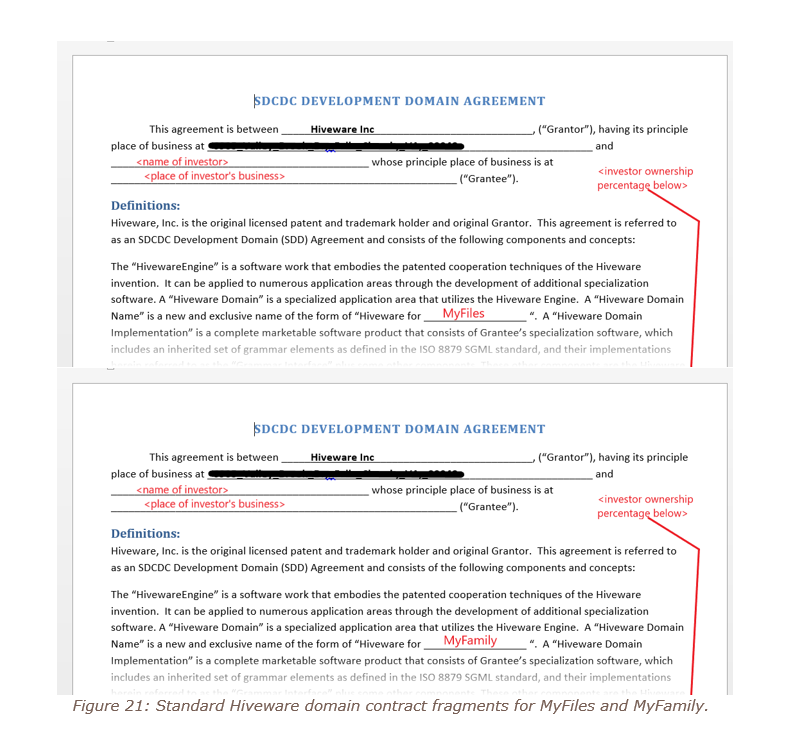
Hiveware has provisions for the casual user of Hiveware functionality as well as for entrepreneurs who wish to develop a Hiveware domain. Investors in this ICO, however, are the latter type. After the ICO, would-be investors will negotiate and sign a legal contract with Hiveware Inc that legalizes their ownership percentage. During the ICO execution phase, these percentages will be implemented in the code. Example contracts are shown in Figure 21. Although for this round the contract will follow traditional contract signing and exchange procedures, there is no reason why in the future a Hiveware entrepreneur can’t develop a contract-with-conditions functionality like the pizza-delivery scenario above and market it to other Hiveware users.
ICO investors will remain confidential until after contracts are signed, after which investors may choose to make their investments public or keep them private.
The Contract takes effect when one half of each investor’s contribution is received by Hiveware Inc and the sum of half of all investor’s contributions is equal to or greater than one half of the Soft Cap in Figure 21.
Upon completion of the ICO execution phase, the other half of the ICO investor amounts will be paid to Hiveware Inc. The exact details of completion criteria will be delineated in the investor contracts.
(Next to be published: 6 Conclusion (6/6))