It is one day left until the Squeezer Pre-Sale ends, more precisely on April 16. Squeezer, the first platform to merge the power of microservices with the immutability of blockchain.
The Squeezer pre-sale started on 2nd of April and the first tier offers a big bonus of 50% for any of your purchases. For only 100 USD (mininum investment), at a price of 20 cents/token you would get 500 SQZR +250 extra.
Nevertheless, the Squeezer Token Sale will last until 31st of May and the generous bonification scheme will be continued with the coming tier consisting of 40% extra in tokens. Therefore, do not miss the last train of 50% Bonus or stay tuned for the upcoming 40% tier.
Buy now the Squeezer tokens and enjoy the last minute bonus!

MAINFRAME — A NEW STANDARD IN DATA AND COMMUNICATIONS SECURITY
It is hard to ingore the fact that it’s been a somewhat tough few months in the cryptocurrency world. After the meteoric rise of mainstream attention on the crypto world in late 2017, the last few months have seen us on a strong downtrend, not just on the charts but in public interest in the crypto space itself. We’ve endured everything from widespread fud, potential bans, hacks, rampant scamming throughout, and a general lack of belief and scepticism in the innovative potential of the blockchain. Something is definitely in the air though. You can’t help but feel the wheels still turning away from the market, where the innovation has continued unabated. Increasingly professional and promising projects continue to emerge, gradually piquing the interest of mainstream organisations along with investors. The standard is undoubtedly rising, we are now seeing an influx of projects that have real potential, addressing real pain points, offering real solutions, and backed by incredible teams fully capable of releasing these projects ambitious visions. Mainframe is one such project.
WHAT IS MAINFRAME ?
So what exactly is Mainframe all about, and what problem are they trying to conquer? In simplest terms, Mainframe is a decentralised network that enables censorship resistant messaging, a messaging layer for the new web.
The core philosophy driving Mainframe is that…
1. Users should have access and control of their own data online
2. Users should be able to reveal and share only what we choose
Just this week it has become glaringly obvious just how real the problems Mainframe aims to tackle are becoming, with the Facebook data privacy scandal making worldwide headlines. Facebook may be one of the largest companies to be put under the spotlight due to data security issues, but it certainly isn’t the first. From the Yahoo breach in 2013 which saw all three billion user accounts compromised, to the 2016 US election interference, or the Sony Pictures hack in 2014 which exposed a full 100 terabytes of precious data ranging from unreleased films, to social security numbers and passwords, data security has become an enormous issue that threatens individuals, businesses, governments, industries, and entire economies. Through the use of advanced cryptography, distributed ledgers, and token economics, Mainframe aims to make unsecured data once again secure, and in addition wants to put control of this data back into the hands of its owners.
Expanding on this philosophy, Mainframe is built around 5 key fundamental principles:
ENCRYPTION:
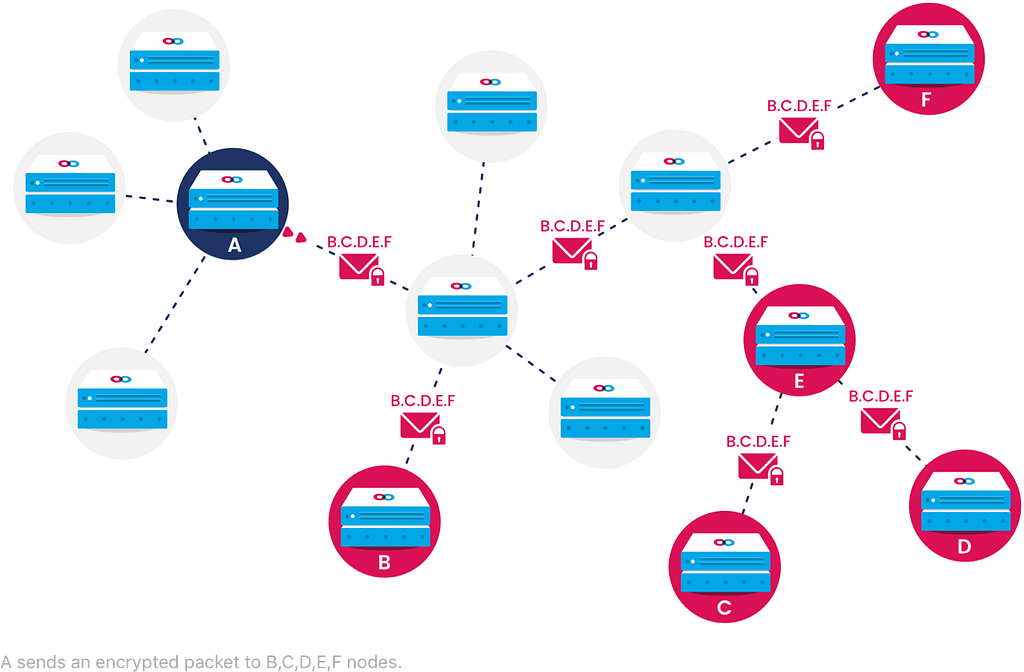
Mainframe will utilise strong encryption to enable secure P2P and group communication, and each Mainframe node will have an asymmetric key pair associated with it. This key will be used to decrypt the packets intended for this node.
2. DARK ROUTING:
Dark routing will be used to enable near impossible to trace messaging, whereby packets will be routed to each node whose address matches the partially disclosed destination address, moving efficiently towards this subset of nodes. Following this they are distributed to all matching nodes, making it impossible for any observer to infer the intended recipient.
3. INCENTIVIZATION
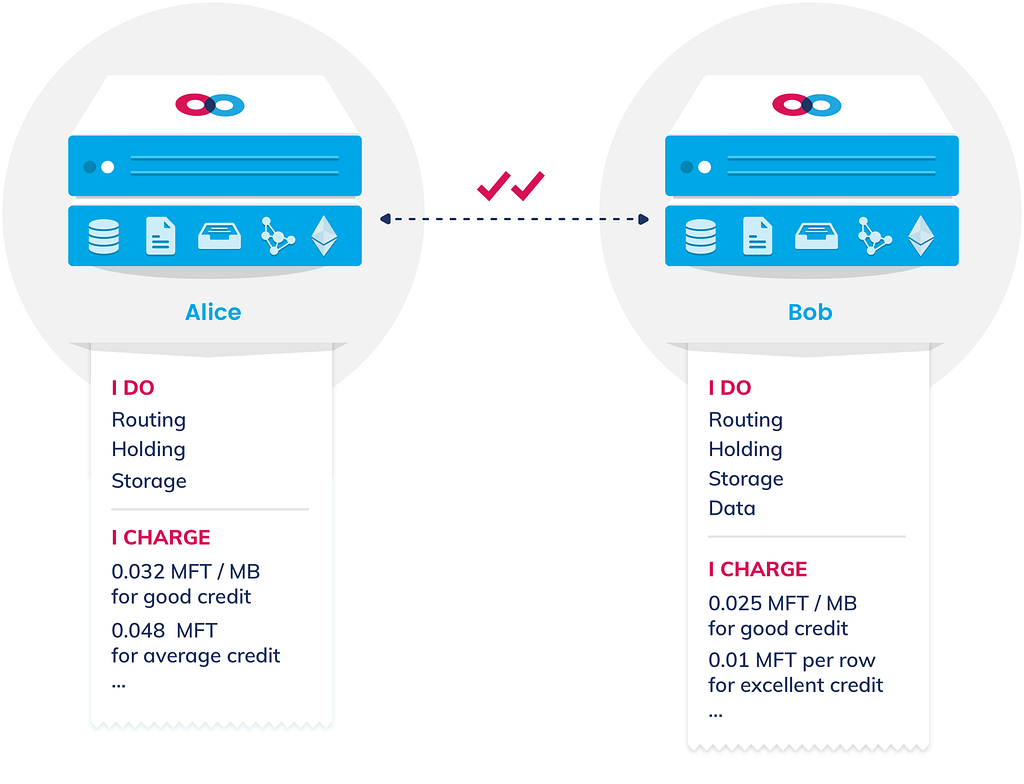
Mainframe will use incentivised packet routing, incentivised packet holding, incentivised file storage, as well as incentivised data services to provide reward to nodes that support the mainframe network.
4. PEER TO PEER AND UNHOSTED ARCHITECTURE
Mainframe will ensure the resilience and prosperity of the network via distribution and decentralization. There is no central authority that can exert any control over the flow of data within the network. There are no single points of failure within the network itself, and the network is extremely resistant to attack, as the operation of the network is non reliant on any set of nodes being present or connectable at any time.
5. INTEROPERABILITY
The design of the network enables integration of the Mainframe platform across all applications. Mainframe will provide software developer kits (SDK’s) for working with Mainframe code on all popular platforms across all languages. In addition, Mainframe will provide users with oracles and smart contracts for interacting with the token based incentivization layers on multiple blockchains. Paid consulting and support services will also allow efficient business adoption of the Mainframe platform.
HOW CAN MAINFRAME BE USED ?
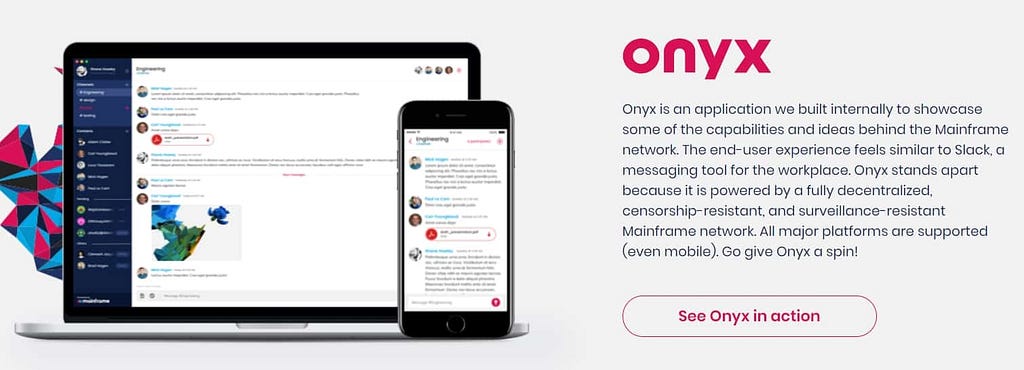
Mainframe is wasting no time in developing working products, with the release of the alpha version of its workplace messaging app ONYX in late 2017. Onyx provides users with a first class messaging product that can be run on all major mobile and desktop platforms, including Windows, MacOS, Linux, iOS and Android. Not only does Onyx provide secure P2P and group chat, but in addition provides users with messaging archiving and search functions, file attachment, storage, editing and sharing capabilities, making it one of the most complete messaging applications currently available, before even considering the added benefits the blockchain provides. Onyx even goes as far as to enable further app creation, whereby apps can be custom built, tailored to specific industries, and then bought and sold using MFT tokens.
Looking further down the road to potential future applications, corporations across various industries will be able to use the Mainframe platform to develop streamlined data exchange systems that comply with strict data privacy regulations. Healthcare, finance, and education sectors could all benefit from the integration of the Mainframe Platform. Consumer products are another area Mainframe could be used, with the platform potentially serving to reduce threats to IOT devices. Even Governments could benefit from the Mainframe platform. As Government agencies transfer large amounts of sensitive data, Mainframe could serve to drastically reduce the risk of data theft and leakage within government bodies. Mainframe may even find its way into the fin-tech world through the development of decentralized finance applications.
It’s very clear that Mainframes vision and potential application extends far beyond simple messaging, and the increase in data issues makes it very difficult to see how it won’t flourish as a widely used service in the coming years.
THE TEAM BEHIND THE VISION
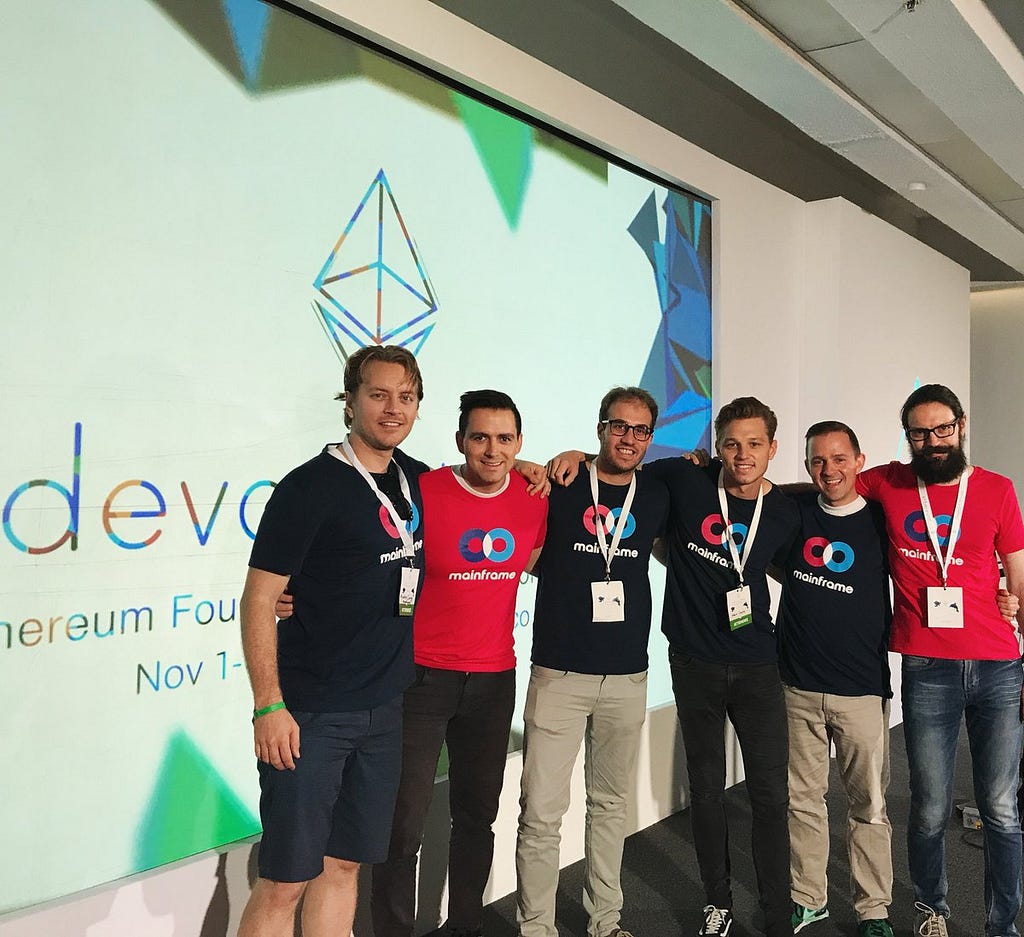
Mainframe is not a project that has just recently sprouted into existence, overly ambitious and without the team experience required to pull it off. Mainframe has been at this for a while now, even prior to the recent rise of the blockchain. CEO and Cofounder of Mainframe, Mick Hagen has already proved his worth via the development of several applications including Zinch in 2006, which connected high schoolers with school officers and scholarships, later acquired by Chegg for $45M in 2011. Mick then moved onto Undrip, an app designed to help users discover the best content from their social media feeds, and recently onto Spatch in 2013, a service focused on the improvement of email services. Mick brings with him a wealth of experience and knowledge that instills a lot of confidence that the team will realise Mainframes’ vision, and the team certainly does not start and end with Mick. In addition to Mick we have :
Carl Youngblood (CTO)-Full Stack engineer of 20+ years, Masters in Computer Science from the University of Washington
Brad Hagen (business development and sales)– Cofounder of Zinch, Vice President Lendio, Cofounder of Studio/Brandr
Shane Howley (engineering, back end)– Engineering degree and PHd in concurrent alogrithms from Trinity college Dublin
Paul Le Cam (engineering, front end)– Previous engineer at Hailo
Milos Mosic (back end engineer)- Lead developer at Evercam
Adam Clarke (front end engineer)- Previous engineer at a number of start ups, product design and user experience expert.
Diogo Perillo (front end engineer)- Remote developer, previous CTO at a company he started.
Austin Craig (head of marketing)- starred in documentary Life On bitcoin, and has generated major public attention and millions in sales through his work.
Clement Jacquier (head of design)- Mastered in Arts at UAL.
Luca Tavazzani (operations and strategy)- Masters degree at London School of Economics.
Matt Larson (business development and strategy)- Active in the blockchain space since 2016, previous experience building developer ecosystems at various start ups, notably Xamarin, a company acquired by Microsoft
Mainframe also brings abord some very valuable advisors including Lars Rasmussen (founder of Google Wave), Andy Mcloughlin (founder of Huddle), Hoa Viet Dinh (founder of google acquired company Sparrow), Sam Khavari (Engineering manager at Zimbra), and Shreyas Doshi (product manager at Twitter.)
WHATS IN STORE (ROADMAP)
Mainframes roadmap is currently split into three stages without specific dates. Usually a lack of specifics would be of concern but we are too often seeing price manipulation and “buy the rumour sell the news” action drawn from anticipation of particular dates. I have no doubt this team is capable of delivering on their goals and I think this approach will encourage more natural appreciation, which is a good thing in my opinion.
MILESTONE 1 — APOLLO
This stage is based around getting the Mainframe node up and running. This first stage will require transitional managed infrastructure before all of the protocols can become available.
Onyx beta release will also occur at this stage which will bring reliable direct and group messaging, secure file attachments with viewers for common MIME (Multipurpose Internet Mail Extensions) types, as well as full text search for messages and contacts.
MILESTON 2 — HAWTHORNE
Incentivization begins in this stage with incentivized packet routing, including node service discovery, functioning swap contracts, as well as invoicing.
Shared mailbox mode will also be added to Onyx in the Hawthorne stage with several features such as organisation wide contact management, threads, reactions, emoji’s, reminders, task sharing, and presence.
MILESTONE 3 — GETTYSBURG
This stage will bring with it a complete fully decentralized communications platform. Full incentivization of all protocol layers will be implemented, including packet routing, delivery, holding, file storage and data services, enabling Onyx to run fully unhosted.
Richer identity and user credit rating API’s will also become available in the final stage, developer SDK’s will be launched, and a fully decentralized user curated marketplace for the products and services that developers build will be available.
Smart contracts, oracles and libraries for interacting with the incentivization layers from other blockchains and development paradigms will also become available at Gettysburg.
THE TOKEN METRICS
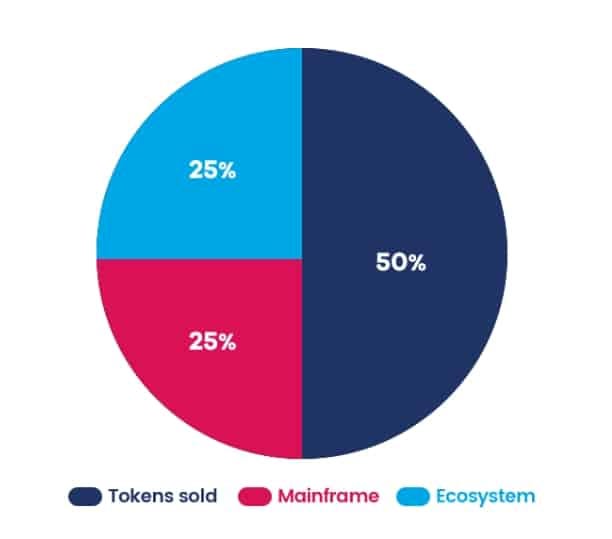
Ticker — MFT
Hardcap — 30,000 ETH
Total MFT — 10,000,000,000
Tokens for presale — 3,350,000,000 (33.5%)
Tokens for public sale — 1,650,000,000 (16.5%)
1 MFT = .000006 ETH
Mainframe presents itself as a top tier project. One read of the white paper makes you realise just how important and apparent the problem Mainframe wants to solve is, and how vulnerable we have become to losing ownership and control over our own data and how we communicate. Without blockchain technology its clear that we are sliding further and further towards having the control over our personal data completely taken from us, instead used to serve corporations who use it to their own financial advantage through advertising, at our expense. There is a clear conflict of interest revolving around our data in the current internet landscape and we are too often the victims. We have come so far in our ability to share information and communicate efficiently with each other, but unfortunately some aspects of internet technology have lagged far behind and we are now faced with far reaching consequences not only to ourselves as individuals, but our businesses, industries, governments, and economies if innovation is not allowed to help us further progress. The Mainframe team certainly looks fit for the challenge and are showing promising signs so far. The brand image is great, and the team looks fully capable in both the technical engineering side as well as non technical areas, both as vital as each other if mainstream adoption is to be achieved. I can’t wait to see this team realise this vision and I think with their pain point being of such current importance, they look set for success.